What should you check before choosing?
First rule out any sizes that can’t be installed in your chosen spot. Then compare the capacity and features of the models that remain.
| Priority |
What to check |
Your needs |
| Space and installation |
Measure the height, width and depth, as well as the route to the space and the clearance needed for the door. For a fixed dishwasher, check the water supply, electricity and drainage. For a fully integrated model, also check the recess and door panel. |
I need to be able to position the appliance and open its door without blocking the way through the kitchen. If I want to hide it under the worktop, my unit must be suitable for the model I choose. |
| Capacity |
Compare the stated number of place settings with the dishes you produce between cycles, and check there’s room for larger utensils. Darty lists the compact Bosch SKS62E32EU as holding 6 place settings; AEG lists 9 for the integrated FSE62417P, and Whirlpool lists 14 for the freestanding WH2FD14BN70. These examples don’t replace checking the exact model you’re considering. |
My loads are sometimes small, but I don’t want to choose an appliance that can’t fit the dishes I use regularly. On the other hand, reserving 60 cm of width only makes sense if I can use that space and capacity. |
| Energy use and noise |
According to ADEME, the energy label lets you compare details including energy use in kWh per 100 cycles, water use per cycle and capacity. Also check the noise level and Eco programme details for the exact model. |
In an open-plan kitchen, I pay attention to how much noise the appliance makes while it’s running. I also want to compare water and energy use on a like-for-like basis, rather than looking only at the energy rating letter. |
| Maintenance and repairs |
Check the documentation, information about spare parts and the services available for the model. Que Choisir notes that diagnosing a fault or carrying out a repair can be more complicated with some dishwashers. |
I want to be able to find maintenance information and understand what repair options are available for the appliance I choose. |
Which brands should you compare?
These models illustrate different sizes and installation requirements. Check the specifications on the product page for the model you’re interested in.
Bosch
Models to compare if you’re weighing up a freestanding compact, a slim freestanding appliance or an under-worktop integrated option.
- Bosch lists its freestanding SPS4EMW17E as measuring 845 × 450 × 600 mm; Darty lists the compact SKS62E32EU as holding 6 place settings.
- The right size depends on the space available in both height and width. According to Bosch, a fully integrated model also needs a suitable door panel.
Electrolux
Models to consider if you’re choosing between a slim integrated appliance and a 60 cm freestanding one.
- Electrolux lists the fully integrated EES42210L at 45 cm wide with 9 place settings, and the freestanding ESS68600SX at 60 cm wide with 14 place settings.
- The stated capacity doesn’t confirm that the model will fit your recess or leave enough room to open the door.
AEG
An option to consider for a fitted kitchen where a 45 cm appliance is being considered.
- AEG lists the FSE62417P as a fully integrated model, 45 cm wide, with 9 place settings.
- According to its product page, this model is supplied without a furniture door. Check the door panel and recess dimensions it requires.
Whirlpool
A 60 cm freestanding model to consider only if that width suits your kitchen.
- Whirlpool lists the WH2FD14BN70 as holding 14 place settings, with a noise level of 44 dB and water use of 9.5 L per cycle.
- Its stated dimensions of 85 × 60 × 59 cm mean you’ll need to check the height, depth and door clearance.
Candy
A brand to explore for compact models with 6 place settings or 45 cm appliances.
- Candy offers 6-place-setting models for smaller loads and a 45 cm range for kitchens where width is limited.
- Check the dimensions, capacity, noise level and connections on the product page for the exact model, rather than relying on the word “compact” alone.
A compact option on Joybuy
This countertop model may suit a kitchen with room for a compact appliance. Its water tank doesn’t mean you can skip checking drainage and installation requirements.
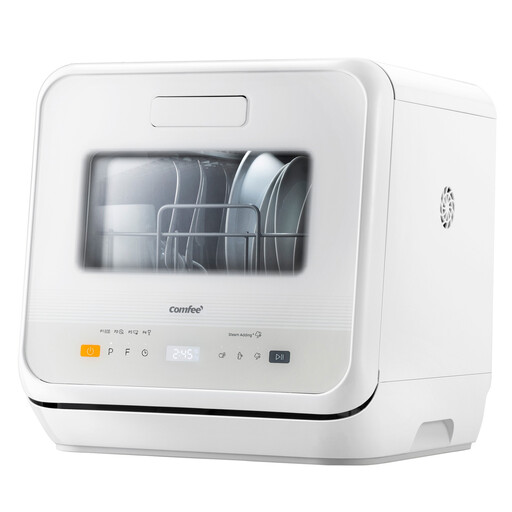 Image unavailable
Comfee CDWMTO201D(W), white countertop dishwasher, 5 L tank
Worth considering if you have a suitable space on your worktop. Its built-in 5 L tank can be filled manually, and a tap connection is also listed as an option. Before choosing it, check where the waste water will drain and whether the appliance’s capacity suits the amount of washing-up you have.
View on Joybuy
Frequently asked questions
Does a compact dishwasher work without connections?
Not necessarily. Bosch says a fixed dishwasher needs to be connected to a water supply, electricity and drainage. A model with a tank, such as the Comfee CDWMTO201D(W) featured here, may allow you to fill it manually. Even so, check its electricity supply and drainage requirements before choosing it.
Does a 45 cm model take up less space than a freestanding compact one?
It may be narrower but much taller. Bosch lists its freestanding SPS4EMW17E as measuring 845 × 450 × 600 mm, while Darty gives the compact SKS62E32EU’s dimensions as 45 × 55.1 × 50 cm. Compare all three dimensions and the space you have, not just the width.
What should you check when fitting a 45 cm dishwasher?
Check the recess dimensions, connections and door panel required by the model. Bosch says a fully integrated model fits under the worktop and needs a furniture door to cover its front. So a recess listed as 45 cm wide isn’t enough to confirm compatibility.
What should you compare on the energy label?
Compare the energy rating, energy use in kWh per 100 cycles, water use per cycle and capacity in place settings—the details listed by ADEME. Also check the noise level and Eco programme duration for each model: a single letter doesn’t tell you everything about how it will work for you.
Does repairability matter when choosing?
Yes, if you want to plan ahead for maintenance. Que Choisir notes that diagnosing faults and carrying out repairs can be more complicated with some dishwashers. Check the documentation and information about spare parts and services for the exact model.


