Who are these formats for?

Tenants without a dedicated water supply

If you’re looking for a low-impact installation, bear in mind that not having a fixed water supply doesn’t remove the need for drainage. If installation involves altering the property or its fittings, ANIL notes in an analysis published on 8 October 2015 that you’ll need the landlord’s written consent.

Small households that cook often

You want your everyday plates, pans and cutlery to fit into a reasonable number of cycles. Compare the basket layout with your own crockery, rather than relying solely on the stated place setting capacity. UFC-Que Choisir describes six-place-setting models as space-saving and suitable for small homes.

Kitchens with no spare worktop space

Floor space may be an option: measure the width, height and depth of a 45 cm model before ruling out a wider appliance. Dimensions vary by model and installation type.

What should you check before buying?

Countertop dishwasher

Consider this if: you’re short on floor space but have a suitable worktop and a way to access a drain.

Bear in mind: the appliance takes up worktop space; a tank-fed model also needs regular refilling.

Compact freestanding model

Consider this if: you have a small, stable surface near the connections and a smaller capacity will meet your needs.

Check: “compact” doesn’t necessarily mean the appliance has a tank or works without a plumbing connection.

Narrow 45 cm model

Consider this if: you have 45 cm of floor width available and your loads are too large for a small countertop appliance. Whirlpool lists the WSFO3T223P as having a capacity of 10 place settings.

Check: height and depth matter too; the models reviewed are up to 85 cm high and 60 cm deep.

Standard 60 cm model

Consider this if: you genuinely have this much floor width and need a basket that’s less restrictive for larger items or frequent loads.

Bear in mind: it takes up more space, so check the dimensions and connections before choosing this option.

Consideration What to check Who it matters most to
Connections Check how the chosen model is supplied with water, how it drains, its electrical connection and the instructions in the manual. If I can’t take on major work, I’ll first check where the wastewater can drain. Around 33% of consumers prioritise a connection that’s practical to install.
Load capacity Compare the stated capacity and basket layout with the size of your plates, serving dishes and pans. If I want to wash everyday dishes without running lots of cycles, I’ll check what really fits in the tub. Around 27% of consumers prioritise their usual load.
Space taken up Measure the width, height and depth, as well as the clearance needed to open the door. If my worktop is already crowded, I’ll look for floor space instead and measure the available area, including room for the door to open. Around 20% of consumers want to preserve their usable space.
Running costs Compare water per cycle and electricity per 100 Eco cycles, along with the capacity and likely frequency of use. The label information cited by the European Commission doesn’t automatically describe a quick programme or a partial load. To keep recurring costs under control, I’ll consider how many cycles my dishes are likely to need, not just the litres per cycle. Around 13% of consumers prioritise running costs.
Noise Compare the declared noise emissions of the models you’re considering and take into account how close they are to your living space. In an open-plan kitchen, I’ll check the stated noise level before deciding when to run the appliance. Around 7% of consumers prioritise quiet operation.

Mistakes to avoid

  • Confusing “no water supply” with “no drainage”

    A tank can replace a fixed water supply on the relevant model, but you’ll still need to deal with the water it uses.

    Before choosing an appliance, find a way to drain it that complies with the instructions.

    Depending on your setup, you may need suitable accessories or a professional installation.

  • Comparing only the width or litres per cycle

    A 45 cm appliance may still be similar in height and depth to a wider model. The number of cycles you need will also depend on how much you can fit inside.

    Measure all three dimensions and estimate how often you’ll need to run a cycle based on your usual load.

  • Making changes to a rented kitchen without checking the implications

    Consent requirements relate to alterations to the property or its fittings, not automatically to simply installing any appliance. In an analysis published on 8 October 2015, ANIL notes that such alterations require the landlord’s written consent.

    Before carrying out work or changing a connection, check your tenancy agreement and get written consent from your landlord.

Brands to know for these formats

Daan Tech

The Bob range is an example of a countertop dishwasher with a built-in tank. It may be worth considering if you don’t have a fixed water supply but can arrange drainage.

  • Daan Tech lists a 3.9 L tank and capacity for 3 place settings for Bob.
  • These specifications apply to this range: check how it’s filled and drained, and what’s included with the model you choose.

Bosch

The models reviewed cover several formats: compact, 45 cm freestanding and 60 cm freestanding.

  • Bosch product information lets you compare the dimensions and stated water use per Eco cycle for the models concerned.
  • Bosch says the compact SKS6ITB00E is no longer available; its existence doesn’t guarantee that a comparable compact model is currently on sale.

Whirlpool

The WSFO3T223P is an example of a 45 cm freestanding model to consider if you have floor space and the necessary connections.

  • For this model, Whirlpool lists a capacity of 10 place settings, dimensions of 45 × 85 × 59 cm, water use of 9 L and a noise level of 43 dB.
  • The manufacturer’s comments on washing performance aren’t independent test results.

Countertop models on Joybuy

This selection features countertop dishwashers, including models listed with a built-in tank for kitchens without a fixed water supply. Check the drainage arrangements and connection instructions for each model.
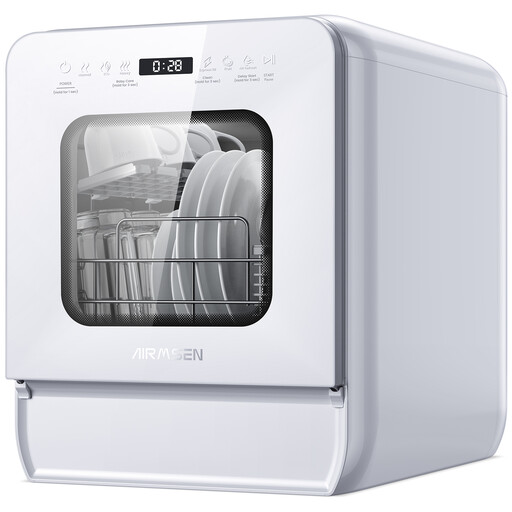
AIRMSEN countertop dishwasher, 5 L tank

AIRMSEN, 5 L countertop dishwasher

Could suit you if you’re looking for a countertop appliance listed with a built-in tank.

The product details list a 5 L tank, capacity for up to 4 place settings, a width of 37 cm, 9 programmes and energy class D. They also mention an optional tap connection; check the full dimensions and planned drainage arrangements.

View on Joybuy
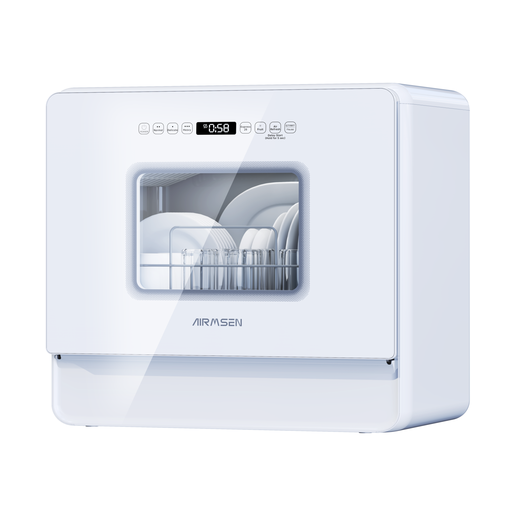
AIRMSEN A01 countertop dishwasher with two-level rack

AIRMSEN A01, two-level rack

Worth considering if you’d like a countertop model with two levels of storage.

The product details list capacity for more than 40 items, a 5 L tank and a tap connection. Check that the dimensions and loading arrangement suit your dishes, and make sure you have a way to drain it.

View on Joybuy
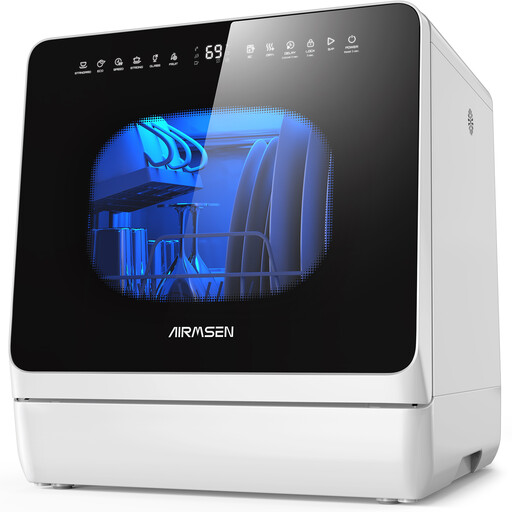
AIRMSEN countertop dishwasher, 8 programmes

AIRMSEN, 8-programme countertop dishwasher

Could suit a small load if the stated capacity matches the items you wash.

The product details list capacity for up to 4 place settings, plates up to 26 cm and a 3.9 L tank, with an optional tap connection. Check that it can accommodate your dishes and that you have the required drainage arrangements.

View on Joybuy
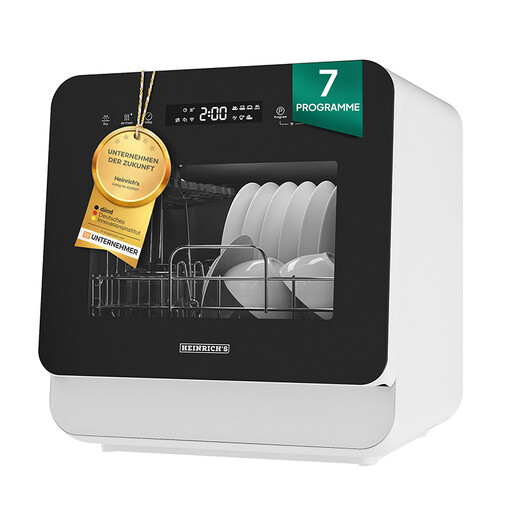
Heinrich’s HTG 8855 countertop dishwasher

Heinrich’s HTG 8855

Worth considering if a stated capacity of 3 place settings is enough for your smaller loads.

The product name lists 7 programmes, a noise level of 56.3 dB and energy class C. Check the water supply method, available space and drainage arrangements in the manual.

View on Joybuy

Heinrich’s HTG 8840 countertop dishwasher

Heinrich’s HTG 8840

Could be an option if you need a countertop model with a stated capacity of 6 place settings.

The product name lists 7 programmes and energy class D. The product details state water use of 6.5 L per cycle, 49 kWh per 100 uses and a noise level of 47 dB. Compare these figures with your needs and check the required connections.

View on Joybuy

Frequently asked questions

Can a tank-fed dishwasher work without any connections?

No. A tank can remove the need for a fixed water supply, but you’ll still need electricity and drainage. Daan Tech says Bob has a built-in tank; check the manual and the setup needed to drain the water.

Can you install a dishwasher in a rented property without the landlord’s consent?

The distinction relates in particular to any alterations to the property or its rented fittings. In an analysis published on 8 October 2015, ANIL notes that such alterations require the landlord’s written consent. Check your tenancy agreement and the proposed connection before carrying out any work.

Which figures should you compare to estimate running costs?

Compare electricity use per 100 Eco cycles, water per cycle, capacity and the number of cycles your dishes will need. The European Commission includes this information among the details shown on the label. Then apply your own water and electricity rates, and factor in consumables and, if needed, installation. Eco figures don’t automatically describe a quick programme or a partial load.

What should you do if your dishes come out wet?

Check your model’s manual and inspect how the dishes are loaded, along with the filters and spray arms. For the appliances covered by its support information, Electrolux says that some quick cycles don’t include a drying phase; this doesn’t automatically apply to every model.

What statutory guarantee applies to a new dishwasher bought from a trader in France?

The statutory guarantee of conformity is provided by the professional seller under the conditions set out by law. In a fact sheet published on 3 October 2023, the DGCCRF states that the period is two years from delivery of the goods. Any commercial guarantee is separate and optional.