What sets the options apart?
First, work out which type of installation is practical. Capacity and ease of use come next.
Tank-fed tabletop model
Consider it if: you can’t use a fixed water supply, but can fill the appliance and drain its waste water as instructed.
The trade-off: you’ll need to fill it by hand, and you should check that it has enough capacity for your dishes.
Plumbed-in tabletop model
Consider it if: a water supply, drain and socket are accessible where you plan to install it.
The trade-off: you won’t need to fill it by hand, but the connections and hoses must be suitable for your existing setup.
Compact integrated model
Consider it if: your kitchenette already has a suitable cabinet and the necessary connections.
The trade-off: a fully integrated model can’t simply be placed on the worktop.
Washing up by hand
Stick with it if: you don’t have a suitable surface, drain or power supply to use the appliances you’re considering properly.
The trade-off: this avoids an unsuitable installation, but you’ll still need to wash the dishes by hand.
| Criteria |
What to check |
Who it matters to |
| Water, drainage and electricity |
Check how the model gets its water, where its drain hose can be routed and what the connection instructions say. |
Without an accessible water supply, I need to be able to fill a tank and find somewhere to drain the waste water. Around 36% of consumers put this practical consideration first. |
| Space and access |
Measure the width, depth and height, then check the clearance needed to open the door, fill the appliance and position the hoses. |
With an already crowded worktop, I want to be able to install and use the appliance without getting in the way in the kitchen. Space is the main concern for around 29% of consumers. |
| Usable capacity |
Compare the stated place settings with the diameter of your plates and the room needed for serving dishes or saucepans. |
If my everyday dishes won’t all fit in the load, I may still need to wash some by hand. For around 21% of consumers, capacity comes before other criteria. |
| Everyday use |
Compare the kWh per 100 cycles, litres per cycle and noise level on the label. Check the manual for drying and maintenance details. |
In an open-plan kitchen, I want to know how noisy the appliance is and what maintenance it needs before choosing. These factors are the priority for around 14% of consumers. |
ADEME lists capacity, water use, energy use and noise among the useful details to consider when choosing a dishwasher. The figures on the label relate to the reference cycle; they don’t necessarily describe a quick programme.
Tabletop dishwashers available on Joybuy
These tabletop models are for small kitchens where you’re considering filling the appliance by hand or connecting it to the water supply. Before choosing based on capacity, check that each model can be installed and drained where you plan to use it.
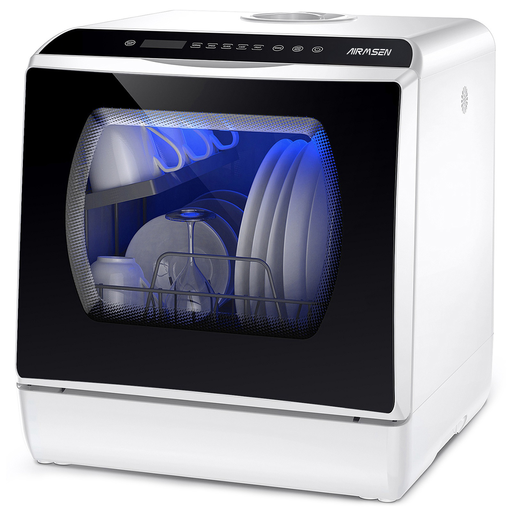 Image unavailable
AIRMSEN tabletop dishwasher, 5 L tank
Worth considering if you don’t have a fixed water supply. The title lists a 5 L tank and 5+1 wash cycles. Check the manual for approved drainage methods and the space needed to use it.
View on Joybuy
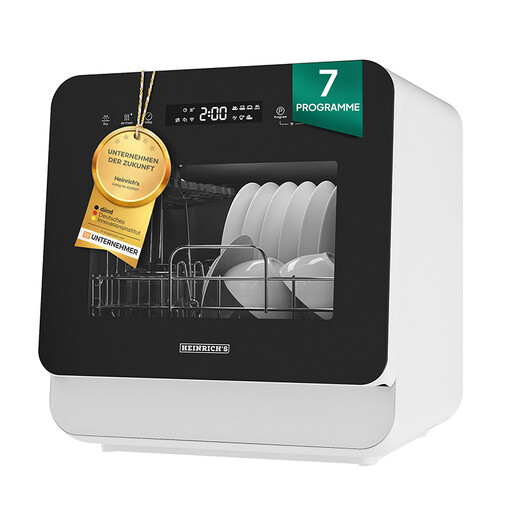 Image unavailable
Heinrich's HTG 8855, tabletop dishwasher, 3 place settings
Worth considering for smaller loads if the location and drainage are suitable. The title lists 3 place settings and 7 programmes. Check the dimensions and connection or filling requirements in the model documentation.
View on Joybuy
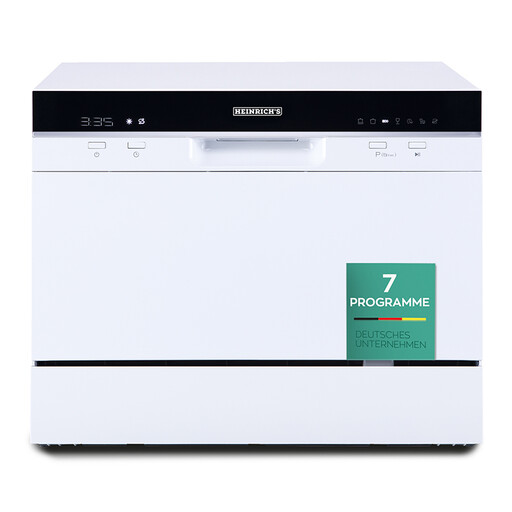 Image unavailable
Heinrich's HTG 8840 Weiss, tabletop dishwasher, 6 place settings
Worth considering if a water supply and drain are accessible and you’re looking for a rated capacity of 6 place settings. The title lists 7 programmes. Check the dimensions, connections and clearance required in the manual.
View on Joybuy
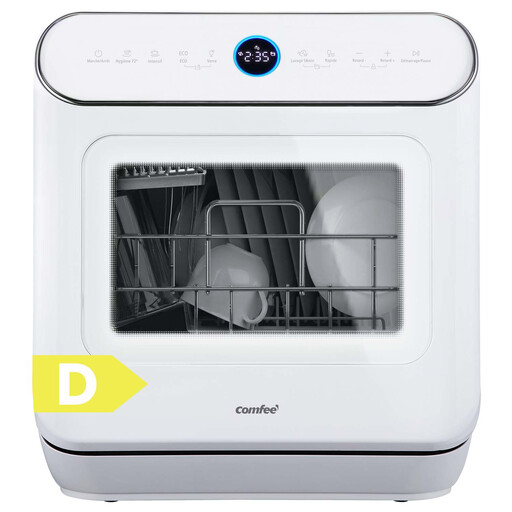 Image unavailable
COMFEE CDWMT305WD, white tabletop dishwasher
Worth considering for a small worktop if you want to fill the appliance by hand. The title lists 7 programmes. Check the manual for the place-setting capacity, drainage method and clearance required.
View on Joybuy
Frequently asked questions
Can a tank-fed dishwasher work without drainage?
No. A tank can replace a fixed water supply, but the waste water still needs to drain away. Daan Tech says Bob’s hose can be directed into the sink or another drain. Check the approved method for the model you’re considering.
What should I check before choosing a plumbed-in tabletop dishwasher?
Make sure a water supply, drain and socket are accessible from where you plan to put it. Bosch notes that all three are needed for installation. Then check the manual for the connections and hose lengths required for the specific model.
Which figures on the energy label should I compare?
Compare capacity, kWh per 100 cycles, litres per cycle, the Eco cycle duration and noise level. ADEME lists these as useful points of reference when choosing. Consumption figures for the reference cycle shouldn’t be attributed to a quick programme.
Is noise especially important in an open-plan kitchen?
Yes, if the dishwasher runs near your living area. Compare the noise levels listed for the specific models and, if you look at independent tests, check that they cover the variants you’re considering.
Does a mini dishwasher need salt and rinse aid?
Follow the instructions for your model and take your water hardness into account. Que Choisir recommends adjusting the water softener to suit the water hardness if the appliance has one. Check the manual to see which products to use and where to add them.


