Before choosing a size for a small kitchen, check the available space and connections. A standard dishwasher needs a water supply, a waste outlet and an electricity supply, while some mini models have a water tank. A compact countertop model is suitable for smaller loads, a 45 cm freestanding dishwasher offers more capacity in a narrower width, and an integrated model only makes sense if the housing unit and door panel are compatible. Then compare the noise level, water use per cycle, kWh per 100 cycles and Eco programme duration on the energy label.
Who are these sizes suitable for?
You’re moving into a home without a fitted kitchen
If you need to keep your layout flexible, a freestanding model means you don’t have to provide a cabinet door panel. When space is very limited, it’s also worth measuring up for a countertop compact model: UFC-Que Choisir describes both options for small spaces.
Your small household uses the dishwasher frequently
If a compact model might be too small but there isn’t enough width for a larger one, consider 45 cm models. UFC-Que Choisir associates this size with 9 to 10 place settings and says it can work for everyday use in a small family.
You rent a home with uncertain connections
Check for a water supply, waste outlet and electricity supply before choosing where to put the dishwasher. If installation would mean altering the property or its fittings, get the landlord’s written consent, as required by Article 7 of the law of 6 July 1989 published on Légifrance.
What sets these sizes apart?
Countertop compact
Consider this: when there’s room on the worktop and you only have a small load of washing up each cycle.
The trade-off: capacity is limited. Only some mini models have a water tank, and you’ll still need to plan for draining the water.
45 or 60 cm freestanding
Consider this: if your kitchen isn’t fitted and you need more capacity than a compact model offers. According to UFC-Que Choisir, 45 cm models hold 9 to 10 place settings, compared with 12 to 17 for 60 cm freestanding models.
The trade-off: even the narrower size takes up the full height of a freestanding appliance and needs accessible connections.
Integrated
Consider this: if your kitchen already has a suitable housing unit and compatible door panel.
The trade-off: fitting it depends on the cabinet and door panel, and won’t solve a lack of space on its own.
When fitting out a small kitchen as you move in, first identify what matters most to you, then compare appliances with a size and capacity suited to your needs.
| Criteria |
What to check |
Relevant to |
| Space and positioning |
Measure the width, depth and height, and allow room for the door to open. If you plan to install it under a worktop, check that the model and its top are suitable. |
When every centimetre counts, I want to open the door without blocking the walkway or losing worktop space; around 36% of consumers put the appliance’s dimensions first. |
| Capacity and washing frequency |
Work out how much washing up you produce between cycles and how much room you need for utensils. UFC-Que Choisir gives capacities of 6 place settings for countertop compact models, 9 to 10 for 45 cm models and 12 to 17 for 60 cm freestanding models. |
If washing up piles up every day, I’d rather have the right capacity than keep running a small appliance; capacity would be the priority for around 29% of consumers. |
| Connections |
Check for a water supply, waste outlet and electricity supply. For a model with a tank, check the instructions for drainage and any other installation requirements. |
If I can’t easily alter the fittings in my home, I need to know whether the appliance will work where I plan to put it; around 21% of consumers prioritise this. |
| Noise and energy use |
On the energy label, compare the noise level in dB, kWh per 100 cycles, litres per cycle and the Eco programme duration, for models with a suitable capacity. |
Near a living area, I want to make my choice with noise and running costs in mind; around 14% of consumers would put these criteria first. |
Mistakes to avoid before installation
-
Assuming every compact model works without a water supply
A standard compact model connects in the same way as a standard dishwasher. UFC-Que Choisir distinguishes these from very small models for 2 or 3 place settings that can work with a water tank.
Check the instructions to confirm the water supply, drainage and capacity of the model you’re interested in.
-
Measuring only the stated width
A 45 cm appliance can still get in the way of the door opening or access to the pipes if the depth and position aren’t right.
Measure the full space with the door open, and check that the appliance can sit securely near the connections.
-
Planning to use an extension lead as a permanent connection
Available space alone doesn’t tell you whether the electricity supply is suitable. Promotelec says a dishwasher’s socket must be on a dedicated circuit.
If you’re unsure about the existing installation, ask a qualified professional to check it rather than improvising the connection.
-
Ordering an integrated model before checking the cabinet
A housing unit with the wrong dimensions or an incompatible door panel can prevent the appliance from fitting, even if the stated width seems right.
Check the dimensions, door-panel fixing system and cabinet compatibility. If you’re renting, get the landlord’s written consent before carrying out work that alters the property or its fittings.
According to UFC-Que Choisir, the matching cabinet door panel required for an integrated model is not supplied with the appliance.
Brands to know for this choice
There are no brands to feature in this section.
Countertop compact dishwashers available on Joybuy
These appliances are countertop compact options for a small kitchen. Before choosing between a model that connects to the water supply and one with a tank, check the space, drainage and electricity supply available where you plan to put it.
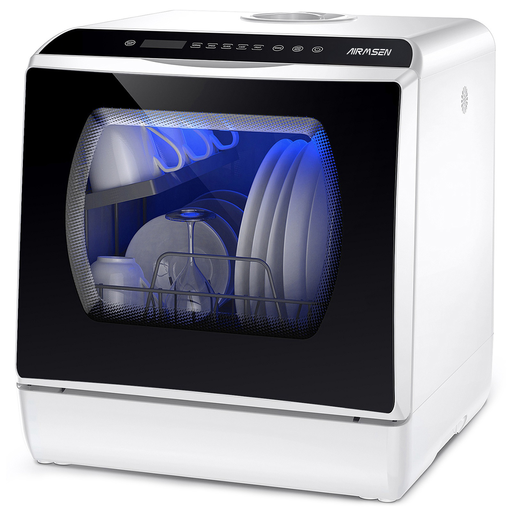 Image unavailable
AIRMSEN countertop dishwasher, 5 L water tank
Worth considering if you want to install a compact model without a permanent water supply. The product name mentions a 5 L tank and 5+1 wash cycles; check the instructions for drainage and electrical compatibility before deciding where to put it.
View on Joybuy
 Image unavailable
Comfee' CDWMTO201D(W), white countertop dishwasher
Compare this model if a tank gives you more flexibility with the water supply. The product name lists a 5 L tank, 6+3 programmes and a D energy class; check the usable capacity and how to drain the water where you plan to put it.
View on Joybuy
 Image unavailable
Heinrich's HTG 8840 Schwarz, countertop dishwasher, 6 place settings
Consider this if you’re looking for a stated capacity of 6 place settings and have the necessary connections. The product name lists seven programmes and a D energy class; check the dimensions, hose reach and energy label details for your installation.
View on Joybuy
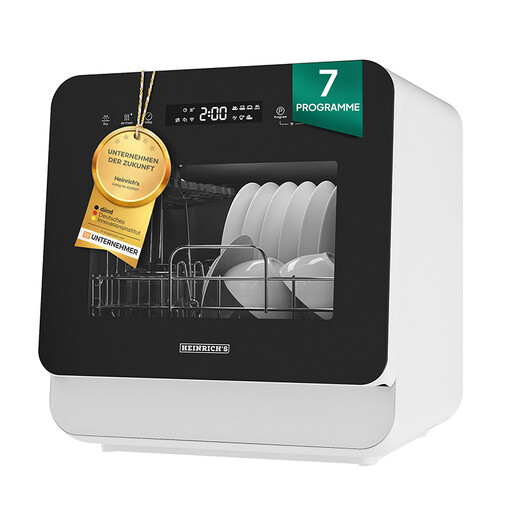 Image unavailable
Heinrich's HTG 8855, mini dishwasher, 3 place settings
Worth considering if you wash only a small amount of dishes each cycle and want to explore a tank-based installation. The product name lists 3 place settings and seven programmes; this capacity may be restrictive if washing up builds up. Also check how to drain the water and the noise level on the model’s label.
View on Joybuy
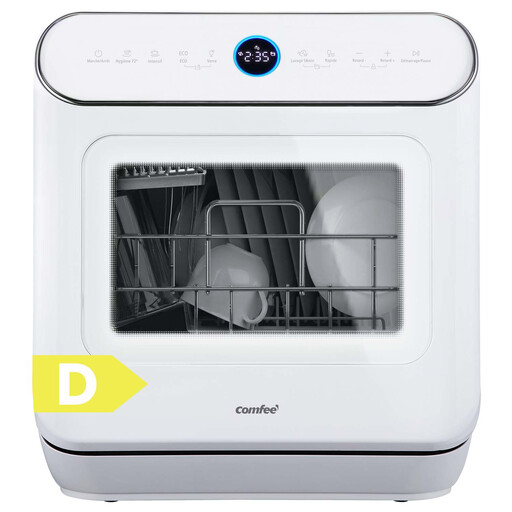 Image unavailable
COMFEE CDWMT305WD, white mini countertop dishwasher
Worth considering for a countertop installation in a small kitchen. The product name lists seven programmes and a D energy class. Check the instructions for the capacity that suits your washing up, and how to drain the water if you plan to fill the tank by hand.
View on Joybuy
Frequently asked questions
Which connections should I check before buying a standard dishwasher?
Check that a water supply, electricity supply and waste outlet are accessible from the planned location: UFC-Que Choisir lists these as the three connections required for a standard dishwasher. Then check the model’s instructions for hose lengths, drainage and the clearance it needs.
Will a countertop compact dishwasher always work without a water supply?
No. Only a model specifically designed with a water tank can do without a permanent water supply. UFC-Que Choisir describes very small tank models for 2 or 3 place settings; check the capacity, electricity supply and drainage solution for the specific model.
Can I alter the connections in a rented home?
If the work would alter the property or its fittings, first get the landlord’s written consent: this is the condition set for tenants by Article 7 of the law of 6 July 1989 published on Légifrance. A simple connection to existing fittings is not necessarily the same as making an alteration; explain any proposed changes to your landlord before carrying out permanent work.
What should I compare on the energy label if I’ll use the dishwasher frequently?
For appliances with a capacity suited to your washing up, compare kWh per 100 cycles, litres per cycle, the Eco programme duration and the noise level in dB, as well as the classes shown. ADEME lists these as useful points to consider; don’t rely on the energy class alone.


