What should you check before choosing?
Start by checking the available space, including openings and connections. Then compare washing capacity and, if needed, drying capacity.
| Consideration | What to check | What you need |
|---|
| Width and depth |
Measure the space and allow room for the hoses. UFC-Que Choisir generally puts slimline front-loaders at between 33 and 45 cm deep, while keeping a width close to 60 cm. A top-loader is around 40 cm wide, but you’ll still need to check the depth of the model you choose. |
“I’m mainly short on depth” points to a slimline front-loader. “The space is too narrow for a front-loader” points to a top-loader, if its depth works for you. |
| Opening clearance |
Allow enough space in front of a front-loader door or above a top-loader lid. Also check that nearby doors and cupboards can still be opened. |
I want to load the machine without blocking the way. If it’s going under a fixed worktop, make sure you account for the top-loading lid. |
| Washing capacity |
Compare the stated capacity in kilograms of dry laundry with your usual loads. For one or two people, UFC-Que Choisir suggests 5 to 7 kg as a guide. Slimline front-loaders have different capacities depending on the model. |
Considering my clothes, bedding and towels, I want to avoid a drum that means I have to run extra cycles. |
| Installation |
For an automatic washing machine, check the water supply, drainage and electrical connection against the model’s instructions. For a mini washing machine, check the filling, drainage and electrical requirements separately; don’t assume they’re the same for every model. |
If I can’t install a standard machine, I could consider a mini washing machine, provided its operation suits my home and the amount of laundry I have. |
| Integrated drying |
Compare washing and drying capacities separately, then check the dimensions and combined-cycle details for the model. UFC-Que Choisir notes that washer-dryers have a lower drying capacity, longer drying cycles and use water during drying. |
I’m also short on space to dry my laundry. Combining washing and drying could help, as long as I keep the load within the drying capacity. |
Top-loading washing machines and washer-dryers on Joybuy
These models show two options for a small home: top-loading when width is limited, and integrated washing and drying when it’s difficult to hang laundry out. Check each model’s dimensions and clearance requirements against the space you have.
 Image unavailable
Candy TCA464TM4-S ProWash 500, 6 kg top-loading washing machine
Consider a top-loader if width is limited and the lid can open freely. Its stated capacity is 6 kg, within the 5 to 7 kg guide UFC-Que Choisir gives for one or two people. Check the depth, space for the hoses and clearance above the machine.
View on Joybuy
 Image unavailable
Haier T Series 7 THASN276TM6-S, 7 kg top-loading washing machine
This top-loader could be a good option if width is limited, as long as you can still access the lid. Its stated capacity of 7 kg is at the top of the 5 to 7 kg guide UFC-Que Choisir gives for one or two people. Check the depth and allow space for the connections, too.
View on Joybuy
 Image unavailable
Samsung WD11DG6B85BEU3, 11 kg / 6 kg washer-dryer
Integrated drying is useful if you don’t have space to hang laundry out. The stated capacities are 11 kg for washing and 6 kg for drying, so you’ll need to reduce a full washing load before drying. Measure the space, including room for the door to open and for the connections.
View on Joybuy
 Image unavailable
Samsung WD10HG6U34BEU3, 10 kg / 6 kg washer-dryer
This washer-dryer combines both functions when there’s no practical space to hang laundry out. Its stated capacities are 10 kg for washing and 6 kg for drying, so adjust the load if you want to run both cycles one after the other. Check the overall dimensions, door clearance and space for the hoses.
View on Joybuy
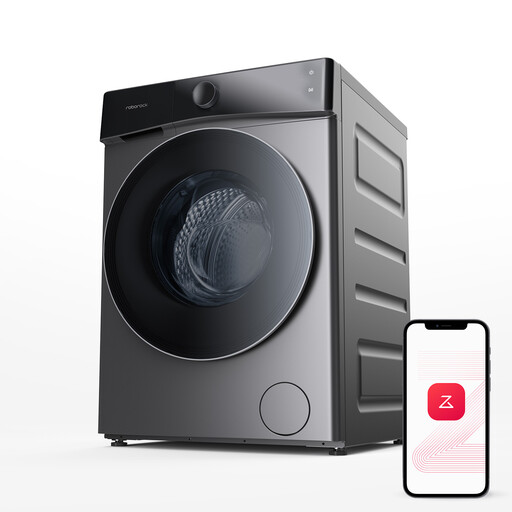 Image unavailable
Roborock Zeo Lite Gray, 10 kg / 6 kg washer-dryer
This model combines washing and drying for homes without a dedicated drying area. It has a stated washing capacity of 10 kg and drying capacity of 6 kg, so plan a load that suits the lower capacity. Before deciding where to put it, check the dimensions and installation clearances in the product details or instructions.
View on Joybuy
Frequently asked questions
What connections does an automatic washing machine need?
Check the electrical supply, water supply and drainage: Bosch’s washing machine instructions list these three connections. The instructions for your chosen model will then specify requirements for its hoses, drainage and power supply. Don’t rely on the information for a different model.
Does a mini washing machine need a fixed water supply?
It depends on the model. Check its instructions to see whether it’s filled manually or connected to a water supply, how the water drains away and what the electrical requirements are. UFC-Que Choisir presents a mini washing machine as a back-up option when it’s impossible to install a standard machine, rather than an appliance with a standard installation method.
Can you put a washing machine in a shower room?
Yes, provided you follow the safety conditions set out by Promotelec for a shower room or bathroom. The appliance must be outside zones 0, 1 and 2 and the concealed zone, connected to earth and powered by a circuit protected by a 30 mA residual-current device. If you’re unsure whether the location and electrical installation meet these conditions, ask a qualified professional to check them.
Can you run a wash and drying cycle one after the other with a washer-dryer?
Yes, as long as the load is within the model’s drying capacity. UFC-Que Choisir notes that this is lower than the washing capacity. If you wash a larger load, remove some laundry before drying or dry it in batches.
When is integrated drying worth it in a studio flat?
Consider a washer-dryer if you also lack somewhere to hang your laundry and its dimensions suit the room. It saves space compared with having a separate appliance, but UFC-Que Choisir notes that its drying capacity is lower than its washing capacity, drying cycles take longer and water is used during drying.


