One person in a studio or one-bedroom flat
If the fridge will be near your bed or desk, consider its noise level as well as its footprint. For usable capacity, Que Choisir recommends an average of 100 to 150 litres for one person.


When choosing a fridge for a small home, start with the usable capacity you need: Que Choisir recommends an average of 100 to 150 litres for one person, plus 50 litres for each additional occupant. Consider a table-top fridge if under-counter space is your priority and you don’t store many frozen foods. If freezing matters more, compare fridge-freezers, checking their height, door clearance and ventilation requirements. In a studio flat, also compare the stated noise levels of models that can actually be installed in your home.
The number of people in your household gives you a starting point for capacity, but the space available and how much frozen food you store will also help determine the right size.
If the fridge will be near your bed or desk, consider its noise level as well as its footprint. For usable capacity, Que Choisir recommends an average of 100 to 150 litres for one person.
Que Choisir suggests adding around 50 litres for each additional person to its guideline for one person. Then compare the space given to fresh and frozen food to see what best suits your usual shopping habits.
Before choosing a built-in or freestanding appliance, measure the space and check that the door can open fully. For a built-in model, compare the cabinet niche dimensions and ventilation requirements with the model’s instructions.
Start with the space you can actually use, then compare the capacity and compartment layout with your shopping habits. Noise is especially important if the appliance will be in your living space.
| Feature | What to check | Your needs |
|---|---|---|
| Usable capacity | Compare usable capacity rather than just the external dimensions. Que Choisir gives an average guideline of 100 to 150 litres for one person, plus 50 litres for each additional occupant; adjust this according to how often you shop. | I want to store my regular shopping without taking up more kitchen space than necessary. |
| Space and installation | Measure the height, width, depth and door clearance. For a built-in model, check the niche, door-front system and ventilation requirements against the instructions; a freestanding model also needs the specified clearances. | My kitchen is narrow or already fitted, so the appliance must fit and open in the space available. |
| Freezing | Check whether the model has a separate freezer compartment and how much space it offers. A table-top fridge and a fridge-freezer won’t meet the same needs if you regularly store frozen food. | If I freeze portions or often buy frozen food, I need to set aside enough space for it, even in a small home. |
| Noise | Compare the stated noise levels in dB(A) for the specific models. Que Choisir puts the quietest fridges below 40 dBA; also consider how close the appliance will be to your living space. | The fridge will be near my bed, desk or sofa, so its noise level is particularly important. |
An appliance may fit in the space you’ve measured without leaving enough room to open the door or meet its ventilation requirements. The dimensions of a built-in niche need to be checked separately.
Measure the space, the route into the kitchen and the door clearance, then compare the niche dimensions and clearances with the model’s instructions.
A compact appliance doesn’t necessarily offer enough space for the food you want to freeze. The right choice depends on how its capacity is divided between refrigeration and freezing.
Think about your shopping habits and the portions you freeze. If you do this regularly, compare the capacity of a separate freezer compartment before choosing a table-top fridge.
In a studio flat, the appliance may be close to your bed or workspace. Que Choisir says the quietest fridges have a noise level below 40 dBA.
Compare the stated noise levels of the exact models you’re considering and think about how close they’ll be to the areas where you spend time.
If you’re replacing an appliance, you’ll need to decide what to do with your old fridge. The DGCCRF describes, among other things, a “one-for-one” take-back service linked to the purchase of new equipment.
Before ordering, check the take-back service offered for your old appliance, as well as the seller’s delivery and installation terms.
These models illustrate different sizes and installation requirements; their features don’t apply to every appliance from the same brand.
The Beko TSE1504FN table-top fridge is worth considering when width is limited.
The Liebherr Rdi 1620 Plus is a useful table-top model to compare with the space available in a small kitchen.
Bosch provides useful guidance on the space needed to install a fridge.
The Electrolux ETS3LE16S built-in fridge-freezer shows why niche dimensions matter in a fitted kitchen.
This Joybuy selection includes fridge-freezers, some of them built-in, and a built-in larder fridge. If you’re choosing your first fridge for a small home, compare each model’s size with your kitchen and the space you need for fresh or frozen food.
 Image unavailable
Worth considering if you want separate spaces for fresh and frozen food in a kitchen where width is a key concern. The product title lists 153 L for refrigeration and 74 L for freezing, as well as a width of 54 cm, a reversible door and Low Frost. Also check the height, depth, door clearance and installation clearances. Low Frost doesn’t mean you’ll never need to defrost it.
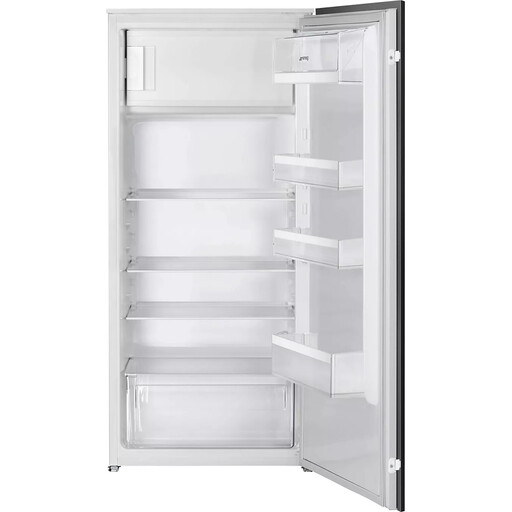 Image unavailable
This built-in model is suited to a kitchen with a compatible niche. The product title lists a capacity of 188 L and a freezer compartment at the top. Compare the freezer capacity with your needs, then check the niche dimensions, door system, required cabinet front and ventilation requirements.
 Image unavailable
Consider this model if you’re looking for separate fridge and freezer compartments in a fitted kitchen. The product title lists a capacity of 249 L and TwinTech No Frost. Before choosing this built-in model, check the available height, niche dimensions and ventilation requirements against its instructions.
 Image unavailable
This fridge-freezer is worth comparing if you want plenty of space for fresh and frozen food. The product title lists a capacity of 333 L, but that doesn’t tell you whether it will fit in a small kitchen. Measure the space and access route, then check the clearances specified in the instructions.
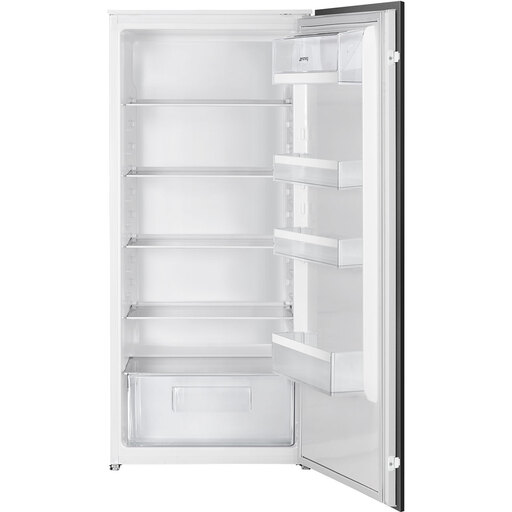 Image unavailable
This option is suited to a fitted kitchen when fresh food is a priority and you don’t need a freezer compartment. Check the usable capacity of the exact model before deciding whether it’s right for your household, and check the niche dimensions and ventilation requirements before installation.
Que Choisir recommends an average usable capacity of 100 to 150 litres for one person, then around 50 litres for each additional person. Adjust this starting point to how often you shop, and check separately how much space you need for frozen food.
Only choose this location if the dimensions, door clearance and ventilation clearances meet the requirements in the instructions for the freestanding model. In its installation FAQ, Bosch recommends at least 200 cm² of clear space behind and beneath the fridge; check the requirements for the appliance you’ve chosen rather than relying on its external dimensions alone.
Check the instructions for your model before plugging it in. In its installation guidance, Electrolux recommends waiting at least 4 hours to allow the oil to flow back into the compressor, and advises leaving space for air to circulate around the appliance.
Arrange for it to be taken back or collected through an appropriate waste electrical and electronic equipment scheme. The DGCCRF describes, among other options, a “one-for-one” take-back service when you buy new equipment. Check the arrangements for your old appliance before delivery.