What should you check before choosing?
Start by measuring the space and checking what installation options are available. Then choose the capacity you need and compare the usage figures for the models you’re considering.
| Priority |
What to check |
My needs |
| Size |
Measure the width, height and depth of the space. Allow room for the hoses and the door to open, and make sure you have a stable surface for a countertop appliance. |
I want to be able to load the appliance without blocking the way or losing worktop space I need. |
| Capacity |
Compare the stated place settings with the amount of crockery you’ll have between washes, including saucepans. The product details cited list 3 or 6 place settings for compact models, and 10 for the 44.8 cm Essentielb ELVS-441s featured by Boulanger. |
If we often cook for two, I’d rather check that a small appliance won’t mean having to run lots of extra cycles. |
| Connections |
Check the manual for the exact model to find out about the water supply, drainage, electrical supply and any accessories you’ll need. UFC-Que Choisir describes these three connections for installing a dishwasher. Check the water supply requirements for a compact model individually, as they can vary from one model to another. |
Before choosing a spot, I want to know where the water will come in and where it will drain away. |
| Noise |
Compare the stated dB level and noise class for the appliances you’re considering. ADEME notes that a 3 dB difference is equivalent to almost doubling the noise. |
My kitchen opens onto the living area, so noise matters even if the appliance is small. |
| Consumption |
Compare the kWh per 100 cycles, litres of water per cycle and Eco programme duration on the energy label, taking capacity into account. The European Commission says these figures are shown on dishwasher energy labels. |
I want to compare appliances using the same programme, rather than looking only at their energy class. |
Brands and models to compare
These models show the range of sizes available. Their features don’t necessarily apply to every appliance from the same brand.
Candy
The CP 6E51LS is an example of a 6-place countertop compact model.
- Candy France lists this model as measuring 550 × 501 × 443 mm and having an E energy class.
- Check the manual for the connections and clearances needed for your space.
Daan Tech
The Bob featured in a Boulanger selection is an example of a 3-place countertop model.
- Boulanger lists the model in its selection as measuring 34 × 49 × 49 cm and producing 43 dB.
- The water supply information differs from that on a Bob product page on Joybuy. Check the version and its manual before deciding how to install it.
Essentielb
The ELVS-441s is an example of a slimline, freestanding appliance.
- Boulanger lists it as having 10 place settings, measuring 44.8 × 84.5 × 61 cm and producing 44 dB.
- Make sure its 61 cm depth and the space needed in front of the door work for your kitchen.
Valberg
The 14S44 B XAD929C is an example of a 60 cm freestanding appliance.
- Electro Dépôt lists this model as having 14 place settings, producing 44 dB and using 9,8 L of water per cycle.
- Check that an appliance this wide leaves enough room to move around and open the door.
Dishwashers available on Joybuy
This selection includes compact countertop models and a 60 cm freestanding appliance, which is only worth considering if your kitchen has room for it. Compare how each one is installed and its capacity against the space you have.
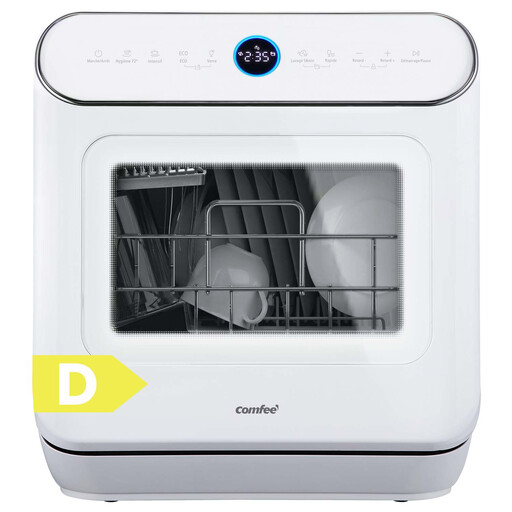 Image unavailable
COMFEE CDWMT305WD, white countertop dishwasher
Worth considering if you’re looking for a countertop appliance with manual filling. The title lists 7 programmes and a D energy class. Check the manual to find out where the drain hose needs to go before choosing a spot for it.
View on Joybuy
 Image unavailable
Comfee' CDWMTO201D(W), white countertop dishwasher
The 5 L built-in tank listed in the title means you can fill it manually. The product details also describe a tap connection. If you choose this option, check that the connection is compatible: the tap adaptor is listed as not included.
View on Joybuy
 Image unavailable
Heinrich's HTG 8840 Schwarz, 6 place settings
Its stated capacity of 6 place settings may suit a household that would find a lower-capacity mini model restrictive. The title lists 47 dB and a D energy class. Measure the space and check the manual for connection and drainage requirements.
View on Joybuy
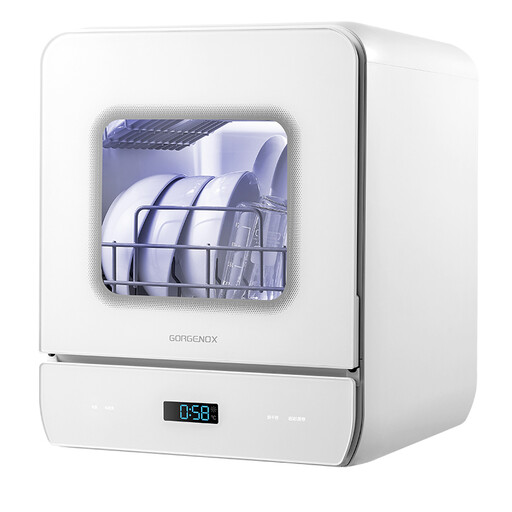 Image unavailable
GORGENOX DW5-D40A, 3-place countertop dishwasher
This 3-place model is worth considering if you have a small amount of washing up between cycles. Before setting aside space for it, check the manual to find out how to supply it with water, where to drain the wastewater and which accessories are included.
View on Joybuy
 Image unavailable
Hotpoint H4FD641A, 60 cm freestanding dishwasher, 14 place settings
This 60 cm model is only suitable for a small home if it can be installed without blocking the way. The title lists 14 place settings, 41 dB and a C energy class. Check the depth, door swing and required clearances.
View on Joybuy
Frequently asked questions
What connections does a compact dishwasher need?
You’ll need an electricity supply and a way to supply and drain water, as set out in the manual for your chosen model. UFC-Que Choisir describes water, electricity and drainage as the three connections needed to install a dishwasher. For a compact model with manual filling, pay particular attention to the drainage system and any required accessories.
Is a small dishwasher always quieter?
No. Size is no substitute for comparing the stated noise level of each model. According to ADEME, an extra 3 dB is equivalent to almost doubling the noise, which is worth bearing in mind, particularly in an open-plan kitchen.
Which figures should I compare on the energy label?
Compare the A to G energy class, kWh per 100 cycles, litres of water per cycle, Eco programme duration, capacity and noise level. The European Commission says these figures are shown on dishwasher energy labels. Also consider them alongside the amount of washing up you expect to do.
Can I use the Eco programme to compare energy and water consumption?
Yes. The European Commission uses the Eco programme as the basis for comparing the figures shown on energy labels. Check the stated duration too, as choosing a model based on these reference consumption figures doesn’t mean you’re choosing the quickest cycle.


