In a small kitchen, start by choosing a fridge that will actually fit, with enough clearance around it. If your weekly shop is mainly fresh food, an under-counter fridge without a freezer may be enough. If you need space for a few frozen items, look at a model with a freezer compartment. If you regularly stock up on frozen food, a compact fridge-freezer may be a better option, provided its dimensions and the capacity of both compartments suit your space and shopping habits.
Which format is right for you?
The space you have available and how much frozen food you buy between shops matter more than the word ‘compact’ on its own.
One person living in a studio flat
If you mainly buy fresh food and have limited space for height, consider an under-counter fridge. UFC-Que Choisir recommends this format for studio flats. However, a model without a freezer won’t suit you if you regularly need to store frozen food.
Moving into your first home, with a few frozen items
An under-counter fridge with a freezer compartment gives you space for a small amount of frozen food without needing a second appliance. Check the capacity of each compartment: Bosch’s KTL15NWEB, for example, offers 106 l of fridge space and an integrated freezer compartment.
A small household doing a weekly shop
If your shopping includes both fresh food and a regular stock of frozen items, compare the separate capacities of compact fridge-freezers. Check that the height and depth, delivery access and door swing will also work in your kitchen.
What should you check before choosing?
For a weekly shop, start with the space where the appliance can be installed, then compare the fridge and freezer capacities with what you usually buy.
Under-counter fridge without a freezer
Consider this: if you need an appliance with a low height and mainly buy fresh food.
The trade-off: you’ll need to do without frozen food or have a separate freezer.
Under-counter fridge with a freezer compartment
Consider this: if you have room for an under-counter fridge and only keep a small amount of frozen food.
The trade-off: the freezer compartment takes up some of the space that could otherwise be used for fresh food.
Compact fridge-freezer
Consider this: if your weekly shop regularly includes a separate stock of frozen food.
The trade-off: you’ll need enough room for an appliance that is generally taller than an under-counter fridge, and a delivery route that can accommodate it.
| What to consider |
What to check |
What I need |
| Dimensions |
Measure the height, width and depth. Allow for the clearances specified in the manual, and check the delivery route and how far the door opens. |
I need to be able to open the door and access the drawers without blocking the walkway. It’s not enough for the appliance simply to fit into the space. |
| Capacity of each compartment |
Compare the usable capacity in litres of the fridge and freezer separately. For the freezer, also check its star rating and freezing capacity if you plan to freeze fresh food. |
Does my weekly shop include a few frozen items or a stock that needs more space? I don’t want to gain a freezer at the expense of essential fridge space. |
| Installation and transport |
Check the model’s manual for ventilation and instructions on setting it up after transport. Make sure the delivery route can accommodate the appliance’s dimensions. |
In a narrow kitchen, I need to know where to put the appliance and how to get it there. |
| Energy and noise |
For appliances of a similar type and capacity, compare the energy rating, stated energy consumption and noise level. The EU energy label uses a scale from A to G. |
If my kitchen opens onto my living space, noise matters too. The energy rating letter alone won’t tell me how loud the appliance is. |
What mistakes should you avoid?
-
Measuring the width and nothing else
A narrow appliance may still be too tall or too deep. Its dimensions alone may not include the space needed for ventilation.
Measure the space and delivery route, then check the model’s manual for clearance requirements and the room needed to open the door. Beko’s and Bosch’s general guidance differs, so neither should be treated as a universal measurement.
-
Assuming every freezer compartment can hold a large stock of frozen food
Having a freezer compartment doesn’t tell you how much it can hold. It may also reduce the space available for fresh food.
Work out the maximum amount of frozen food you’ll have between shops. Then compare the capacity of each compartment, the star rating and, if needed, the model’s freezing capacity.
-
Plugging the appliance in without considering how it was transported
You’ll need to follow the instructions for your appliance and how it was moved. Electrolux recommends waiting at least four hours before plugging it in, according to its installation guide; Bosch advises transporting the fridge upright.
Before a delivery or house move, check the manual, empty the appliance and protect any removable parts. Then follow the waiting time specified for your model before switching it on.
-
Comparing energy ratings alone
The A to G rating doesn’t tell you everything about storage capacity or noise – both useful things to consider when your fridge is in a small, open-plan space.
As well as comparing energy ratings, check the stated energy consumption and noise level of appliances with a similar type and capacity.
A few brand examples
These models illustrate differences in dimensions and compartment capacities; they aren’t representative of each manufacturer’s entire range.
Beko
Beko publishes specifications for slim appliances, including the RDSA240K40WN, which is listed as 54 cm wide, with 177 l of fridge space and 46 l of freezer space.
- These separate capacities help you work out whether it will suit your weekly shop.
- Beko’s general advice to leave at least 5 cm on each side and at the back doesn’t replace the installation instructions for the model you choose.
Bosch
Bosch’s KTR15NWEB and KTL15NWEB under-counter fridges let you compare a model without a freezer compartment with one that has one.
- The KTL15NWEB offers 106 l of fridge space with an integrated freezer compartment, so your choice depends on how much room you need for fresh and frozen food.
- Bosch’s installation advice recommends at least 200 cm² of clear space behind and underneath the appliance. Check the requirements for the model you choose.
Liebherr
Liebherr lists the KTe551 under-counter fridge at 85 × 55 × 60,7 cm, while the CTPele231-26 fridge-freezer measures 140,1 × 55 × 63 cm and has a total capacity of 233 l.
- These dimensions show why two appliances with a similar width can need very different amounts of space.
- The total capacity of a fridge-freezer doesn’t tell you how much room each compartment has, so check them separately.
Fridge-freezers to consider on Joybuy
These three fridge-freezers are for kitchens that can fit an appliance taller than an under-counter fridge, and for shops that include both fresh and frozen food. Before choosing a model, check its full dimensions and installation instructions.
 Image unavailable
CHiQ JR263LGE, 262 L Low Frost fridge-freezer, black
Worth considering if you want to store fresh and frozen food in one appliance and have enough height to fit it. The product listing describes it as 54 cm wide and 176 cm tall, with a stated 70/30 split. Check the depth, delivery access and clearances in the manual. Low Frost means you’ll still need to defrost it manually.
View on Joybuy
 Image unavailable
CHiQ JR227LSE, 227 L Low Frost fridge-freezer, silver
This model has 153 L of fridge space and 74 L of freezer space – compare these capacities with what you usually buy. The product listing gives a width of 54 cm, a 4-star freezer, a reversible door and an E energy rating. Check the height and required clearances before deciding where to put it.
View on Joybuy
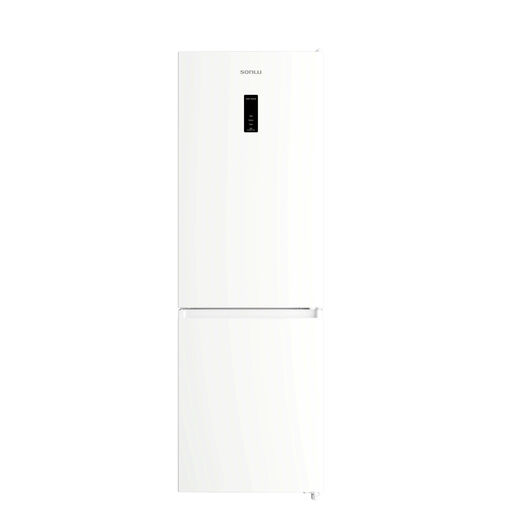 Image unavailable
Sonlu CD‑350RW, 310 L fridge-freezer
If your kitchen can accommodate its 60 cm width, compare its 211 L of fridge space and 99 L of freezer space with the room your shopping takes up. The product listing mentions a reversible door, an inverter compressor and an E energy rating. Check the height, depth, clearances and freezing performance you need.
View on Joybuy
Frequently asked questions
How much space should you leave around a fridge in a small kitchen?
Follow the instructions for the exact model rather than relying on a single clearance measurement for every appliance. Beko’s general guide recommends leaving at least 5 cm on each side and at the back, while Bosch’s installation advice recommends at least 200 cm² of clear space behind and underneath the appliance. Also allow for the door to open and for access to the drawers.
Is a small freezer compartment enough for a week’s frozen food?
It depends on how much you keep between shops: simply having a freezer compartment doesn’t tell you its capacity. Compare its volume with your usual stock and check its star rating and freezing capacity if you want to freeze fresh food.
Should you wait before plugging in a fridge that has been delivered or moved?
Follow the waiting time specified for your appliance and take its transport conditions into account. Electrolux recommends waiting at least four hours before plugging it in, according to its installation guide; Bosch advises transporting a fridge upright. Check the manual for your model before switching it on.
How do you compare the energy use and noise levels of two small fridges?
Compare appliances of a similar type and capacity, then check their energy rating, stated energy consumption and noise level. The European energy label uses a scale from A to G. If your fridge will be near your living space, check the noise information too.
What should you do with your old fridge?
The French ministry responsible for environmental affairs lists options for electrical and electronic equipment such as taking it to a waste and recycling centre or returning it to a retailer. Before your new appliance is delivered, check the collection options offered by the seller.


