If you regularly store fresh food in a studio flat, choose a compact fridge with a capacity, layout and installation that suit your shopping. Choose a drinks and snacks cooler as a secondary appliance if that’s your main need. Before storing perishable food in it, check that it can reach and maintain the required temperature.
Which type of use is right for you?
Studio flat dweller storing fresh food
If you regularly buy perishable food, look for an appliance that can serve as your main fridge. Check how much usable shelf space it offers and the temperature in its coldest area: Anses recommends keeping food at an ideal temperature of between 0 and +4 °C in this part of the fridge.
Tenant with an under-counter space
An existing space may point you towards an integrated model, but be sure to measure its height, width and depth. The door system and ventilation route must also meet the requirements in the instructions for the fridge you choose.
Bedroom or office user
If you want to keep a few drinks or snacks close at hand, a secondary appliance may suit your more modest needs. If you also plan to store perishable food in it, check its temperature and the conditions of use in the instructions rather than relying on its marketing name.
What should you check before choosing?
First work out what you need to store, then check that the available space and installation conditions meet your needs.
| What matters |
What to check |
Who it matters to |
| Keeping fresh food |
Temperature in the coldest area and whether you can check it; enough room to store food without cramming it in. |
If I regularly buy perishable food, I need to be able to store it in a suitably cold area. Around 36% of consumers put this need first. |
| Space and installation |
External dimensions and door clearance; for a fitted space, internal dimensions and the required ventilation. |
In a studio flat that’s already fitted out, I need to find a spot where the appliance can be opened and ventilated as specified in its instructions. This is the top priority for around 29% of consumers. |
| Freezer compartment |
Compartment capacity and star rating for the intended use. |
If I buy frozen food, I want to know what the compartment can actually store, without losing sight of how much room will be left for fresh food. Around 21% of consumers prioritise having freezer space. |
| Extra space for drinks and snacks |
Usable capacity, room for the containers you plan to store and suitable placement in the room. |
In a bedroom or office, a few drinks and snacks may be all I need, as long as I’m not storing my daily fresh food shopping in it. For around 14% of consumers, this secondary use is the main requirement. |
Which mistakes should you avoid?
-
Choosing based on the word ‘mini’ alone
A small external footprint doesn’t guarantee enough room for your containers or sufficient capacity for fresh food. Tabletop models from Bosch, Beko and Liebherr also come in different dimensions.
Make a list of what you want to store over the course of a week, then compare usable capacity, interior layout and all three external dimensions.
-
Putting a freestanding appliance in a fitted space
A poorly suited space may prevent the appliance from getting the ventilation it needs. The installation requirements for an integrated model don’t automatically apply to a freestanding one.
Follow the diagram for the model you choose. As guidance specific to its installation guide, Bosch recommends at least 200 cm² of ventilation space behind and beneath the fridge.
-
Storing perishable food in a secondary appliance without checking how cold it gets
A compact design doesn’t tell you what temperature the coldest area reaches. Anses recommends an ideal temperature of 0 to +4 °C in this part of the fridge for keeping food.
If you plan to store perishable food in it regularly, check the settings in the instructions and measure the temperature after installation.
-
Assuming every small compartment is suitable for your frozen food
Available space and the stated uses for the compartment vary by model. Having one also reduces the space available for fresh food.
Before choosing this configuration, check the compartment capacity and star rating for the exact model on its product page.
Brands to compare
Bosch
Freestanding tabletop models and under-counter options to consider, depending on where you plan to put your appliance.
- Bosch lists the KTL15NWEB as offering 106 L of fridge space, an integrated freezer compartment and dimensions of 85 × 56 × 58 cm.
- Don’t apply this model’s ventilation requirements and dimensions to another fridge without checking its instructions.
Beko
Tabletop fridges to compare if you need a compact appliance for your kitchen area.
- Beko’s product information for the TSE1284N gives a width of 54 cm, a reversible door and a top freezer compartment.
- Check the capacity and compartment features for the specific version you’re considering.
Liebherr
Tabletop and under-counter models let you compare freestanding appliances with options for fitted spaces.
- Liebherr lists a total capacity of 125 L for the Rdi 1621 and a niche size of 82 to 88 × 60 × 56 cm for the under-counter URd 3601.
- These measurements are for two different models. Check the dimensions of your chosen appliance before preparing its space.
Electrolux
An integrated model to consider if your studio flat already has a compatible under-counter space.
- Electrolux lists a niche height of 820 mm and a fridge capacity of 94 L for the ELB3AE82YY.
- Whether it can be integrated depends on the cabinetry, door fitting and ventilation requirements. This model isn’t designed to be freestanding.
Secondary appliances on Joybuy
These two appliances are suited to keeping drinks to hand in a bedroom, office or small space. Their inclusion here doesn’t mean they’re suitable for storing perishable food every day.
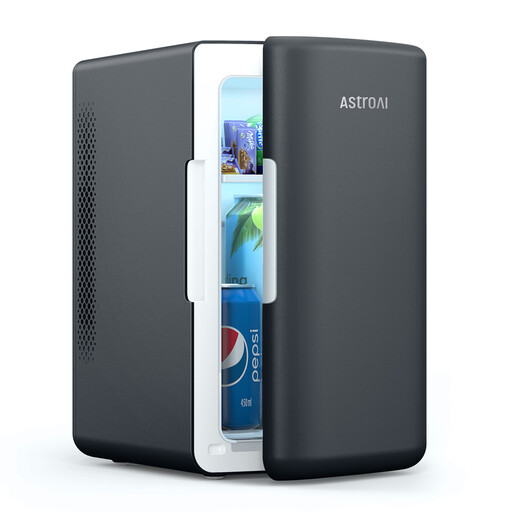 Image unavailable
AstroAI 6L 8-Can AC/DC Deep Black
Worth considering if you want a small supply of drinks close at hand, rather than an everyday kitchen fridge. The product name indicates a 6 L capacity, space for 8 cans and AC/DC power. Before storing perishable food in it, check what temperature it can maintain in your conditions of use. Make sure you don’t block its ventilation either.
View on Joybuy
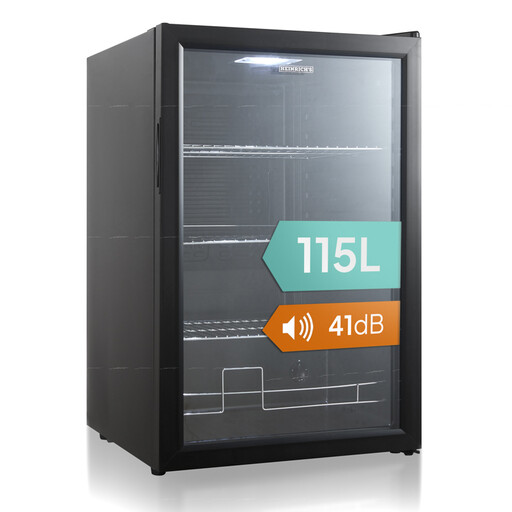 Image unavailable
Heinrich´s drinks cooler, 115 L, 41 dB
Consider this if you want to store more drinks in a small space: the product name gives a capacity of 115 L and a noise level of 41 dB. Check its dimensions and interior layout against your bottles. Choose a freestanding location with the clearances specified in the instructions. A stated minimum temperature alone doesn’t prove that it can consistently maintain 0 to +4 °C for perishable food.
View on Joybuy
Frequently asked questions
What temperature should I check to keep fresh food safely?
Anses recommends an ideal temperature of between 0 and +4 °C in the coldest part of the fridge. Check it regularly, using a thermometer if the appliance doesn’t provide a reliable reading.
Can I put a freestanding fridge under a worktop?
Yes, but only if the instructions for that model allow it and you follow the specified dimensions and ventilation requirements. Don’t assume that a space designed for an integrated appliance will also suit a freestanding model.
Is an integrated compartment suitable for frozen food?
Check the star rating, capacity and stated uses for the exact model. Beko says that the 4-star compartment in some models in its range can freeze fresh food and store frozen food. This feature isn’t available in all small fridges.
How should I store food in a very full small fridge?
Leave room for cold air to circulate and put sensitive foods in the coldest area. Anses also recommends covering opened food and not putting hot food in the fridge.


