One person in a studio flat
A table-top fridge may be a good choice if space is tight and you buy relatively little frozen food. For fridge capacity, UFC-Que Choisir gives an average guide of 100 to 150 l of usable space for one person.


For one person, UFC-Que Choisir gives an average guide of 100 to 150 l of usable capacity. Start with your usual shopping habits, then measure the space before choosing a format. A table-top or single-door model can meet modest frozen-food needs; if you regularly store frozen food, consider a compact fridge-freezer instead. In a fitted kitchen, an integrated model is suitable only if the cabinet space, door fixing and installation requirements match the model you choose.
A table-top fridge may be a good choice if space is tight and you buy relatively little frozen food. For fridge capacity, UFC-Que Choisir gives an average guide of 100 to 150 l of usable space for one person.
If frozen food is a regular part of your shop, compare the freezer compartment capacity of a small appliance with that of a compact fridge-freezer. As UFC-Que Choisir points out, a small freezer compartment may not meet your needs if you want to store a lot of frozen food.
If you’re replacing an appliance built into your kitchen units, check the cabinet space, door fixing and instructions for the model you’re considering. French product pages from Bosch and Liebherr show how these specifications can vary between integrated models.
Start by checking the measurements and installation type, then compare formats based on your shopping habits, how much room you need for frozen food and how close the fridge will be to your living space.
| Factor | What to check | My needs |
|---|---|---|
| Size | Compare the height, width and depth with the available space, then check that the door can open and that the appliance will fit through to the kitchen. For an integrated model, measure the cabinet space and check the door fixing specified for that model. | I need to leave enough room to move around and open the door, rather than assume that an appliance described as ‘compact’ will fit in my kitchen. |
| Fresh-food capacity | Check the usable capacity of the fridge compartment, which is separate from the total capacity. UFC-Que Choisir recommends an average of 100 to 150 l of usable capacity for one person; adjust this guide to how often you shop. | If I shop little and often, I can consider a smaller appliance. If I store more fresh food, I’ll check how much usable space there is inside. |
| Freezing | Tell the difference between a small built-in freezer compartment and a separate freezer section, and compare their capacities. UFC-Que Choisir warns that a small freezer compartment alone may not be enough to store a lot of frozen food. | I buy frozen food regularly, so I’ll look at compact fridge-freezers rather than choosing based only on the fridge’s width. |
| Noise | Compare the stated noise level in dB(A) for the exact model. UFC-Que Choisir describes appliances rated below 40 dBA as the quietest; the European energy label also shows noise emissions. | The fridge will be near my bed or desk, so its noise level matters just as much as its size. |
| Energy | On the European label, compare the A to G rating, annual energy consumption in kWh and the stated capacities. According to the European Commission, this information appears on the label for household refrigerators. | I want to compare appliances with a capacity that suits my shopping habits, rather than judging their energy use by the rating letter alone. |
| Installation | Check whether the model is designed to be freestanding or integrated. Consult the instructions for ventilation clearances and other installation requirements: the clearance specified for one appliance won’t necessarily apply to another. | My fridge will go in an alcove or behind a cabinet door, so I’ll check the model’s instructions before ordering. |
An appliance may be too deep for the available space or its door may not open fully. Fitting it into a unit adds further considerations, including cabinet dimensions and door installation.
Measure the height, width and depth, as well as the route to the kitchen. For an integrated model, also compare the cabinet space and door fixing with the product details and instructions for that exact model.
UFC-Que Choisir says that a small freezer compartment alone may not be enough to store a lot of frozen food.
Think about what you usually buy: if you regularly keep frozen food at home, compare the freezer capacities of compact fridge-freezers.
Beko’s instructions specify ventilation around the fridge. The stated installation clearances apply to the model and set-up described, not to every appliance.
Follow the clearances and installation instructions provided for the exact fridge you’ve chosen.
In a studio flat, the fridge may be close to your sleeping area or desk. UFC-Que Choisir counts models rated below 40 dBA among the quietest.
Before choosing between two appliances that fit the space, compare their stated noise levels in dB(A).
These model examples can help you identify the features to compare; they don’t represent every product from each brand.
For a freestanding table-top fridge, the French product page for the Beko TSE1234FSN lists a width of 54 cm.
Bosch France product pages let you compare a table-top model with an integrated model that has a freezer compartment.
Liebherr’s integrated models show why it’s important to choose based on the cabinet dimensions, rather than the visible width alone.
These models include integrated appliances, compact freestanding fridge-freezers and a small single-door fridge. Compare each format with your available space and shopping habits. This selection doesn’t replace checking the product details for the model you choose.
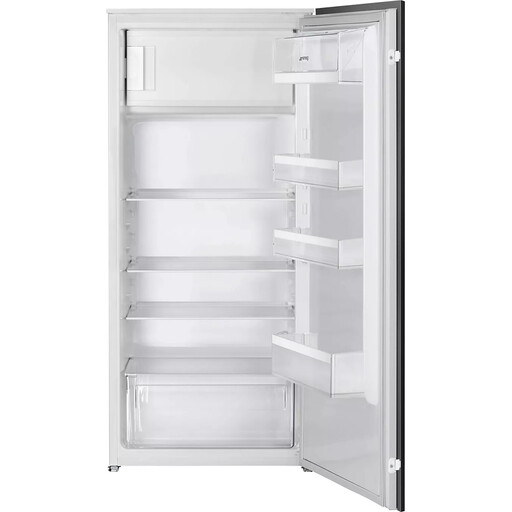 Image unavailable
Worth considering for a fitted kitchen if the cabinet space and door fixing are right for this integrated model. The product title lists a capacity of 188 l, a single door, a top-mounted freezer and an E energy rating; check how the capacity is divided before choosing.
 Image unavailable
If you have a small kitchen and regularly buy frozen food, compare its 153 l fridge capacity and 74 l freezer capacity with your needs. The product title lists a width of 54 cm, Low Frost technology, a reversible door, adjustable feet and an E energy rating; check that you have enough height and depth, too.
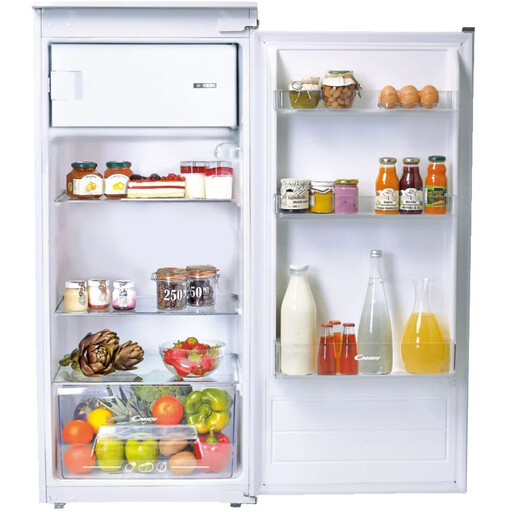 Image unavailable
Compare this 179 l single-door fridge-freezer with the space you need for fresh and frozen food. If you’re considering it for a fitted kitchen, check the product details for its installation type, required dimensions and door fixing before ordering.
 Image unavailable
This fridge-freezer could suit a household looking for a total capacity of 262 l without needing a space wider than the listed 54 cm. Its stated height is 176 cm and the product title mentions Low Frost. Check there’s enough clearance below your wall units and consider whether this capacity suits your shopping habits.
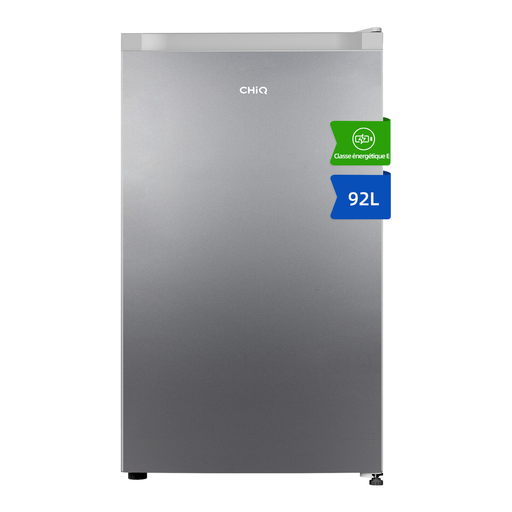 Image unavailable
Worth considering when space is the priority and 92 l is enough for your shopping: this is below the average guide of 100 to 150 l given by UFC-Que Choisir for one person. The product title mentions a small freezer compartment and an E energy rating. If the appliance will be near your bed, compare its stated noise level on the product page.
UFC-Que Choisir recommends an average of 100 to 150 l of usable capacity for one person. Use this as a starting point, then adjust it to how often you shop and distinguish between fridge capacity and the space set aside for frozen food.
A table-top fridge may be suitable if its capacity covers your shopping needs and you don’t store much frozen food. UFC-Que Choisir describes it as a good fit for studio flats, but points out that a small freezer compartment alone may not be enough if you want to store a lot of frozen food.
Measure the height, width and depth of the space, then check that the door can open and that the appliance will fit through to the kitchen. For an integrated model, also compare the cabinet dimensions and door fixing with the details for that exact model.
Yes. Follow the clearances specified in the instructions for your model and installation type. For one specific model installed in an alcove, Beko’s instructions call for at least 5 cm between the appliance and the ceiling, as well as the side walls; this isn’t a general rule.
For household refrigerators covered by the European label, compare the A to G rating, annual energy consumption, capacities and noise emissions shown. The European Commission explains that the QR code links to information about the model in the EPREL database.