Someone who cooks in their studio flat
If you store fresh food, leftovers and several meals between shops, compare the fridge compartment capacity rather than the total capacity alone. Any freezer compartment will take up some of that space.


To store meals and groceries for one person in a studio flat, start by comparing the fresh-food capacity of top-freezer or under-counter fridges. A mini fridge leaves less room for everyday food. Next, measure the space and check how the door opens. Only choose a freezer compartment if its capacity and storage conditions suit the frozen food you buy. In a single-room home, check the noise level of the specific model too.
If you store fresh food, leftovers and several meals between shops, compare the fridge compartment capacity rather than the total capacity alone. Any freezer compartment will take up some of that space.
In a single-room home, the fridge’s noise level deserves particular attention. Compare the stated noise levels in dB for the specific models you’re considering; don’t assume a smaller appliance will be quieter.
A freezer compartment doesn’t tell you what you’ll be able to store in it. Check its capacity, rating and the manufacturer’s instructions. For a freezer, the Ministry of Agriculture recommends a temperature of −18 °C.
For a fridge to store everyday meals in a studio flat, first check that it fits the space and has enough room for fresh food. Then narrow down your options based on the frozen food you buy and how close the appliance is to your living area.
| Criterion | What to check | Who this matters to |
|---|---|---|
| Dimensions | External dimensions and door clearance; for a built-in model, the niche dimensions and installation instructions. | If the appliance needs to fit into a niche or a tight corner, a few centimetres can make all the difference. Around 30% of consumers prioritise getting the fit right. |
| Fresh-food storage | The fridge compartment capacity, separate from the total capacity, and the space available for your usual containers. | When my groceries need to last between several meals, I want to store fresh food and leftovers without relying on daily shopping. This is the top priority for around 30% of consumers. |
| Freezer compartment | Separate capacity, the compartment’s rating, and storage and defrosting instructions. | If I regularly buy frozen food, a small freezer compartment may not suit the quantities I need to store. Around 20% of consumers put this use first. |
| Noise and energy consumption | The specific model’s noise level in dB and annual energy consumption in kWh; compare appliances of a similar size and capacity. | In a room where I sleep or work, I pay attention to the appliance’s noise and its energy use over time. Around 20% of consumers prioritise these criteria. |
The stated figure may include a freezer compartment. For the Candy CNOQ2S58EX model listed by Boulanger, the advertised 114 L is split between a 100 L fridge and a 14 L freezer compartment.
Compare the two capacities separately, then check there’s enough room for your bottles, meal containers and fresh food.
An appliance designed mainly for drinks or cosmetics shouldn’t be chosen for fresh food based on its size alone. According to Anses, the coldest part of the fridge should be between 0 and +4 °C to keep food safely.
Before buying, check that the model is designed for food storage and read its temperature instructions.
Electrolux’s product information for the EXB3AE82R specifies an 820 mm installation niche. The appliance’s height alone therefore isn’t enough to tell you whether it will fit under a worktop.
Measure the niche in every direction and check the manual for ventilation, fixing and door-system requirements.
The presence of a freezer compartment doesn’t tell you how much space it offers or what storage conditions frozen food requires. Some small compartments may also need to be defrosted manually, depending on the model.
If you regularly buy frozen food, check the compartment’s rating and capacity, along with the defrosting instructions. For a freezer, the Ministry of Agriculture recommends −18 °C.
The CNOQ2S58EX is an example of a top-freezer fridge to consider for one person’s everyday storage needs.
The B1854N is worth considering if your kitchen is designed for a built-in under-counter fridge.
The EXB3AE82R is a built-in under-counter model for a fitted kitchen.
The TK12Ve01 is a top-freezer model to consider if you want to keep fresh food separate from small amounts of frozen food.
These two appliances suit different spaces: the SMEG is a built-in model to consider for a fitted kitchen, while the CHiQ is a compact fridge to compare for a smaller space. For both, check the installation requirements and the space you’ll actually need before making your choice.
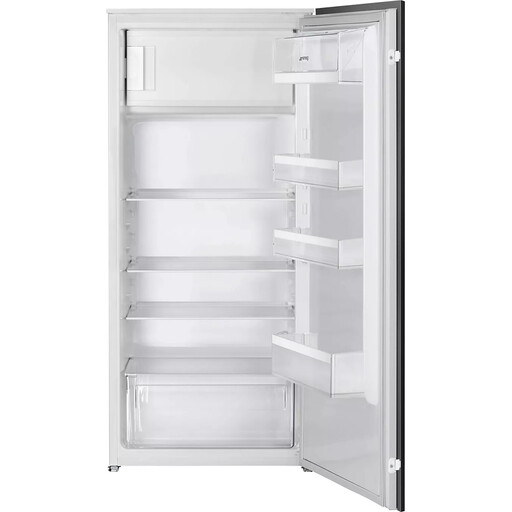 Image unavailable
Consider this for a fitted kitchen if the niche and door system meet the model’s installation requirements.
The product title states a total capacity of 188 L, a top freezer compartment and an E energy rating. Check how the capacity is split between the compartments and read the temperature instructions before relying on the freezer for frozen food.
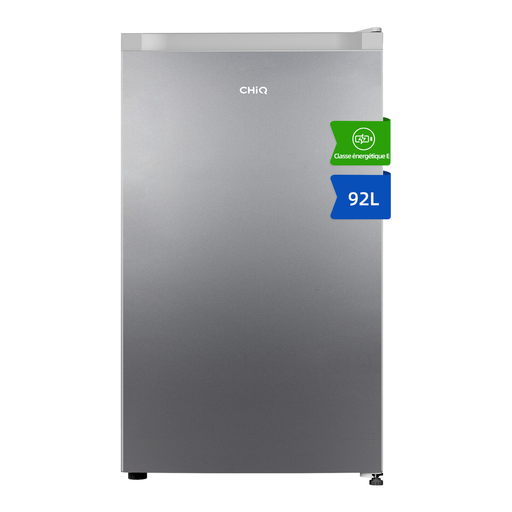 Image unavailable
Compare this model if you’re looking for a compact appliance for everyday food and would like a freezer compartment.
The product title states a total capacity of 92 L and an E energy rating. Measure the space using the model’s confirmed external dimensions. If you buy frozen food, also check the freezer compartment’s capacity and rating. For a single-room home, ask for the noise level in dB.
Choose based on how much fresh food you need to keep between shops, rather than assuming one capacity will suit everyone. Compare the fridge compartment capacity, the shelf layout and the space taken up by any freezer compartment.
A small freezer compartment may suit limited quantities if its rating and instructions match how you plan to use it. Check its separate capacity and the storage conditions specified by the manufacturer. For a freezer, the Ministry of Agriculture recommends −18 °C.
Check the temperature at the coldest point: Anses recommends keeping food between 0 and +4 °C there. Use a thermometer to check the temperature once the appliance is running. Also avoid overfilling the compartments so cold air can circulate.
Ask the retailer about taking back your old appliance when you buy a new one. The Ministry for the Ecological Transition describes a ‘one-for-one’ take-back scheme when buying a product of the same type. Check the practical arrangements with the retailer, particularly if the new appliance is being delivered.