If you shop often and mainly buy fresh food, choose a small fridge without a freezer. A freezer compartment is better suited to occasional frozen food; if you regularly stock up, compare models with a separate freezer, while bearing in mind the extra space they take up. Que Choisir suggests 100 to 150 L of usable capacity for one person. Use this as a guide, alongside your shopping habits and the dimensions of the space available.
Who are these sizes suitable for?
Someone living alone in a studio flat
If you often make small shopping trips, look for enough fresh-food capacity to suit your purchases and the size of your kitchen. Que Choisir suggests an average of 100 to 150 L of usable capacity for one person. Adjust this to suit the food you keep in your fridge.
Occasional visitor to a holiday home
If you only need a few fresh items while you’re staying there, consider how long you’ll be there and what you’ll buy when you arrive. Whether you need to store frozen food may affect which size is right for you.
Small household that keeps frozen food
If you only keep a few frozen items, a freezer compartment could be a useful feature. If you regularly stock up, compare the capacity of models with a separate freezer instead. Que Choisir says a small freezer compartment alone won’t be enough if you eat a lot of frozen food.
What sets the models apart?
First, work out how much space you have and how much fresh food you need to store. Then decide whether freezing food is worth the space it takes up. For each appliance, check the installation instructions and energy label against the way you plan to use it.
| Criteria |
What to check |
Who is it for? |
| Size and installation |
Measure the height, width and depth, as well as the space needed to open the door. Check the model’s instructions for ventilation clearances. |
In a narrow kitchen, I want to be able to open the door and reach the drawers without disrupting the installation; around 36% of consumers would make this their priority. |
| Fresh-food capacity |
Compare the litres available for refrigeration, not just the total capacity, with how often you shop. Que Choisir suggests an average of 100 to 150 L of usable capacity for one person. |
If I’m eating at home for several days, I need to store my fresh food without cramming it in. Refrigeration capacity would be the main consideration for around 29% of consumers. |
| Freezing |
Check whether there’s a freezer compartment and how much it holds. Que Choisir advises against relying on a small freezer compartment alone if you eat a lot of frozen food. |
If I regularly buy frozen food, I want to know whether a freezer compartment will be enough or whether I need a separate freezer; around 21% of consumers would put this question first. |
| Noise and energy use |
Compare the noise emissions in dB(A) and annual energy use in kWh on the energy label. Ideally, compare appliances of a similar size and capacity. |
If my room is also used for sleeping or working, I take the appliance’s noise and energy use into account. These factors would come first for around 14% of consumers. |
Mistakes to avoid
-
Focusing on width alone
An appliance may fit into the space but leave too little room for ventilation or for the door to open. The clearance required depends on the model and its design.
Measure the height and depth as well, and check how far the door swings open. Then follow the installation instructions for the model you’ve chosen. Bosch’s claims that certain Perfect Fit models can be placed close to a wall don’t apply to all fridges.
-
Relying on a freezer compartment for all your frozen food
An integrated compartment may suit occasional use, but Que Choisir says a small freezer compartment alone won’t be enough if you eat a lot of frozen food.
Think about your usual shopping before choosing between a small compartment and a model with a separate freezer. Also compare how much space each option leaves for fresh food.
-
Confusing total capacity with fresh-food space
In an appliance with a freezer compartment, the total capacity doesn’t show how much space is available for fresh food. The shelves and interior layout also affect how easy it is to store your shopping.
Compare the refrigeration and freezing capacities separately, then check that you can store your usual shopping without cramming it in.
-
Overlooking noise and temperature settings
The compressor can be disruptive in a room that serves multiple purposes. The temperature inside the fridge also matters for food storage: Anses recommends keeping the coldest part between 0 °C and 4 °C.
Check the noise emissions and energy use on the energy label. Once the fridge is installed, check its internal temperature, especially if the room is warm or the door is opened often.
Brands to consider
Beko
Beko’s under-counter models let you compare a fridge with a top-mounted freezer compartment with one that has no freezer.
- Beko says the TSE1284N is 54 cm wide and has a reversible door.
- Beko describes the TSE1504FN as an under-counter fridge without a freezer. Check the specifications of the model you choose rather than assuming they apply across the whole range.
Bosch
The KTR15NWEB and KTL15NWEB models show the choice between fresh-food capacity without a freezer and an integrated freezer compartment.
- Bosch gives the dimensions of both models as 850 × 560 × 580 mm. The KTR15NWEB offers 134 L of refrigeration capacity and no freezer, while the KTL15NWEB has 106 L of refrigeration capacity and an integrated freezer compartment.
- Perfect Fit installation is available on models designed for this purpose. Check the model and required clearances in its instructions.
Whirlpool
The brand offers under-counter fridges designed for smaller spaces.
- Whirlpool says most of its freestanding under-counter fridges are suitable for spaces less than 90 cm high.
- This doesn’t replace measuring your space or checking the dimensions and installation instructions for the model you’re considering.
Compact fridges on Joybuy
These models suit different needs: keeping mainly fresh food in a small space, having a freezer compartment for occasional use, or setting aside more room for frozen food. They’re not interchangeable, so check the dimensions and instructions before choosing one for a recess or under a worktop.
 Image unavailable
CHiQ JR227LSE 227 L fridge freezer, silver
Consider this if you need separate space for fresh and frozen food, provided the appliance fits in the space available.
The model name indicates 153 L of refrigeration capacity, 74 L of freezer capacity, a width of 54 cm, a reversible door and an energy rating of E.
Check the overall height and the clearances specified in the instructions. If noise and annual energy use matter to you, check the energy label.
View on Joybuy
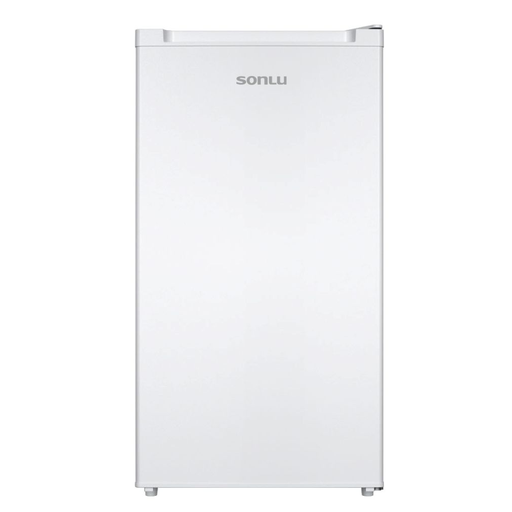 Image unavailable
Sonlu CS-100L 82 L larder fridge
Worth considering for small shops of fresh food or occasional stays, if you don’t need to store frozen food.
The stated capacity is 82 L and the energy rating is E. This is below the average guide of 100 to 150 L of usable capacity that Que Choisir gives for one person.
Think about how much food you keep between shops, then check the model’s dimensions and installation clearances.
View on Joybuy
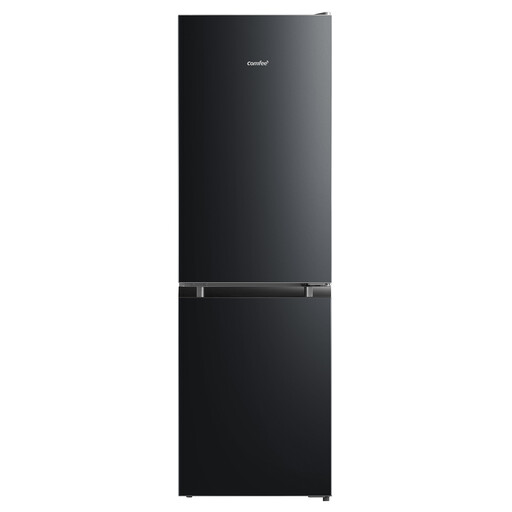 Image unavailable
Comfee' by Midea RCB230BL2EU(E) 174 L fridge freezer, black
Compare this model if you want to store fresh and frozen food in one appliance and have enough height available.
The model name indicates a capacity of 174 L, a reversible door, an adjustable thermostat, LED lighting and Low Frost technology.
This model is listed as 1,500 mm high. Check this against the space available and consult the instructions for the required clearances. See the energy label to compare noise and annual energy use.
View on Joybuy
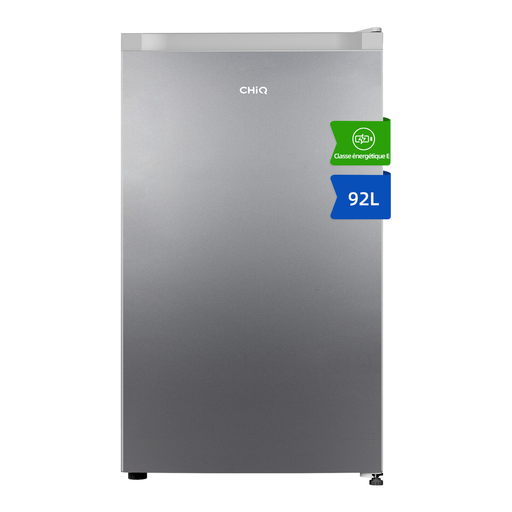 Image unavailable
CHiQ JR92DSE 92 L fridge with freezer compartment, matt silver
Consider this for a small space if a freezer compartment for occasional use suits your frozen-food shopping.
The model name indicates a capacity of 92 L, a freezer compartment, a footprint of 0.22 m² and an energy rating of E.
Before relying on this capacity for your shopping, check how the space is split between the fridge and freezer compartments. Also check the full dimensions and installation clearances.
View on Joybuy
Frequently asked questions
What capacity should one person allow for in a studio flat?
Que Choisir suggests an average of 100 to 150 L of usable capacity for one person. Adjust this to suit how often you shop and how much fresh food you keep at a time. When comparing models with a freezer, look at the refrigeration capacity rather than the total capacity.
Can you place a small fridge against a wall or under a worktop?
Only if the model’s instructions allow this installation with the clearances available. For appliances covered by its instructions and placed in a recess, Beko specifies at least 5 cm between the appliance and the ceiling and wall. Some Bosch Perfect Fit models are designed to be installed close to a wall. Also measure the space needed to open the door and reach the drawers.
How can you compare the noise and energy use of two small fridges?
Check their energy labels and, ideally, compare models of a similar size and capacity. The European energy label shows annual energy use in kWh and noise emissions, among other details. It also distinguishes between the capacity for refrigeration and freezing.
What temperature should you check after installation?
Anses recommends a temperature of between 0 °C and 4 °C in the coldest part of the fridge. An internal thermometer can help you check this, especially if the room is warm, the appliance is very full or the door is opened often.


