What should you look for?
If you’re choosing a main fridge for a small kitchen, first make sure it can be installed and used without getting in the way. Then compare the different configurations based on your usual shopping habits and how much room you want to give to frozen food.
| Criteria |
What to check |
Who it’s for |
| Size and installation |
Measure the width, depth and height, then check the door clearance and the space required according to the manual. Distinguish between a freestanding appliance placed under a worktop and an integrated model. |
When there’s little room between walkways or cabinets, the first thing I need is an appliance that will actually fit. Around 31% of consumers would make this their priority. |
| Fresh food capacity |
Compare the usable fridge capacity and interior layout with the amount of food you need to store. |
If I cook often and keep leftovers, I want enough space for fresh food without having to shop more often. This would be the priority for around 31% of consumers. |
| Freezer capacity |
Check whether there’s a freezer compartment, how much it holds and the storage guidance for the exact model. |
Without a separate freezer, I need to store a few frozen items regularly, even if that means less room for fresh food. Around 25% of consumers would prioritise this need. |
| Energy use and noise |
Compare the kWh/year and stated noise level in dB, and follow the installation and settings guidance. |
In a small room, I pay attention to how the appliance runs day to day and how it keeps my food. This would be the main concern for around 13% of consumers. |
Brands and models to compare
These models illustrate differences in configuration and installation; their specifications don’t apply to every appliance from the same brand.
Bosch
The freestanding table-top KTR15NWEB and KTL15NWEB let you compare two different uses in the same stated external dimensions of 850 × 560 × 580 mm.
- According to Bosch France’s product specifications, the KTR15NWEB offers 134 L of fridge space with no freezer compartment, while the KTL15NWEB has 106 L of fridge space with an integrated compartment.
- Choosing the integrated compartment reduces the stated fresh food capacity in this case. Check the KTL15NWEB’s freezing specifications if they’re important to your decision.
Candy
The COT1S45EW and CM4S59EW show the difference between a freestanding appliance that can be placed under a worktop and an integrated under-counter model.
- Candy lists the COT1S45EW as 500 × 570 × 840 mm and the CM4S59EW as 540 × 545 × 871 mm, in width, depth and height order.
- For both models, check the manual for ventilation requirements and make sure they’re compatible with the intended space.
Liebherr
The KTe550 table-top fridge offers another point of comparison for capacity, depth and stated noise level.
- Liebherr lists this model as having a total capacity of 125 L, dimensions of 85 × 55 × 60,7 cm and a noise level of 35 dB.
- Check its depth of 60,7 cm against the available space, and don’t forget to follow the installation instructions in the manual.
Fridges to discover on Joybuy
These appliances suit different needs: storing fresh and frozen food in one appliance, choosing a single-door fridge or fitting out a niche. Their inclusion here doesn’t mean they’re all suitable for under-counter installation: check the dimensions and installation type of each one.
 Image unavailable
CHiQ JR227LSE, 227 L silver fridge freezer
Worth considering if you want to store fresh and frozen food in the same appliance.
The product name lists 153 L for refrigeration, 74 L for freezing and a width of 54 cm. Check its overall height and ventilation clearances before choosing where to put it.
View on Joybuy
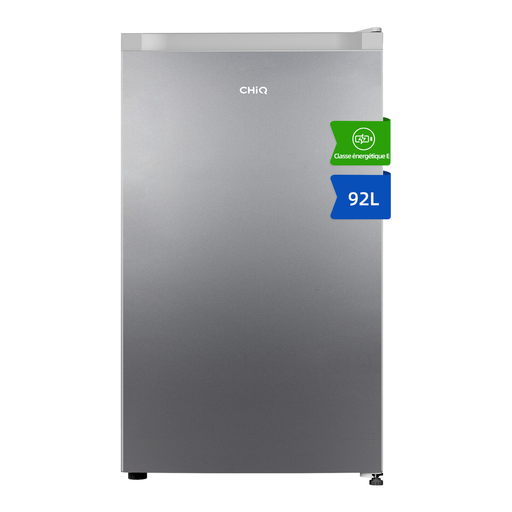 Image unavailable
CHiQ JR92DSE, 92 L single-door fridge
Consider this if you’re looking for a single-door appliance for everyday food and have limited space.
Check the layout of the interior compartment before relying on it for freezing. Also check the full dimensions and installation clearances.
View on Joybuy
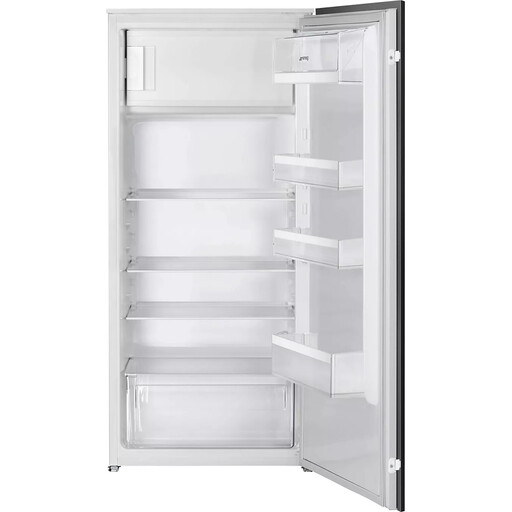 Image unavailable
SMEG S4C122E, integrated fridge
Worth looking at if your kitchen has a niche designed for an integrated appliance.
Check the niche dimensions and make sure the sliding-door system is compatible. Also confirm the model’s usable capacity and freezer configuration before choosing it to meet your storage needs.
View on Joybuy
Frequently asked questions
Can a table-top fridge be the main fridge for two people?
Yes, if its usable capacity and layout suit your usual shopping habits. As a guide for these specific models, Bosch lists the KTL15NWEB with a freezer compartment as having 106 L of fridge space, and the KTR15NWEB without a compartment as having 134 L.
Do I need a freezer compartment?
Choose one if you regularly store frozen food and don’t have a separate freezer. If you mostly store fresh food, compare how much space the compartment takes up: Bosch lists the KTL15NWEB with a compartment as having 106 L of fridge space, compared with 134 L for the KTR15NWEB without one, despite their identical external dimensions.
Does a fridge described as “under-counter” count as integrated?
No, that description alone doesn’t confirm that it’s an integrated model. Candy describes the COT1S45EW as a freestanding under-counter appliance and the CM4S59EW as integrated. If you’re choosing one for a niche, check the installation type and ventilation requirements in the manual for the model you’ve chosen.
What temperature should I check after installation?
Anses recommends keeping the coldest part of the fridge between 0 and +4 °C. Check it especially if the kitchen is warm or the door is opened frequently.
How can I compare the energy use of small fridges?
Compare the kWh/year figures for models that suit your space and storage needs, rather than looking at the energy rating alone. ADEME points out that an appliance’s actual energy use also depends on its size and how it’s used.


