What should you check before choosing?
When choosing a small-format pasta sauce as part of a lactose-free shop, check the recipe before the packaging. Then compare the net weight and storage instructions after opening with the number of meals you have planned.
| Criteria |
What to check |
Who it matters to |
| Ingredients and traces of milk |
Check the ingredients for milk and look for any trace warnings on the packaging of the specific variety. An ingredients list that does not declare milk is not, by itself, a guarantee that a product is ‘lactose-free’. |
I want to rule out recipes containing milk and take traces into account where necessary; around 42% of consumers would put this check at the top of their list. |
| Quantity for one meal |
Compare the net weight with how much you use, and distinguish between a ready-made sauce and passata that needs extra ingredients. |
For a single plate of pasta, I’d rather avoid a pack that leaves a lot over; nearly 33% of consumers would prioritise pack size. |
| Use after opening |
Check the refrigeration instructions and the stated time limit for that product before planning several meals. |
If I’m using the sauce across several meals, I need to be able to use it within the stated time after opening; around 25% of consumers would prioritise this flexibility. |
Brands to compare when checking labels
These products show how recipes, quantities and packaging can differ. A brand name alone doesn’t tell you whether a sauce is suitable for a lactose-free shop.
Barilla
Auchan lists a 200 g jar of tomato and basil sauce.
- The small jar makes it easy to compare a ready-to-use sauce with tomato bases of the same weight.
- Auchan’s listing says to refrigerate the sauce and use it within five days of opening. Check the information on the jar you buy, particularly about milk and traces of milk; don’t assume the recipe is ‘lactose-free’.
Panzani
The range presented by Panzani includes tomato sauces, pestos and cooking bases.
- Carrefour describes 200 g cartons of tomato base made with fresh tomatoes and citric acid.
- Carrefour’s listing for Panzani Pesto Rosso mentions cheese containing milk and whey proteins. Check each recipe separately.
Turini
E.Leclerc lists a 200 g tomato purée with basil flavour, which is best treated as a base to season.
- E.Leclerc’s listing says it contains 99% tomato purée, natural basil flavouring and citric acid.
- Tomato purée is not a fully prepared pasta sauce. Also check the label on the product you buy against your own dietary requirements.
Auchan Bio
Auchan lists a 200 g jar of tomato and basil sauce.
- The 200 g size makes it easy to compare with other small sauces and tomato bases.
- Auchan warns that the product may contain traces of milk, celery and mustard, and says to refrigerate it after opening and use it within 48 hours. The trace warning is important if you also need to avoid traces.
Baresa
Lidl France lists a 560 g tomato and onion sauce.
- Its net weight gives you a useful point of comparison with the 200 g products.
- At 560 g, you’ll need to plan for more than one use if you want to avoid leftovers. Check the ingredients and allergen information on the packaging before adding it to a lactose-free shop.
A small-format sauce on Joybuy
This selection features a 200 g sauce to compare with the amount you need for your pasta. If you’re shopping without lactose or specifically looking for a metal tin, check the product information and packaging before deciding.
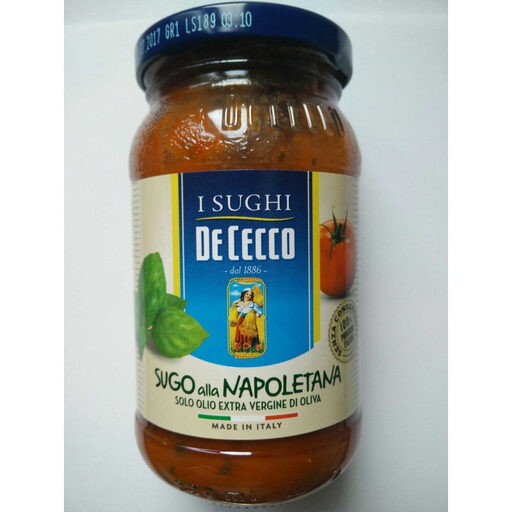 Image unavailable
De Cecco Italian Neapolitan Sauce 200g
For a small pasta dish, compare this 200 g pack with the amount you usually use.
Check the ingredients, any warnings about traces of milk and the type of packaging on the product. Its name does not guarantee a ‘lactose-free’ claim or that it comes in a metal tin.
View on Joybuy
Frequently asked questions
Is a red sauce always suitable for a lactose-free shop?
No: a red sauce may contain dairy ingredients. Carrefour’s listing for Panzani Pesto Rosso mentions cheese containing milk and whey proteins. Read the ingredients for the specific product, even if it contains tomato.
What should you look for on the label of a prepacked sauce?
Read the ingredients list, highlighted allergens and any warnings about possible traces. The French Directorate-General for Competition Policy, Consumer Affairs and Fraud Control states that allergenic ingredients must be listed and highlighted. Depending on what you need to avoid, look out in particular for milk, cheese, cream, butter and whey.
How long can you keep a sauce after opening?
Follow the instructions for the product you buy, as storage times vary. Auchan’s listings say to refrigerate the 200 g Barilla tomato and basil sauce for five days, the 200 g Auchan Bio sauce for 48 hours, and the 300 g Auchan pouch for eight days.
Is an ingredients list with no milk enough to confirm that a product is ‘lactose-free’?
No: the absence of declared milk in the ingredients list does not, by itself, mean that a product is labelled ‘lactose-free’. Some sauces also carry a warning that they may contain traces of milk, such as Auchan Bio’s 200 g tomato and basil sauce. Check the packaging and the manufacturer’s information against the ingredients you need to avoid.


