Choose a washer-dryer if you only have space for one appliance and your usual loads fit within its drying capacity, which is generally lower than its washing capacity, according to UFC-Que Choisir. If you can install two compatible appliances, side by side or stacked, compare their capacities and the space they need. If you can air-dry your laundry, a washing machine with a suitable spin-drying performance is another option. In every case, check the actual dimensions. For a washer-dryer, also compare the full cycle time and energy and water consumption.
Who are these options for?
People with space for just one appliance
If you don’t have a utility room or enough width for two appliances, you’ll want to wash and dry your clothes in the same footprint. UFC-Que Choisir highlights the space-saving benefits of a washer-dryer, provided you check its dimensions and drying capacity.
Households drying several loads a week
If you regularly dry large loads, the difference between washing and drying capacities may mean you have to remove some laundry before starting the drying cycle. Compare this with the space needed for two separate appliances.
Renters who mostly air-dry their clothes indoors
If you have space to hang your laundry, you could consider a washing machine without a built-in dryer. ADEME recommends checking its spin-drying efficiency class if you plan to dry your clothes indoors afterwards.
What sets these options apart?
Washer-dryer
Consider it: when one appliance needs to handle both washing and drying, and your load is within the model’s drying limit.
The trade-off: according to UFC-Que Choisir, drying capacity is lower than washing capacity. You’ll also need to compare the full cycle time and consumption.
Two appliances
Consider them: if you often dry large loads and have space for two appliances, or enough height to stack compatible models.
The trade-off: stacking requires a kit that’s compatible with the exact models. Electrolux, for example, asks customers to check that its kit is compatible.
Washing machine and indoor drying
Consider it: if you can hang your laundry to dry and only need space for a washing machine.
The trade-off: a spin cycle isn’t a substitute for a tumble dryer. ADEME recommends choosing a good spin-drying efficiency class to help your laundry dry more easily afterwards.
| Criteria |
What to check |
Who it matters to |
| Space and installation |
Measure the overall depth, allow clearance for the door and check access to the connections. If stacking, make sure the kit is compatible with both model numbers. |
If I only have one space available, the appliance needs to fit without blocking the door or access to the connections. This would be a priority for around 38% of consumers. |
| Drying capacity |
Compare the capacity in kilograms for washing alone and for a wash-and-dry cycle with the size of your usual loads. |
If I often dry sheets or towels, I want to know whether the whole load can stay in the drum. The amount that can actually be dried would come first for around 31% of consumers. |
| Time and consumption |
Check the figures for washing alone and for the full cycle separately. Also consider spin noise if the appliance is near a living area. |
In a room used every day, I need to be comfortable with how long the drum is occupied, the noise and the resources used. Around 31% of consumers would prioritise these practical considerations. |
What to avoid before you buy
-
Assuming the washing capacity is the same as the drying capacity
A load that fits for washing may exceed the limit for the full cycle, meaning you’ll need to remove some damp laundry before drying. UFC-Que Choisir points out that the two capacities generally differ.
For a model listed as 8/5 kg, check the 5 kg figure to see how much laundry it can wash and then dry without you having to unload it part-way through.
-
Relying only on the depth given in the product title
The door, protruding parts and connections can make an alcove unusable, even if the appliance’s main body seems to fit.
Check the overall dimensions of the exact model and allow enough space to open the door and access the connections.
-
Comparing washing figures alone
Figures for washing alone don’t necessarily tell you how long a wash-and-dry cycle takes or how much it consumes.
Compare the figures for each mode on the label and product information, especially if you expect to use the full cycle often.
-
Assuming stacking kits are universal
Similar dimensions aren’t enough to guarantee that two appliances and a kit will work together.
Before planning a stacked installation, check with the manufacturer that the kit is compatible with each model number.
Brands to consider, model by model
These model examples show which features to compare. The capacities and functions mentioned apply to the specific models listed, not to every appliance from that brand.
Bosch
The WNA13400FF lets you compare washing, drying and a programme for smaller loads.
- Bosch lists an 8 kg washing capacity and a 5 kg capacity for the wash-and-dry cycle on this model.
- The advertised 60-minute programme is for small loads; it doesn’t indicate how long a full-capacity cycle takes.
LG
The F852SV52IRS shows which measurements to check if you’re choosing a model for its shallow depth.
- For this model, LG lists an 8.5 kg washing capacity, a 5 kg drying capacity and a depth that varies depending on which parts are included.
- Its advertised full cycle of 7 h 50 is a reminder that a slim design doesn’t mean you can overlook how long the appliance will be in use.
Electrolux
The range includes washer-dryers as well as accessories for certain stacked installations.
- An 8/4 kg washer-dryer is among the models listed by Electrolux France.
- Electrolux asks you to check that its stacking kit is compatible with the appliances in question. Don’t assume it will work with other models without checking.
Samsung
The models available in France include washer-dryers with separate washing and drying capacities.
- Samsung lists configurations including 9+6 kg and 11+6 kg.
- Check the product information for the model you choose: these capacities and other features don’t apply to the entire range.
Joybuy products for two different needs
These two appliances suit different needs in a small home: washing and drying in one machine, or using a washing machine and then hanging your laundry indoors.
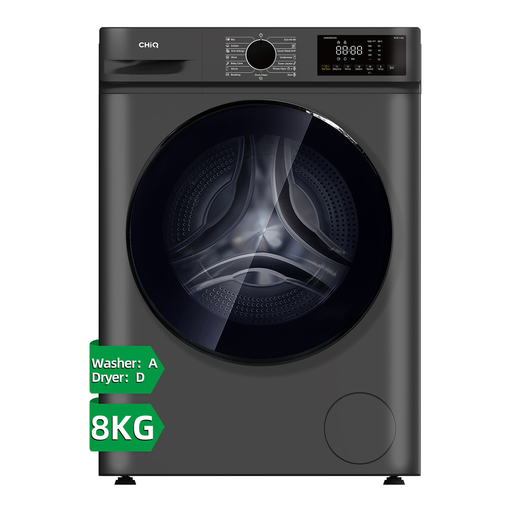 Image unavailable
CHiQ JW85882HG, 8/5 kg washer-dryer
Wash and then dry with a single appliance, as long as your drying load doesn’t exceed 5 kg.
The model name indicates an 8 kg washing capacity, a 5 kg drying capacity and a spin speed of 1,400 rpm.
Before choosing this model for a narrow alcove, check its overall dimensions and the clearance it needs. Also compare the full cycle time and consumption.
View on Joybuy
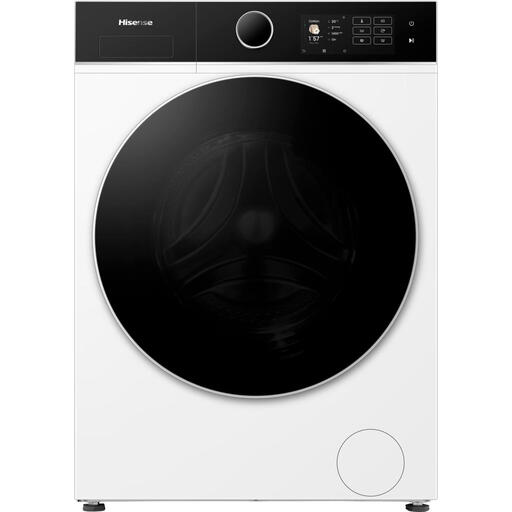 Image unavailable
Hisense WF5I8043BWF, 8 kg washing machine
Worth considering if you can hang your laundry to dry after washing: this is a washing machine with no built-in dryer.
Its name indicates an 8 kg capacity and a spin speed of 1,400 rpm. Before choosing this option, check the installation dimensions and the model’s spin-drying efficiency class.
View on Joybuy
Frequently asked questions
Can I wash 8 kg and then dry the whole load in an 8/5 kg washer-dryer?
No. To run a wash-and-dry cycle on an 8/5 kg model, your load must be within the 5 kg limit for the full cycle. The washing capacity alone doesn’t tell you how much laundry the appliance can then dry without you removing some of it.
Which figures should I compare on a washer-dryer’s label?
Compare the information for washing alone and for the wash-and-dry cycle separately, including consumption, cycle time and the capacity listed for each mode. Also check the noise level if the appliance will be used near a living area.
Can you stack any tumble dryer and washing machine?
No. You need a kit explicitly compatible with both model numbers, as well as enough height for the installation. For example, Electrolux lists a depth range and asks you to check the product number for one of its kits. These conditions don’t automatically apply to other kits.


