No floor space for a 45 cm model
A countertop appliance is worth considering if you can set aside a stable surface for it and are happy with a smaller load. Make sure it won’t take up the worktop space you need for preparing meals.


In a small flat kitchen, choose a size that leaves enough room to open the door and use your worktop, not just one that fits the available width. A countertop model is suitable if you’re happy with a smaller load; a 45 cm model gives you more room for dishes if you can set aside floor space for it. Only choose a 60 cm model if its depth and open door won’t obstruct movement around the kitchen.
A countertop appliance is worth considering if you can set aside a stable surface for it and are happy with a smaller load. Make sure it won’t take up the worktop space you need for preparing meals.
A 45 cm model is worth considering if you want to wash more dishes than a countertop appliance can hold, without dedicating 60 cm of width to the machine. The basket layout is still key for fitting your plates and pans.
Consider a standard-size model if its open door won’t obstruct movement or meal preparation, and its greater capacity suits the amount of washing-up you have.
Start with the space you can actually use, then compare the capacity and baskets with the dishes you use every day. Que Choisir generally gives a capacity of 9 to 10 place settings for freestanding 45 cm models and 12 to 17 for 60 cm models. These figures don’t replace checking the inside of the specific model.
| Priority | What to check | What consumers say |
|---|---|---|
| Save space | Measure the width, depth and height; check the door clearance and hose routing on the model’s diagram. | If the appliance takes up my food-preparation space or blocks the way, its capacity won’t be much use to me. Around 42% of consumers put saving space at the top of their list. |
| Balance capacity and size | Compare the baskets with your large plates and pans, and check how much room you need for a 45 cm model. | I want to wash the dishes I use every day without setting aside the width needed for a standard-size appliance. This compromise is the main priority for around 33% of consumers. |
| Fit more dishes | Check the dimensions and clearance needed for a 60 cm model, then look at its basket layout. | If there’s room for it, being able to wash more dishes matters more to me than saving width. This capacity, provided it fits the kitchen, comes first for around 25% of consumers. |
A dishwasher may fit the available width but still be too deep, too tall to fit under the worktop, or lack room for the door to open and the hoses to run.
Measure the space in all three dimensions and compare it with the installation diagram for the exact model, allowing for the open door too.
The stated capacity doesn’t tell you whether your large plates, pans and glasses will fit in the baskets.
Check the basket adjustments and cutlery space, keeping in mind the items you wash most often.
Manual filling can remove the need for a fixed water supply on some models, but you’ll still need a suitable way to drain the water and a stable surface.
Check the instructions for filling, draining, the loaded weight and the connection requirements for your chosen model.
Manual filling also takes time every time you use it.
Consumables, maintenance and, if you’re replacing an appliance, getting rid of the old one are all part of the day-to-day arrangements.
Check which consumables the instructions specify and what take-back options the retailer offers before delivery. The French Ministry for Ecological Transition reminds retailers that they must offer to take back a used appliance when it’s replaced.
Worth considering for narrow or standard-size freestanding models with published dimensions.
Worth considering if your kitchen has a suitable space for a compact built-in appliance.
Worth considering if you’re looking for a 45 cm freestanding model for a small household.
These models suit two possible setups: an appliance on the worktop, or a standard-size freestanding model if your kitchen can accommodate its width and open door. If you’re considering a 45 cm model instead, use the measuring and loading criteria above to compare models of that size.
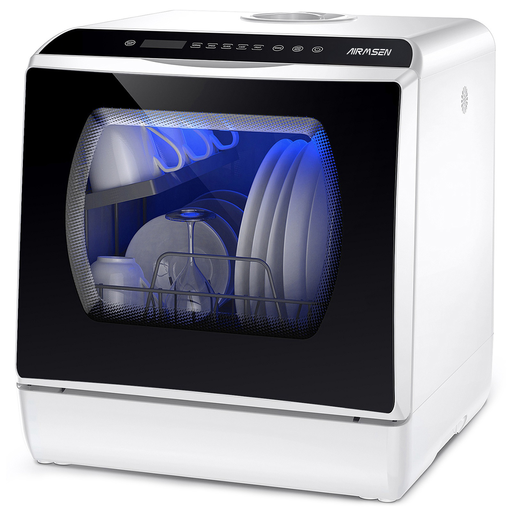 Image unavailable
Worth considering if you have space on your worktop and want the option of filling the tank or connecting to a water supply. Stated dimensions: 45,8 × 42,8 × 42,5 cm; stated capacity: 4 place settings. Allow for drainage and check the door clearance.
 Image unavailable
The 5 L water tank and manual filling are worth considering if you don’t plan to have a fixed water supply at this location. Stated dimensions: 420 × 435 × 435 mm. Check that there’s room for your dishes and drainage; the product description says the adapter for connecting to a tap isn’t included.
 Image unavailable
This countertop model is worth considering for smaller loads if its dimensions and connections suit your space. It’s listed as having a capacity of 6 place settings and 7 programmes. Check the instructions to measure the space it needs, allow for the door to open and confirm the water supply and drainage requirements.
 Image unavailable
Worth considering if you can set aside a standard-size space without obstructing movement around the kitchen. Stated dimensions: 59,8 × 60 × 84,5 cm; stated capacity: 14 place settings. The upper basket is adjustable. Check the door clearance and installation requirements for this variant, particularly if you’re planning to fit it under a worktop.
 Image unavailable
This standard-size model is worth considering if its width leaves enough room to move around and prepare meals. Stated dimensions: 85 × 60 × 59 cm; stated capacity: 14 place settings. Its upper basket is adjustable. Check the door clearance and connections, and make sure your dishes will fit in the baskets.
Measure the width, depth and height of the space, then check how much room is needed to open the door fully. Compare these measurements with the diagram for your chosen model and make sure the water inlet and drain hoses will be accessible and won’t be trapped.
A water tank may mean some models don’t need a fixed water supply, but they’ll still need suitable drainage and an electrical connection that meets the requirements in the instructions. You’ll also need a stable surface, and should check the drain hose route before buying.
Check the dishwasher’s instructions for its connection requirements and make sure the socket you plan to use meets them. If the wiring looks old or you’re thinking of changing a circuit, ask a qualified professional to assess it rather than attempting a makeshift connection.
In France, the ministry responsible for the ecological transition says that retailers must offer to take back an old appliance when you buy a new one. Ask how this works before delivery, including any access requirements for collecting the appliance.