If width is your main constraint, consider a top-loading washing machine, provided you can keep the space above it clear. If depth is the issue, look at slim front-loading models, which are generally close to 60 cm wide. For installation under a worktop, choose a front-loader that is explicitly suitable and check the model’s instructions. In all three cases, the appliance dimensions alone won’t guarantee easy access to your laundry.
Who are these options for?
Studio flat residents with a narrow alcove
If width is your limiting factor, a top-loading machine is worth considering. The French National Consumer Institute says top-loaders are commonly 40 to 45 cm wide; you’ll also need enough room to open the lid.
Households limited by appliance depth
You have room for a standard-width front-loader, but the machine would stick out into the walkway. A slim front-loader mainly reduces depth: UFC-Que Choisir notes that this format is generally still close to 60 cm wide.
Anyone planning an under-counter installation
You want to fit the machine under a worktop without making the laundry difficult to reach. Look for front-loaders designed for this use, then check the available height, connections and installation instructions for the specific model.
What should you check before choosing?
First identify which dimension is preventing installation, then check access and day-to-day usability before comparing other features.
Top-loading
Consider it if: width is limited and the lid can open freely.
The trade-off: the top of the machine needs to stay accessible and can’t be blocked by a worktop.
Slim front-loader
Consider it if: depth is limited, but there’s still room for a front-loader’s width.
The trade-off: you’ll still need space in front of the machine to open the door and load your laundry.
Under-counter front-loader
Consider it if: you want to use the space under a worktop and can keep the front accessible.
The trade-off: suitability depends on the model, available height and the conditions in its instructions.
| Priority |
What to check |
What I need |
| Dimensions and access |
Measure the alcove’s width, depth and height, as well as the delivery route. Compare these with the model’s overall dimensions and check its instructions for installation and connections. |
I want to be able to bring in and install the machine without it obstructing a necessary walkway. |
| Access to your laundry |
Allow for the lid to open above a top-loader or the door to open in front of a front-loader. Also make sure you’ll have room to stand while loading and unloading the machine. |
In a small room, I need enough space to use the machine, not just fit it in. |
| Capacity |
Compare the stated capacity with the loads you usually wash. ADEME says a 7 kg washing machine is enough most of the time; use this as a guide and adjust it to suit your household and laundry. |
I want a drum that suits my usual laundry loads, rather than choosing capacity based only on the machine’s external dimensions. |
| Energy and noise |
Once you’ve confirmed the space, compare the energy label details, including energy use, water per cycle and noise, as well as the repairability rating shown. |
If the machine is near a living area, its noise level also matters to me. |
What mistakes should you avoid?
-
Focusing only on the appliance’s width
A front-loader might fit in an alcove but still be difficult to load if its door is obstructed. A top-loader can also be unusable if a shelf prevents the lid from opening.
Measure the space, the access route and the clearance needed to open the machine before choosing a model.
-
Assuming “slim” means narrow
According to UFC-Que Choisir, slim front-loaders mainly reduce depth and are generally still close to 60 cm wide. So they won’t solve a width constraint of 40 to 45 cm.
If width is the issue, compare top-loader dimensions first; if depth is limited, look at slim front-loaders.
-
Assuming any front-loader will fit under a worktop
A front-loading design alone doesn’t guarantee that a machine can be installed under a worktop. The height of the alcove, the top of the appliance and the connections all matter too.
Choose a model that is explicitly designed for this type of installation, then check its diagram and instructions before ordering.
-
Choosing a format without considering how you’ll use it
A machine that fits the alcove may still be impractical if its capacity doesn’t suit your usual loads or it’s too noisy for a nearby room.
Once you’ve taken measurements, compare each model’s capacity and energy, water and noise information.
Which models illustrate these formats?
These manufacturers’ models illustrate different space requirements; their inclusion here doesn’t mean they’re part of the Joybuy selection below.
Electrolux
Electrolux France lists the EW6T5137AG, a 7 kg top-loading washing machine measuring 890 × 400 × 600 mm (height × width × depth).
- At 400 mm wide, this model is worth considering when the alcove’s width is the main constraint.
- The lid needs to remain accessible; check the model’s installation instructions.
Candy
Candy France gives the ProWash 300 GD 27S7-S front-loader’s dimensions as 595 × 467 × 850 mm (width × depth × height).
- Its stated depth of 467 mm is worth checking if the appliance might stick out too far into the room.
- It is still 595 mm wide, and the door needs space in front of the machine for loading.
Bosch
Bosch France offers a category of front-loaders with removable tops for under-counter installation. Its WUU28T18FR product page lists dimensions of 845 × 598 × 590 mm (height × width × depth).
- Models explicitly designed for under-counter installation are worth considering for this type of set-up.
- For the WUU28T18FR, as with any model you’re considering, use the instructions to confirm exact suitability, the space needed for connections and access to the door.
Which washing machines should you look at on Joybuy?
These two options suit different constraints: a top-loader when width is limited, and a front-loader to consider when depth is the issue. Check the chosen model’s installation dimensions before deciding.
 Image unavailable
Haier T Series 7 THASN276TM6-S, 7 kg top-loading washing machine
Top-loading can help when width is limited, provided the lid can open freely. The product details list a 7 kg capacity and a spin speed of 1,200 rpm. Check the overall width and the clearance required in the instructions for your space.
View on Joybuy
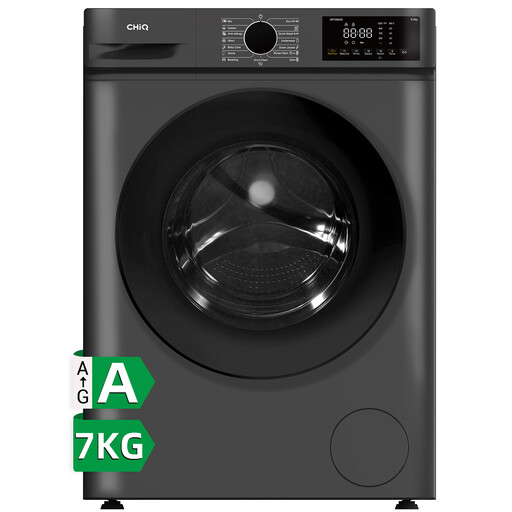 Image unavailable
CHiQ JW75883G, 7 kg front-loading washing machine
If depth is your main constraint, compare this front-loader’s overall dimensions with your alcove, then allow for the door to open. The product details list a 7 kg capacity and a spin speed of 1,200 rpm; also check the width and delivery route.
View on Joybuy
Frequently asked questions
When should you choose a top-loader rather than a front-loader?
Consider a top-loader if width is your main constraint: the French National Consumer Institute says this format is commonly 40 to 45 cm wide. However, you’ll need room to open the lid above the machine, so it won’t work under a worktop that blocks access.
Is a slim front-loader suitable for a narrow alcove?
Generally not if the alcove is only 40 to 45 cm wide. UFC-Que Choisir explains that slim front-loaders mainly reduce depth while remaining close to 60 cm wide. Check the specific model’s dimensions rather than relying on the name of its range.
What should you measure before ordering?
Measure the space’s width, depth and height, as well as the route to it. Then allow for the space needed in front of a door or above a lid, and check the exact model’s instructions for its connections and installation requirements.
What should you compare once you’ve chosen a format?
Compare the capacity with your household’s laundry loads, then check the energy, water and noise information on the label. Noise deserves particular attention if the machine is near a living area. Also check the repairability rating shown for the models you’re considering.


