People looking for skimmed milk
You want cow’s milk for coffee, cereal or brunch recipes, with a fat content that meets the skimmed category. The DGCCRF sets the maximum at 0.5% by mass.


For brunch, choose skimmed milk if your priority is to stay within the category containing no more than 0.5% fat by mass, according to the DGCCRF. Semi-skimmed is suitable if you’re happy with a higher fat content. If you’re also looking for a lactose-free option, check for that claim separately. Finally, choose the number of cartons to suit the amount you’ll need, and follow the storage instructions after opening.
You want cow’s milk for coffee, cereal or brunch recipes, with a fat content that meets the skimmed category. The DGCCRF sets the maximum at 0.5% by mass.
You’re considering milk for a range of dishes and can choose semi-skimmed if staying within the skimmed category isn’t essential.
You want to check the lactose content as well as the fat content: the word ‘skimmed’ alone doesn’t tell you whether a milk is lactose-free.
First decide whether the milk needs to be strictly skimmed, then check the lactose content and the quantity you’ll need separately. According to the DGCCRF, skimmed milk contains no more than 0.5% fat by mass, compared with 1.50% to 1.80% for semi-skimmed milk.
| Criteria | What to check | Who is it for? |
|---|---|---|
| Skimmed category | The ‘skimmed milk’ description and the ‘fat’ figure in the nutritional information. | If you want to serve milk that meets the skimmed category, the fat threshold comes before other criteria; around 42% of consumers would make it their priority. |
| Brunch uses | The milk category and its fat content, particularly if you’re considering semi-skimmed. | If you’re planning to serve milk with coffee and cereal and use it in recipes, you may be happy with semi-skimmed rather than insisting on skimmed; around 25% of consumers would prioritise this flexibility. |
| Lactose | An explicit ‘lactose-free’ claim and the stated lactose content, as well as the skimmed category if that matters to you. | If lactose content guides your choice, the word ‘skimmed’ alone won’t meet your needs; around 17% of consumers would make lactose their main criterion. |
| Pack size | The total volume, the date shown and the storage instructions after opening. | For a one-off brunch, you’ll want enough milk without opening more cartons than necessary; around 16% of consumers would put pack size and the risk of waste first. |
The skimmed category refers to fat content, not lactose content. Standard skimmed milk may therefore not be suitable if you’re looking for lactose-free milk.
Look for a ‘lactose-free’ claim and the stated lactose content, then check the milk category separately.
According to the DGCCRF, semi-skimmed milk contains 1.50% to 1.80% fat by mass, compared with a maximum of 0.5% for skimmed milk.
Read the milk description and compare the fat figures in the nutritional information.
The storage life of unopened UHT milk doesn’t determine how long you can use a carton once it’s been opened.
Estimate how much you’ll need and check the after-opening instructions for each product you buy.
Cartons left open beyond the amount you use can lead to waste.
Lactel offers a range of UHT skimmed milk, including a version enriched with vitamin D and an organic option.
GrandLait semi-skimmed and Candia+ lactose-free skimmed milk meet two different needs.
The product reviewed is sterilised UHT skimmed milk.
Auchan’s range includes UHT skimmed milk in a 1 L carton.
The Delisse product reviewed is semi-skimmed milk in a pack of 6 × 1 L.
This product suits anyone looking for a multipack of skimmed milk for brunch. If lactose is also a consideration, check the claim on the packaging before you buy.
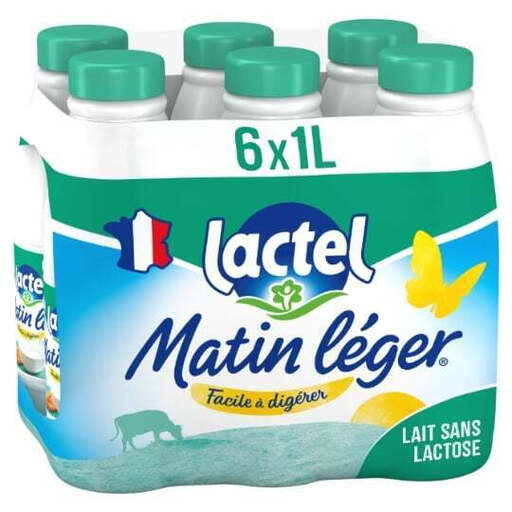 Image unavailable
If you want skimmed milk for brunch, check that six 1 L cartons are the right amount for your plans, and follow the storage instructions after opening.
In France, skimmed milk contains no more than 0.5% fat by mass, according to the DGCCRF. Semi-skimmed milk contains between 1.50% and 1.80% by mass.
No: ‘skimmed’ describes its fat content, not its lactose content. If lactose matters to you, look for an explicit ‘lactose-free’ claim and check the stated figure for the product you buy.
Once opened, follow the instructions on the carton or bottle you’ve bought. Before opening, the Ministry of Agriculture says UHT milk can be stored at room temperature for up to three months. For some of its skimmed milk products, Lactel recommends refrigeration at a maximum of 6 °C and consumption within three days of opening.
No: a claim about lactose doesn’t mean that a milk is free from milk allergens. Check the ingredients list; the DGCCRF states that allergenic ingredients must be highlighted on the label.