Skimmed milk loyalists
You want to stick with this category of milk, even if another option seems better suited to the texture you’re looking for in a recipe.


If you want to stick with skimmed milk for Sunday lunch, check the product description first: according to the DGCCRF, this category contains no more than 0.5% fat in France. If the texture of your recipe is your priority, compare it with the result you’d get using semi-skimmed milk, which belongs to a different category. Terms such as ‘matured’ or ‘aged’ are not established criteria for choosing skimmed milk.
You want to stick with this category of milk, even if another option seems better suited to the texture you’re looking for in a recipe.
You need to decide whether skimmed milk will work in your recipe, or whether the texture you want makes it worth comparing another category of milk.
You want both ‘skimmed’ and ‘lactose-free’ on the label, and then to choose a size that suits how you’ll use the milk after opening.
When shopping for Sunday lunch, first decide whether it’s essential to stick with skimmed milk. Then compare the details of the specific product, especially whether it’s lactose-free and what the instructions say about storing it after opening.
| Criterion | What to check | Who it matters to |
|---|---|---|
| Skimmed milk category | Check the product description ‘skimmed milk’ and its fat content. According to the DGCCRF, this category contains no more than 0.5% fat in France. | I want to buy skimmed milk for Sunday lunch without switching to a higher-fat category; around 46% of consumers put this first on their list of criteria. |
| Lactose-free option | Check that the product you choose is labelled lactose-free, as well as its size and the instructions for storage after opening. | If the milk also needs to be lactose-free, I can’t rely on the word ‘skimmed’ alone. This is a priority for around 27% of consumers. |
| Recipe texture | If you’re considering a change to get the texture you want, compare skimmed and semi-skimmed milk, taking their fat content into account. | For a family recipe, I’d rather decide whether switching categories will give me the result I want than look for supposedly ‘aged’ milk; around 27% of consumers prioritise this culinary choice. |
According to the DGCCRF, semi-skimmed and skimmed milk belong to separate categories. In France, semi-skimmed milk contains between 1.50% and 1.80% fat, while skimmed milk contains no more than 0.5%.
If your recipe leads you to consider semi-skimmed milk, make it a deliberate choice to switch categories rather than treating it as a variety of skimmed milk.
‘Skimmed’ and ‘lactose-free’ describe two different characteristics. For example, the product details for Lactel Matin Léger Bio écrémé state that it contains less than 0.1 g of lactose per 100 ml; this does not apply to all skimmed milk products.
Check the lactose-free claim and the stated lactose content on the product you choose, then follow its storage instructions after opening.
Its product information lets you compare organic UHT skimmed milk with a lactose-free skimmed version from the Matin Léger Bio range.
The retailer’s range of skimmed milk includes products from its Classic’, Extra and organic ranges.
Candia+ Lait Écrémé Sans Lactose is included in the range of skimmed milk presented by Carrefour.
The Auchan Bio product covered here is organic UHT skimmed milk, collected and packaged in France in a 1 L carton.
This product suits anyone looking for lactose-free skimmed milk for Sunday lunch. Consider whether the 6 × 1 L multipack matches the amount you’re planning to use.
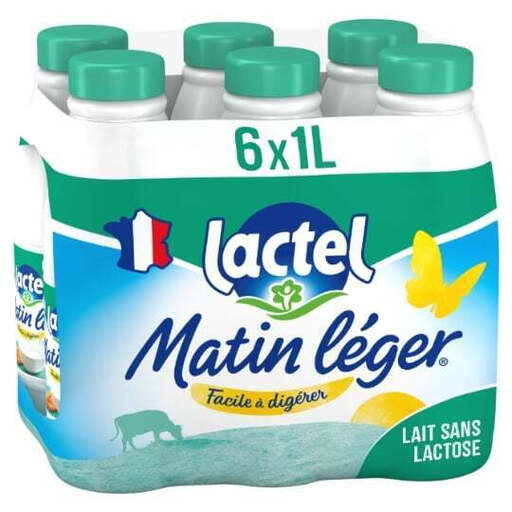 Image unavailable
Worth considering if you’re looking for both skimmed and lactose-free milk for your meal.
UHT milk in a pack of 6 × 1 L. According to the product details, refrigerate each carton after opening and use within 3 days.
According to the DGCCRF, ‘skimmed milk’ contains no more than 0.5% fat. Check the product description: semi-skimmed milk belongs to a different category, with a fat content of between 1.50% and 1.80%.
Follow the storage time and temperature shown on the product you buy. Lactel says to keep its Bio écrémé milk and Matin Léger Bio écrémé version refrigerated for 3 days, while the Auchan Bio écrémé product details state that it keeps for up to 5 days at a maximum of +6 °C.
No. The lactose-free label addresses a specific requirement you may want to cater for at mealtimes; it doesn’t replace choosing the right size or category of milk for your recipe. The product details for Lactel Matin Léger Bio écrémé state that this product contains less than 0.1 g of lactose per 100 ml.