Those keeping an eye on fat content
Whether you’re having cereal or making a hot chocolate for an afternoon snack, you’re looking specifically for skimmed rather than semi-skimmed milk.


For an afternoon snack, choose skimmed milk if keeping fat content low is your priority: France’s DGCCRF states that this category contains no more than 0.5% fat. If taste matters most, compare it with semi-skimmed milk, bearing in mind its higher fat content. If lactose is a factor in your choice, look separately for a product labelled ‘lactose-free’.
Whether you’re having cereal or making a hot chocolate for an afternoon snack, you’re looking specifically for skimmed rather than semi-skimmed milk.
You need your chosen product to be clearly labelled ‘lactose-free’. ‘Skimmed’ refers to the fat content, not the lactose.
If you only have milk with a snack occasionally, or prepare snacks away from home, the size of each container and the storage instructions after opening can help you decide.
| Criterion | What to check | Who is it for? |
|---|---|---|
| Fat content | Compare the ‘skimmed’ or ‘semi-skimmed’ description with the fat content shown in the nutritional information. In France, the DGCCRF states a maximum of 0.5% for skimmed milk and 1.50% to 1.80% for semi-skimmed milk. | If I mainly want to limit the fat in the milk served with an afternoon snack, this is what helps me choose between the two categories. Around 45% of consumers would put this need first. |
| Lactose | Look for the words ‘lactose-free’ on the exact product variant and check its ingredients; skimming tells you nothing about lactose. | If I want to prepare an afternoon snack with lactose-free milk, I can’t rely on the word ‘skimmed’ alone. Around 33% of consumers would put the absence of lactose first. |
| Pack size and storage | Choose a volume that suits how much you use, and read the storage instructions on the container after opening. | If I only use milk for the occasional snack, a container that’s too large could be left open beyond the recommended period. Around 22% of consumers would put finding the right pack size first. |
‘Skimmed’ describes the fat content. A lactose-free product will be labelled separately.
If this is essential to your choice, check for the words ‘lactose-free’ and look at the ingredients of the exact product variant.
These categories have different fat contents. In France, the DGCCRF states a maximum of 0.5% for skimmed milk, compared with 1.50% to 1.80% for semi-skimmed milk.
Read the milk description and the ‘fat’ line in the nutritional information, rather than judging by the appearance of the pack.
A multipack or large container may hold more than you need for occasional snacks. Storage instructions after opening vary by product.
Check the volume of each container and follow the storage advice on its packaging.
Any milk left over beyond the recommended period may end up being thrown away.
On their own, these words don’t tell you the category, ingredients or taste of a liquid skimmed milk.
To compare products for an afternoon snack, look at their descriptions, nutritional information, any ‘lactose-free’ labelling and pack sizes.
The range includes organic UHT skimmed milk and a skimmed Matin Léger product labelled ‘lactose-free’.
GrandLait semi-skimmed milk can be a useful point of comparison if you’re deciding between the two categories for an afternoon snack.
Its skimmed milk range lets you compare own-brand products with national brands.
This multipack of skimmed milk is a good fit if you’re looking for 1 L cartons for regular afternoon snacks. If you specifically need a lactose-free product, check the label on the one you choose.
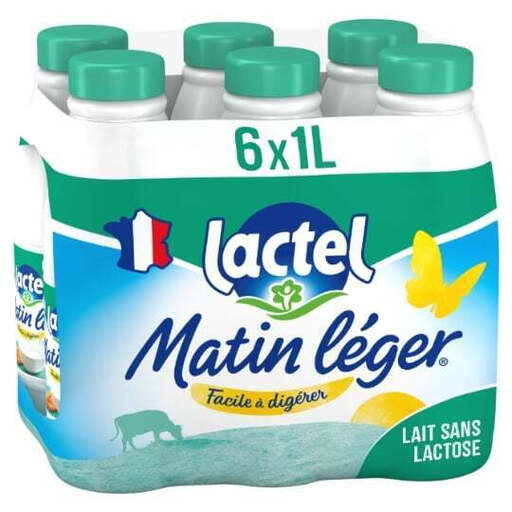 Image unavailable
For regular afternoon snacks, this multipack contains six 1 L cartons of skimmed milk. If lactose-free is important to you, check the label on the variant you choose, as well as its storage instructions after opening.
The main difference is the fat content. In France, the DGCCRF states a maximum of 0.5% for skimmed milk and 1.50% to 1.80% for semi-skimmed milk. For an afternoon snack, choose the category you’re looking for and check the nutritional information for the product.
No. Skimming affects the fat content, not the lactose. If you’re looking for a lactose-free product, check that it’s clearly labelled as such. Lactel states that its Matin Léger skimmed milk contains less than 0.1 g of lactose per 100 ml.
Follow the storage period and temperature shown on the packaging of the product you buy. For example, Lactel says its organic skimmed milk can be kept refrigerated for 3 days after opening. Don’t automatically apply this advice to other milk.
Start by checking the milk description, then look at the ingredients and nutritional information. The DGCCRF highlights the importance of this information for pre-packed foods in France. Complete your comparison by checking the pack size and storage advice for the product you choose.