You’re following a recipe that calls for skimmed milk
If you want to stick to the specified ingredient, check that the packaging says “skimmed milk” rather than relying on a general suggestion that it’s light.


If your recipe calls for skimmed milk, start by choosing a product labelled as such. In France, the DGCCRF sets a maximum fat content of 0.5% (m/m) for this category. The word “mature” alone won’t tell you how your cake will turn out. Only consider semi-skimmed or whole milk if the recipe allows the substitution, then choose a pack size that suits the amount you’ll use.
If you want to stick to the specified ingredient, check that the packaging says “skimmed milk” rather than relying on a general suggestion that it’s light.
If the recipe allows you to use a different type of milk, compare the fat content of skimmed, semi-skimmed and whole milk. Switching categories changes the ingredient, but doesn’t guarantee a particular texture or flavour.
If you’re sharing the cake with someone who avoids lactose, check the relevant label and the ingredients list. If you only use a little milk, compare pack sizes too, along with the instructions for use after opening.
Start with the type of milk specified in the recipe. Then check for any lactose-related requirements, followed by how much you’ll be able to use once the pack is open.
| Criteria | What to check | Who it matters to |
|---|---|---|
| Stick to skimmed milk | Look for the label “skimmed milk”. In France, the DGCCRF sets a maximum fat content of 0.5% (m/m) for this category. | When a recipe specifies skimmed milk, I want to buy that ingredient without accidentally substituting something else. Around 40% of consumers prioritise this. |
| Consider a different fat content | Check that the recipe allows a substitution, then compare the fat content shown per 100 ml. | If a recipe is flexible, I can try semi-skimmed or whole milk, knowing that I’m changing the ingredient and without assuming what the result will be. This is the top priority for around 30% of consumers. |
| Choose lactose-free skimmed milk | Check for the “lactose-free” label, the ingredients list and the milk allergen. “Lactose-free” does not mean “milk-free”. | If the cake is for someone who avoids lactose, I want to use skimmed milk while taking this requirement into account. Around 20% of consumers make this their top priority. |
| Avoid leftovers | Compare the pack size with the amount needed for the cake, and read the storage instructions for after opening. | When I’m only making a cake now and then, I prefer a pack size I can use within the time stated on the packaging. Pack size is the top priority for around 10% of consumers. |
These labels refer to different fat contents. In France, the DGCCRF sets a maximum of 0.5% (m/m) for skimmed milk and a range of 1.50% to 1.80% (m/m) for semi-skimmed milk.
If the recipe calls for skimmed milk, stick with that category. Only switch to a different type if the recipe allows it.
This word doesn’t tell you the type of milk, its fat content or how it will affect a cake.
Start with the type specified in the recipe, then compare the nutritional information and pack size shown on the product.
The ingredients listed for Lactel Matin Léger skimmed milk and Candia+ lactose-free skimmed milk include milk. So the lactose-free label doesn’t address a milk allergy.
Always check the ingredients and allergens if the cake is for someone with an allergy or intolerance.
How long a product can be used after opening depends on the product. The guidance given for some Lactel products is to keep them chilled and use within three days, while the Candia GrandLait semi-skimmed product considered here has a four-day limit.
Choose a pack size to suit the recipe and any other planned uses, then follow the instructions on the packaging you buy.
Lactel’s range lets you compare organic UHT skimmed milk with Matin Léger lactose-free skimmed milk.
GrandLait semi-skimmed and whole milk are useful comparisons if your recipe allows a different type of milk. Candia+ also offers a lactose-free skimmed milk.
E.Leclerc features a 1 L carton of Delisse skimmed milk among its products.
For a recipe that calls for skimmed milk, and if you need a lactose-free option, this pack of six 1 L cartons is best suited to you if you expect to use several cartons. Check the stated shelf life after opening each one.
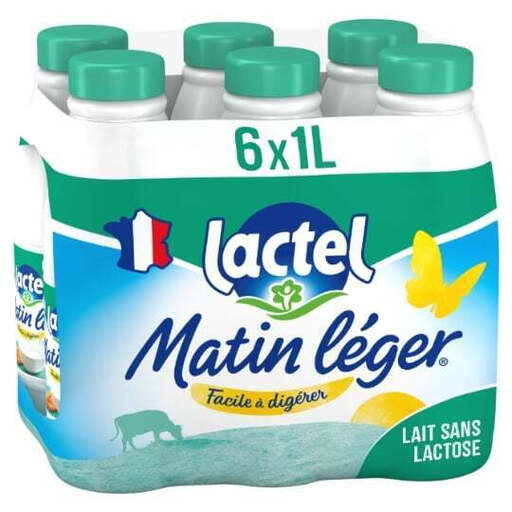 Image unavailable
Worth considering if your recipe calls for skimmed milk and you’re looking for the lactose-free Matin Léger range. The pack contains six 1 L cartons, so choose it based on how much you expect to use.
For Matin Léger skimmed milk, Lactel lists less than 0.1 g of lactose per 100 ml and names milk and lactase in the ingredients. Lactose-free milk still contains milk.
Look for “skimmed milk” on the packaging. In France, the DGCCRF states that this category has a maximum fat content of 0.5% (m/m); semi-skimmed and whole milk have different labels.
The word “mature” alone won’t tell you how a cake will taste. Start by choosing the type of milk specified in the recipe. If the recipe can be adapted, you could consider semi-skimmed or whole milk, without assuming the result will be the same.
No. The ingredients lists shown for Lactel Matin Léger skimmed milk and Candia+ lactose-free skimmed milk contain milk. If someone eating the cake needs to avoid milk itself, check the ingredients and allergens rather than relying on the “lactose-free” label.
Compare the amount required by the recipe with the carton size and any other ways you plan to use the milk. The time you can keep it after opening varies by product, so follow the storage instructions on the packaging you buy.