Home bakers keeping an eye on fat content
You’re looking for milk to use in your baking and want to compare its fat content without routinely changing the other ingredients in the recipe.


For home baking, choose skimmed milk if you want to add liquid milk while keeping fat content low. Semi-skimmed milk is another option if your recipe or personal preference calls for more fat. Neither choice on its own guarantees a particular result or a flavour children will enjoy. So, the word “mild” is no substitute for reading the label or trying it in your recipe.
You’re looking for milk to use in your baking and want to compare its fat content without routinely changing the other ingredients in the recipe.
You’re baking for children or for a household that is sensitive to the taste of milk. A label such as “mild” can’t predict whether everyone will enjoy the result: the flavour depends on the product and recipe you choose.
You need to check the lactose content of the milk you use in cooking. This is separate from the fat content: Lactel’s Matin Léger Bio is lactose-free, but contains 1.2% fat and is not skimmed milk.
For home baking, start with the milk specified in the recipe, then compare the product description, nutritional information per 100 ml and pack size you’ll be able to use after opening.
| Criterion | What to check | Who is it for? |
|---|---|---|
| Fat content | Check that it is described as “skimmed milk” and look at the value per 100 ml. Lactel lists 0.1 g for its Bio skimmed milk; E.Leclerc lists 0.2 g for its Délisse skimmed milk. | If you want to keep liquid milk in your mixture while prioritising a low fat content, this comes ahead of the other criteria. Around 31% of consumers would prioritise it. |
| Recipe requirements | Check whether the recipe calls for skimmed or semi-skimmed milk, and compare their values per 100 ml without assuming that this difference alone will determine the result. | If you want to use milk with a higher fat content in your recipe, you may want to consider semi-skimmed. This would be the main requirement for around 31% of consumers. |
| Pack size and storage | Choose a volume that suits your batches and check the product’s storage instructions after opening. Lactel says to keep its Bio skimmed milk at no more than +6 °C and use it within three days. | If you only bake occasionally, you may prefer not to open more milk than you can use within the stated time. Nearly 23% of consumers would put this need first. |
| Lactose and ingredients | Check the product’s lactose information, fat content, ingredients and allergens separately. | If lactose content determines your choice, you can’t rely on the word “skimmed” alone; around 15% of consumers would make this their priority. |
The term doesn’t tell you how the finished bake will taste. Nor does it provide information about the milk’s fat content, ingredients or allergens.
Check the label of the specific product and try it in your recipe if its flavour is important to your household.
Lactel’s lactose-free Matin Léger Bio contains milk and has a fat content of 1.2%. A reduced lactose content doesn’t mean it’s free from milk proteins.
Check the lactose information, fat content, ingredients and allergens separately. Don’t choose lactose-free milk as a substitute for a dairy-free product.
Storage instructions vary by product: Lactel says to keep its Bio skimmed milk refrigerated at no more than +6 °C and use it within three days of opening, while Auchan says its 6 × 50 cl semi-skimmed milk keeps for four days at this temperature.
Choose an opened volume that suits your baking plans and follow the instructions on each pack.
The range includes Bio skimmed milk, as well as separate products such as semi-skimmed and lactose-free milk.
The Auchan range includes Candia+ skimmed lactose-free milk in a pack of 6 × 1 L.
The retailer lists Lactel Bio skimmed milk, making it useful for checking the details of this product.
E.Leclerc’s Délisse skimmed milk is available in a pack of 6 × 1 L.
The retailer offers UHT skimmed milk in 1 L packs or packs of 6 × 1 L, as well as separate semi-skimmed products.
These two products suit different uses: liquid skimmed milk that you can measure straight into a recipe, and skimmed milk powder to use according to the preparation instructions. The product descriptions don’t predict how your finished bake will taste.
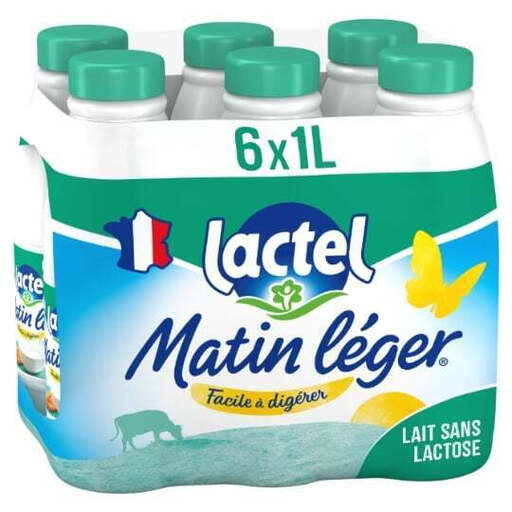 Image unavailable
Consider this if your recipe calls for liquid skimmed milk. The pack contains 6 × 1 L cartons. If lactose or allergens matter to you, check the information on the specific product.
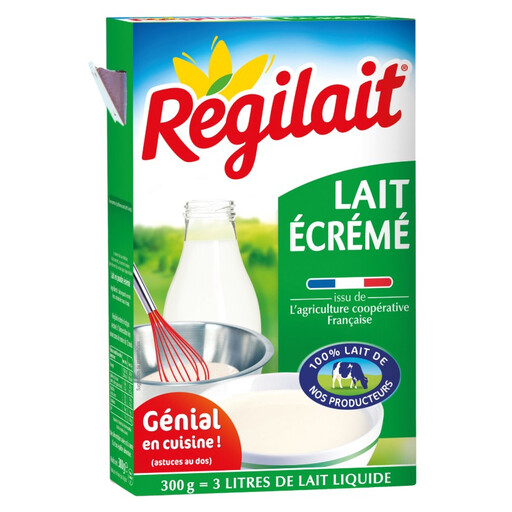 Image unavailable
Consider this if your recipe allows for milk powder. This 300 g product isn’t liquid milk that’s ready to measure, so check the dosage instructions before using it in place of the milk specified in your recipe.
No. Choose it if you want liquid milk with a low fat content and it suits the recipe. For comparison, Lactel and E.Leclerc list 0.1 to 0.2 g of fat per 100 ml for the skimmed milk products mentioned here; the semi-skimmed products mentioned by Lactel and Auchan contain 1.5 g and 1.6 g per 100 ml respectively. These values alone aren’t enough to predict how a bake will turn out.
No, the label doesn’t guarantee that a child will enjoy the taste of the milk or the finished bake. Check the product’s ingredients and allergens, then try it in the recipe you have in mind rather than judging the flavour by a single word.
Follow the storage time and temperature stated for the product you buy. For its Bio skimmed milk, Lactel says to keep it refrigerated at no more than +6 °C and use it within three days of opening; Auchan says its 6 × 50 cl semi-skimmed milk keeps for four days at no more than +6 °C.
No. A statement about lactose doesn’t mean the product is dairy-free. Lactel lists milk and lactase in the ingredients of its lactose-free Matin Léger Bio. If you have questions about allergens, check the information for the specific product rather than relying on the words “lactose-free” alone.