
Livraison le jour même ou le lendemain

Qualité garantie

Débloquez vos offres de bienvenue: Livraison GRATUITE | Jusqu'à -80 % | 30 jours d'essai gratuits à JoyPlus
Téléchargez l'application
Remote work, freelancing, studying… long hours spent sitting in front of a screen have become our daily reality. The challenge? Maintaining good posture and staying dynamic from morning to night. This is where a well-designed ergonomic workstation becomes a game-changer. At the top of the list, the sit-stand desk stands out as the ideal solution for alternating positions and moving more often.
But with an overwhelming number of options on the market, how do you find your way? This guide is here to provide clarity, help you identify the criteria that truly matter, and introduce our selection of the best models, whether you need a large 160 cm desk or an even more generous surface.
Before you take the plunge, let's review a few essential technical points. They will ensure your future desk fits perfectly into your space and adapts to your way of working.
The main difference between models lies in the adjustment mechanism. An electric desk offers unparalleled ease of use: a simple press of a button is all it takes to adjust the desktop's height. The most advanced models include a position memory system, allowing you to save your preferred heights (one for sitting, one for standing) and return to them in an instant. A real daily advantage for hassle-free use.
The size of the desktop is obviously a key criterion. To be comfortable, especially if you're juggling multiple monitors, a laptop, and files, a top that's at least 140 cm wide is a good starting point. A large 160 cm or 180 cm desk will offer you premium freedom for movement and organisation, transforming your office corner into a true command centre. Don't forget to take out the measuring tape to ensure the desk will fit without cluttering the room.
An adjustable desk, especially in its highest position, must be rock-solid. The sturdiness of the frame, most often made of steel, is therefore a non-negotiable criterion. Remember to check the supported maximum load capacity: it must be sufficient to safely accommodate your entire setup (computers, monitors, stands, etc.). The presence of adjustable feet is also a plus to compensate for minor floor irregularities and guarantee perfect stability.
Now let's get down to business with a few models that caught our attention for their design, features, and value, specifically chosen for today's remote work environment.
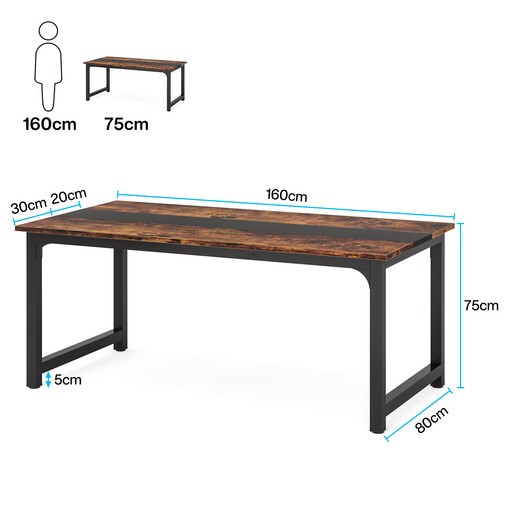
What sets it apart While it's not height-adjustable, this model more than compensates with its massive surface and exceptional sturdiness. Its industrial-style desk design, with a vintage brown top and black steel frame, adds character to most interiors. It's the perfect foundation for building a durable, ergonomic setup.
Highlights
Who is it for? Professionals and creatives who need a very large, stable work surface and prioritise sturdiness and design over height adjustment. It also makes an excellent meeting table or a large shared workstation.
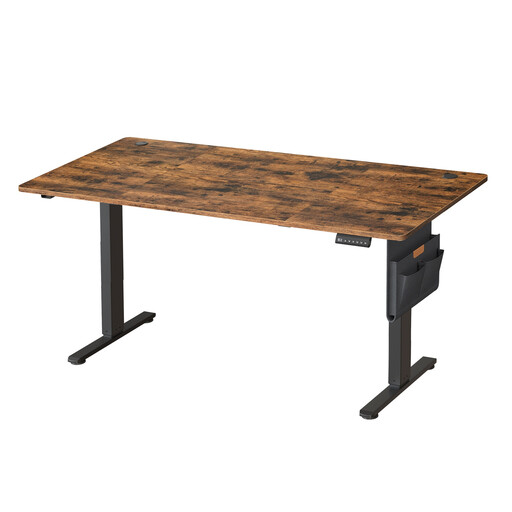
What sets it apart This electric desk combines a very large desktop with the flexibility of height adjustment. Switch from sitting to standing smoothly thanks to its quiet motor. It also packs in thoughtful features for intensive use.
Highlights
Who is it for? Demanding users who want the ultimate in comfort: an XXL, fully motorised ergonomic workstation. Ideal for those who juggle multiple peripherals and refuse to compromise on ergonomics.
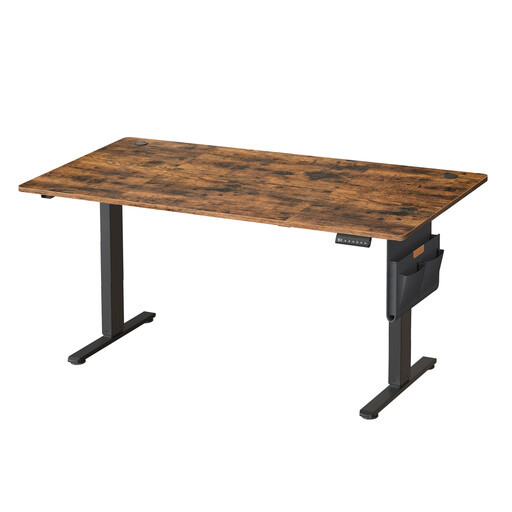
What sets it apart This model represents the perfect balance. It packs all the essential features of a modern sit-stand desk into a large 160 cm desk format that's easier to fit into most interiors. Its discreet motor and memory function make it a great daily companion.
Highlights
Who is it for? This is the sensible choice for most remote workers and students. It checks all the boxes: a functional height-adjustable desk that's well-sized and equipped with essential comfort options like position memory.
Did the industrial style of our selection catch your eye, but you'd like to explore other options for your workspace? To discover a wider range of models with timeless charm, take a look at our collection of vintage desks.
Discover our selection of vintage desks
In a seated position, your forearms should rest flat on the desk, forming a 90-degree angle with your upper arms, and your feet should be flat on the floor. In a standing position, the same 90-degree elbow angle rule applies. The whole point of a desk with position memory is to be able to save these two ideal heights and switch between them without a second thought.
Recent models are designed to be particularly discreet. The motor noise is generally very low (often under 50 dB), which is equivalent to the whisper of a quiet conversation. In other words, it won't be the thing that breaks your concentration while you work.
The load capacity varies greatly from one model to another, ranging from 50 kg for the lightest to over 100 kg for the most robust. In our selection, the electric versions support 70 kg, while the fixed model goes up to 400 kg. Be sure to check this specification to ensure it's compatible with the weight of all your equipment (monitors, PC tower, etc.).