When choosing soup as part of managing diabetes, compare the carbohydrates, sugars and salt per 100 ml, then calculate how much you’ll have for the amount you plan to drink. Assurance Maladie recommends taking the quantity actually consumed into account. A single-serve carton or sachet can help you decide on a portion, but the packaging doesn’t tell you whether the recipe meets your needs. If you’re specifically looking for a single-serve metal tin, check its label and volume rather than assuming it has the same characteristics as a carton.
Who are these criteria for?
People who track carbohydrates per portion
If you count the carbohydrates in what you eat, the amount you pour into your bowl matters just as much as the figures shown per 100 ml. Assurance Maladie advises relating the nutritional information to the amount actually consumed.
People keeping an eye on salt
If salt is one of your dietary considerations, compare the amount per portion rather than relying on a claim such as “vegetables” or “single-serve”. Manger Bouger recommends that adults limit their salt intake.
People looking for a portion with no leftovers
A 30 cl carton or a sachet made up with 200 ml of water lets you plan a set amount. Auchan lists these formats for different Liebig and Royco recipes, while Carrefour offers a Carrefour Bio soup in two 30 cl cartons. None of these packs is a single-serve metal tin.
What should you compare before buying?
Start with the recipe and the amount you plan to drink, then choose packaging that suits how you’ll serve and store the soup. The DGCCRF says that nutritional values for prepacked foods are given per 100 g or 100 ml, making it easier to compare labels on a like-for-like basis.
Single-serve carton
Worth considering: if you want to pour a set amount without having to make up the soup. Auchan and Carrefour list recipes in packs of two 30 cl cartons.
Bear in mind: a 30 cl carton is not a metal tin, and its size doesn’t mean you can skip checking the values for the recipe you choose.
Instant soup sachet
Worth considering: if you prefer to make up a cup when you want one; the Royco pumpkin sachet listed by Auchan is made with 200 ml of water.
Bear in mind: adding water determines the volume of the prepared soup, but you’ll need to check the sachet’s ingredients to find out how much carbohydrate, sugar and salt are in your cup.
Family-size carton
Worth considering: if you can measure out each serving or share the contents. Carrefour, for example, lists a Knorr soup in a 1 L carton.
Bear in mind: the pack doesn’t define the amount in each bowl, so also follow the storage instructions on the carton once it’s open.
| Criteria |
What to check |
Who it matters to |
| Carbohydrates and sugars |
Check the values per 100 ml and calculate them for the amount you’ll actually serve; also read the recipe’s ingredients list. |
If I track carbohydrates during a meal, I want to know what’s in my bowl, whether it comes from a small carton or a larger pack. Around 42% of consumers are said to rank this per-portion calculation as their main concern. |
| Salt |
Compare the amount of salt per 100 ml, then per planned portion, even if the packaging highlights vegetables or a reduced-salt recipe. |
If I need to watch the salt in my diet, a small cup isn’t enough to help me judge the recipe. Keeping salt in check is said to be the main priority for around 33% of consumers. |
| Format and storage |
Check the volume of each unit, the preparation instructions and, for an opened carton, the stated storage time. |
If I’m having soup on my own, I want an amount I can prepare or use without leaving any over. This is said to be the top selection criterion for around 25% of consumers. |
Mistakes to avoid
-
Taking the per-100 ml figure as the amount in your bowl
Values per 100 ml make it easier to compare recipes, but they don’t tell you how much is in a 30 cl carton or the amount you pour from a 1 L carton. Assurance Maladie recommends calculating them for what you actually consume.
Check how much you’re going to drink before using the nutritional values in your food diary.
-
Assuming “single-serve” means “low in salt”
A small pack defines an amount, not the salt content of the recipe. Salt can still be an important factor in your choice, even if you’re only having one cup.
Compare the salt figures for the recipes you’re considering, both per 100 ml and for the amount prepared or served.
-
Opening a large carton without planning what to do with the rest
A family-size carton can provide several bowls, but you’ll need to measure each portion and consider how to store what’s left.
Check the instructions for after opening before you buy. A Liebig recipe listed by Auchan should be refrigerated and consumed within 48 h of opening, but always follow the instructions on the product you buy.
-
Guessing the ingredients from the soup’s name
The words “vegetable soup” don’t give you the full recipe or rule out ingredients you need to look out for.
Check the ingredients list and allergen information on the exact pack. The DGCCRF says allergenic ingredients must be highlighted on the labels of prepacked foods.
Brands to consider by format
Liebig
Liquid soups in cartons: Auchan lists a 12-vegetable recipe in a pack of two 30 cl cartons, as well as a separate reduced-salt recipe.
- The 2 x 30 cl format makes it easy to see the volume of each carton.
- The “reduced salt” claim on another recipe doesn’t tell you how much salt is in the product you’re buying, so check its label.
Royco
Instant soups in sachets. The pumpkin and crouton recipe listed by Auchan is made with 200 ml of water.
- Making it up when you want it lets you plan the volume of your cup.
- Prepare the sachet according to its instructions, and check the nutritional values and ingredients for the specific recipe.
Carrefour Bio
Carrefour lists an organic, velvety seven-vegetable soup in a pack of two 30 cl cartons.
- Each carton contains a clearly defined volume of 30 cl.
- Organic status doesn’t replace the need to compare the carbohydrates, sugars, salt and ingredients in this recipe.
Knorr
Carrefour lists a liquid nine-vegetable soup in a 1 L carton. It’s a format to serve from, rather than an individual portion.
- You can divide the contents into several measured servings.
- You’ll need to measure how much you pour into each bowl and follow the storage instructions after opening.
A single-serve carton option on Joybuy
This Liebig soup is the “single-serve carton” option: the pack contains two 30 cl cartons. If you’re specifically looking for a single-serve metal tin, don’t confuse the two types of packaging.
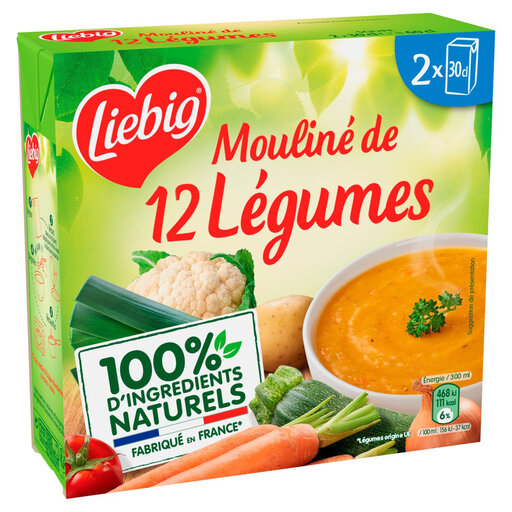 Image unavailable
Liebig 12-vegetable soup, 2 x 30 cl
Worth considering if you want to serve a set amount without having to make up the soup. Compare the carbohydrates, sugars and salt in the recipe for the amount you plan to drink.
Pack: two 30 cl cartons, not a single-serve metal tin.
View on Joybuy
Frequently asked questions
Which values should you check on soup if you’re tracking carbohydrates?
Check the carbohydrates and sugars per 100 ml, then calculate them for the amount you’re going to drink. Also check the salt and ingredients list. Assurance Maladie reminds consumers to consider nutritional information in relation to the amount actually consumed.
Is a single-serve sachet always a better choice than a large carton?
No. A sachet makes a set amount of soup, while a large carton lets you measure the portion you serve, but neither format tells you whether the recipe is right for you. For the Royco pumpkin sachet listed by Auchan, follow the instructions to make it up with 200 ml of water and check the product label to compare its nutritional values.
How long can you keep an opened carton of soup?
Follow the storage time and instructions on the carton you buy. For one Liebig recipe it lists, Auchan advises refrigerating the soup and consuming it within 48 h of opening. Don’t assume the same instructions apply to every soup.
Where can you check the allergens in prepacked soup?
Check the ingredients list for the exact recipe. The DGCCRF says allergenic ingredients must be highlighted for prepacked foods. The words “vegetable soup” aren’t enough to tell you whether those ingredients are present or absent.


