People eating alone during a short break
You’re looking for a single portion with reheating instructions that work with the appliance you have.


For a quick lunch on your own, choose a meal whose packaging states the number of portions, then check that its weight and reheating instructions suit your break and the appliance you have available. The word ‘individual’ alone doesn’t tell you how much you’re getting: check the ingredients too, and plan how you’ll transport the frozen meal to somewhere it can be stored.
You’re looking for a single portion with reheating instructions that work with the appliance you have.
You check the net weight and number of portions to tell a small tray from a meal meant for sharing.
You’ll need to read the ingredients, allergens and nutrition information for the exact product you choose. For pre-packed foods, the DGCCRF also reminds shoppers that allergens must be highlighted in the ingredients list.
For a quick lunch, start with the reheating method and ingredients, then compare the stated quantity with how much you plan to eat.
| What to check | Look for | Who it matters to |
|---|---|---|
| Reheating | Approved appliance, power setting, cooking time and preparation instructions on the packaging. | If I have a short break and only a microwave available, I want to be able to follow the meal’s instructions without switching appliances; around 36% of consumers would put this compatibility first. |
| Comparing portion sizes | The net weight and stated number of portions for each product. | When choosing between two trays, I want to know how much each contains; around 29% of consumers would make this their top priority. |
| Ingredients | The ingredients list, highlighted allergens and nutrition information for the exact product. | If I avoid certain ingredients, I need to be able to check the label of the meal I’m going to eat; around 21% of consumers would put this check ahead of the others. |
| Portion size for lunch | A ‘1 portion’ label and a quantity that suits your lunch. | I’m looking for a portion that suits me without having to share the meal or deal with leftovers; around 14% of consumers would put this fit first. |
Meals labelled as individual portions don’t all weigh the same, and similar products may be intended for two servings.
Check the number of portions and net weight of the exact product, then compare them with what you expect to eat for lunch.
To maintain the cold chain, Anses recommends buying frozen food at the end of your shop and using an insulated bag to carry it home.
Pick up your meal last and store it promptly, following the storage instructions on the packaging.
According to Anses, using too high a reheating power setting can increase the migration of substances from certain food packaging.
Follow the instructions for the exact product, including the appliance, power setting, cooking time and whether to remove the film lid.
Carrefour has a category for single-serve frozen ready meals, available for delivery and Drive collection.
Picard has a category dedicated to single-serve frozen meals.
Auchan lists frozen meals labelled as one portion in its individual meals category.
E.Leclerc has a category of Marque Repère individual meals.
Lidl has a category for frozen ready meals.
Aldi includes ready meals among its frozen products.
This frozen kimchi onigiri could be an option for a short break. Its product name states 100 g: check the net weight and number of units on the packaging before relying on it as your only lunch.
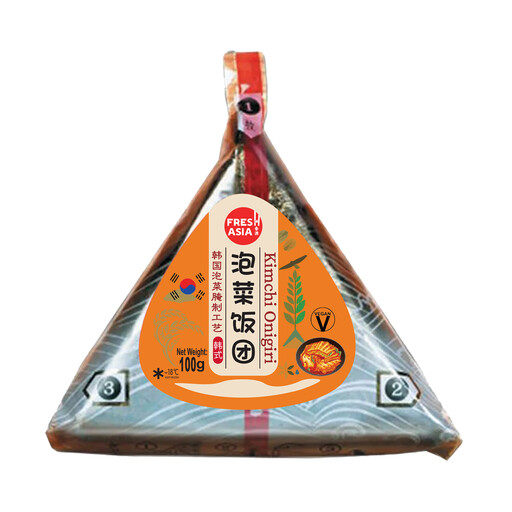 Image unavailable
Worth considering if you’re looking for an onigiri for a short break. Check the net weight, number of units, allergens and reheating instructions on the packaging; the 100 g product name alone doesn’t mean it will make a lunch on its own.
Look for the number of portions shown on the product and check its net weight. A ‘1 portion’ label tells you the intended serving size, but it’s up to you to decide whether it’s enough for your lunch.
Read the ingredients list and check the allergens highlighted on the packaging of the exact product. The DGCCRF notes that this information appears on pre-packed food labels; the name of a recipe isn’t a substitute for checking it.
No. Use the microwave and tray only as instructed on the packaging. Anses recommends following the manufacturer’s guidance, especially on power settings and cooking times.
Buy it at the end of your shop, carry it in an insulated bag and store it promptly as instructed on the packaging. These precautions follow Anses guidance on maintaining the cold chain.