
Livraison le jour même ou le lendemain

Qualité garantie

Débloquez vos offres de bienvenue: Livraison GRATUITE | Jusqu'à -80 % | 30 jours d'essai gratuits à JoyPlus
Téléchargez l'application
For any virtual racing enthusiast, ditching the controller for a sim racing wheel is a real game-changer. It's the promise of exponentially more immersion, more precise control, and truly authentic sensations. But when faced with intimidating technical jargon—"force feedback," "Direct Drive," "hybrid"—making the right choice when starting out in sim racing can quickly become a headache.
Our guide is here to demystify the topic. We will decode these concepts and present our selection of the best wheel and pedal bundles currently available, designed for all profiles and platforms. The goal: to give you all the keys to finding the equipment that perfectly matches your driving style and budget.
Before we put our selection under the microscope, here are the essential criteria to keep in mind to avoid making a mistake.
Force feedback is the heart of the engine. It's the technology that transmits every subtle detail of the track directly into your hands: the vibrations from the kerbs, a sudden loss of grip, the resistance of the wheel in a high-speed corner... There are two main technological approaches:
This is the non-negotiable starting point. A wheel designed for Xbox will not work on PlayStation, and vice-versa. While most console wheels are also PC-compatible, caution is advised. Scrupulously check that the model you have your eye on is compatible with your machine of choice, whether it's a PC wheel, a PS5 wheel, or an Xbox wheel.
A good wheel is nothing without a pedal set to match. Entry-level models often make do with two pedals (accelerator and brake). For greater realism, especially in pure simulation, a three-pedal set (with a clutch) is a must. Pay close attention to the sensor technology: magnetic pedals (using Hall effect sensors) are a real bonus. They guarantee far superior precision and durability compared to traditional potentiometers, which inevitably wear out over time.
We have selected three bundles that stand out for their philosophy and performance, to support both novice and seasoned drivers.
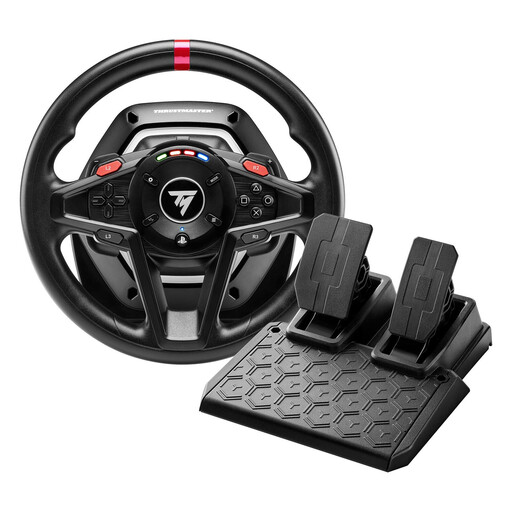
Why we recommend it: The T128-P is the perfect entry point into the world of force feedback. It relies on Thrustmaster's HYBRID DRIVE technology to deliver immersive sensations, light-years ahead of a standard controller.
Advantages:
Who is it for? Ideal for the driver on PlayStation (PS5/PS4) or PC who wants to get serious about sim racing without breaking the bank, while still enjoying the essential sensations of force feedback.
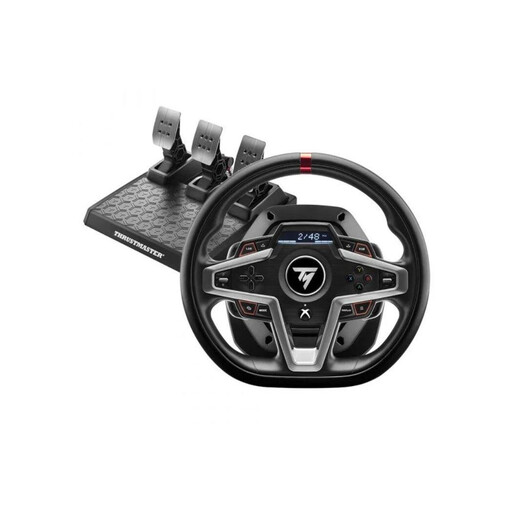
Why we recommend it: The Thrustmaster T248X steps things up a notch with its telemetry screen and customisable force feedback. It allows for extensive customisation directly from the wheel, a major plus for adjusting your strategy mid-race.
Advantages:
Who is it for? The Xbox or PC driver looking for versatile and high-performance equipment. Its integrated screen and on-the-fly adjustments will appeal to those who love to fine-tune their setup without heading back to the pits.
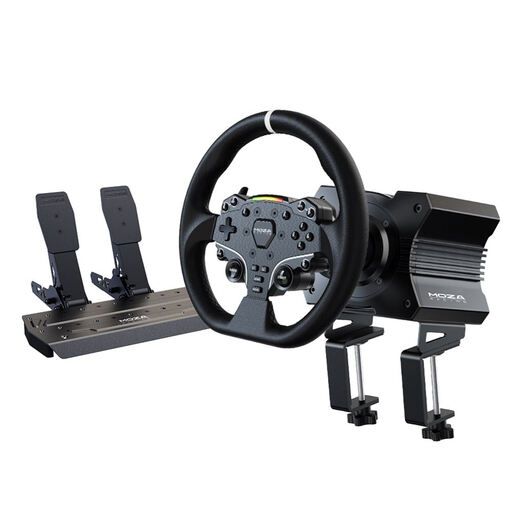
Why we recommend it: The Moza R5 bundle makes Direct Drive technology accessible. It offers a level of finesse and responsiveness beyond the reach of belt or gear-driven systems. It's a complete package for a no-compromise simulation experience on PC.
Advantages:
Who is it for? The discerning PC gamer, from beginner to intermediate, ready to invest in Direct Drive technology for maximum immersion and performance. The logical choice for anyone who takes sim racing seriously.
This selection is just a taste. To explore other models, compare brands, or find specific accessories, our full catalogue awaits you.
? Discover our complete range of PC wheels
To put it simply, a standard force feedback wheel uses a system of belts and/or gears to multiply the force of a small motor. A Direct Drive wheel has its rim attached directly to the shaft of a much larger and more powerful motor. The result: more direct, precise, and nuanced feedback, without the filtering or slight vagueness imposed by intermediate mechanisms.
Not at all. To begin, a sturdy desk is all you need. Most bundles, including those presented here, come with a robust clamping system that allows them to be mounted firmly. A cockpit becomes relevant if you step up to very powerful Direct Drive bases or high-pressure pedal sets (like Load Cell), as it guarantees rock-solid stability.
The honest answer? No, not magically. More powerful equipment won't suddenly give you the talent of a professional driver. However, it will provide two crucial things: consistency and more information. Good force feedback allows you to better feel the car's grip limit, correct a slide more instinctively, and be more precise with your lines. It's this consistency that, with practice, will help you shave off precious tenths of a second.