
Livraison le jour même ou le lendemain

Qualité garantie

Débloquez vos offres de bienvenue: Livraison GRATUITE | Jusqu'à -80 % | 30 jours d'essai gratuits à JoyPlus
Téléchargez l'application
With its near-luxurious glossy finish, Silk PLA filament is a star among 3D printing enthusiasts. Ideal for decorative pieces, visual prototypes, or figurines, it has the power to transform a mundane object into a show-stopping creation. But be warned: the market is saturated with unkept promises, and choosing the wrong spool often leads to failed prints, wasted time, and money down the drain.
I'm the Head of Product Recommendations at Joybuy, and my job is to do the legwork for you. Let's break down the pitfalls to avoid and the criteria that truly matter when choosing a shiny 3D filament that won't let you down.
Don't be dazzled by a vibrant colour in the product photo. Behind the promise can lie flaws capable of ruining your entire printing experience.
The "Shiny" Letdown and Visible Layer Lines: The #1 promise of silk-effect PLA is its lustre. Unfortunately, many low-end filaments use a cut-rate chemical formula. The result? An uneven shine depending on the viewing angle, highly visible layer lines that ruin the smooth effect, and compromised strength. If the additive responsible for the shine is poor quality, it can even weaken the bond between layers.
The Colour Lottery and the Nozzle-Clogging Nightmare: Be careful, the colour shown on the PLA spool doesn't always match the final result. The finish is highly dependent on extrusion temperature and printing speed. Worse still, a poorly wound filament or one with an inconsistent diameter is the #1 cause of nozzle jams (the dreaded clogging). Watching a 10-hour print get ruined at the last minute by a knot in the spool... it's a frustration we wouldn't wish on anyone.
To ensure your prints are successful, here are the three technical points you absolutely must check.
"Silk PLA" is a standard PLA enriched with elastomers that give it its reflective appearance. A good formulation guarantees not only the shine but also excellent layer adhesion. The non-negotiable criterion: diameter tolerance. For a 1.75?mm3D printer filament, aim for a tolerance of ±?0.02?mm, or ±?0.03?mm at the absolute maximum. Anything beyond that will lead to irregular extrusion and visible defects on your creations.
Every filament has its own recipe. A reputable manufacturer will always provide a precise temperature range for the nozzle (usually between 190°C and 230°C) and for the heated bed (often between 35°C and 60°C, if required). These recommendations are a true sign of reliability: they save you from playing the guessing game to find the right settings. A filament sold without clear instructions? That's often a sign of a generic product with no quality control.
It may seem trivial, but neat, mechanical winding is absolutely crucial. A well-ordered PLA spool ensures a smooth, snag-free feed, which prevents the knots and tension that cause jams. A quick glance at the spool is all it takes: the winds should be perfectly even and aligned.
To illustrate these criteria in action, here is our selection of filaments that check all the boxes, each meeting a specific need.
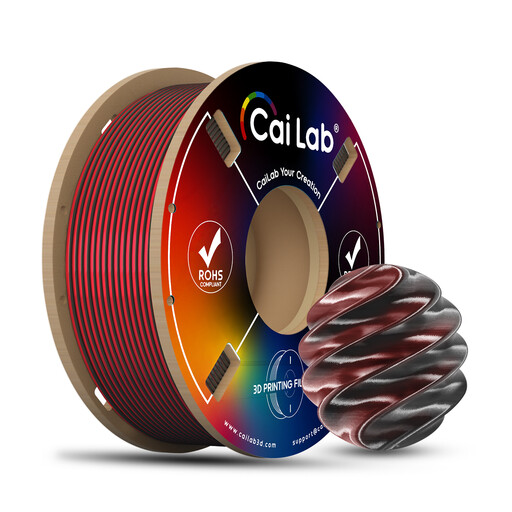
Why we chose it: Ideal for creating objects with a dynamic visual effect that changes depending on the viewing angle. Perfect for vases, abstract sculptures, or pieces that need to stand out.
This dual-colour PLA turns the "colour lottery" into a key feature. The colour variation is intentional and controlled, creating a subtle gradient between red and black.
A unique visual effect without needing a multi-extruder printer. Its neat winding minimises the risk of jams.
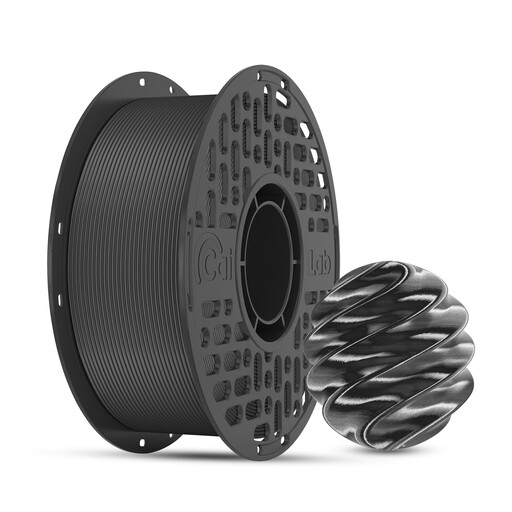
Why we chose it: For users seeking a deep, uniform, and ultra-glossy black finish. Ideal for enclosures, cosplay parts, or decorative objects where elegance and subtlety are key.
Its formulation ensures an even dispersion of pigments and additives. This overcomes the "uneven shine" pitfall by delivering a consistent lustre across the entire surface of the object.
Delivers an intense black colour and a very smooth, silky finish. Its clear print settings ensure reliable results from the very first try.
We have selected a full range of products for you that meet our strict selection criteria and current safety standards.
Stringing is often more pronounced with silk PLA due to its composition. To reduce it, try slightly lowering your print temperature (in 5°C increments) and increasing the retraction speed and distance in your slicing software (slicer). A dry filament is also a key factor: remember to store it in a sealed bag with desiccant packets.
Overall, silk PLA is slightly less resistant to impact and tensile stress than standard PLA. The additives that create its shine can weaken the adhesion between layers. This makes it perfect for decorative objects or visual prototypes, but we don't recommend it for mechanical parts that need to withstand stress.
No, absolutely no special equipment is needed. Silk PLA filament can be printed on almost any FDM 3D printer on the market, just like standard PLA. There's no need for an enclosure or a hardened steel nozzle. You just need to fine-tune the temperature and retraction settings to optimise the finish.