
Livraison le jour même ou le lendemain

Qualité garantie

Débloquez vos offres de bienvenue: Livraison GRATUITE | Jusqu'à -80 % | 30 jours d'essai gratuits à JoyPlus
Téléchargez l'application
Looking to give your 3D creations a smooth, glossy, almost luxurious finish? Silk PLA filament is the perfect solution. Unlike standard PLA, its formula is enriched with additives that catch and reflect light, creating a unique satin effect that enhances the details and curves of every model.
With a jungle of options available (monochrome, dual-colour, rainbow, etc.), it can be hard to know where to start. Our mission? To help you navigate the choices. This guide shares our selection criteria and our favourite filaments to help you make the right decision, hassle-free.
Before you fill your shopping cart, here are the key points to check to ensure your next 3D printer filament purchase is a complete success.
The main appeal of Silk PLA lies in its visual finish. Your choice will therefore depend entirely on the aesthetic you're aiming for:
Good news: most Silk PLA filaments are as easy to use as standard PLA. However, be sure to check these two crucial points:
A poorly wound filament is every maker's nightmare and a common cause of failed prints. A clean, tangle-free winding is therefore non-negotiable to ensure smooth feeding into the extruder. Since PLA is also sensitive to moisture, a good filament must be delivered in vacuum-sealed packaging with a desiccant packet to preserve its properties until its first use.
Enough theory, let's get practical! Here are the filaments that caught our editors' attention, from the most understated to the most daring.
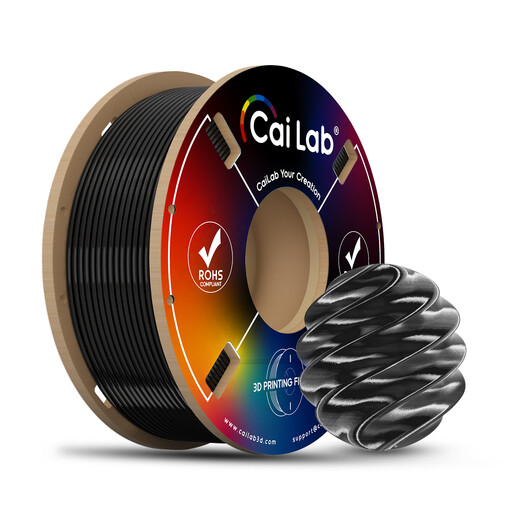
What makes it stand out This filament offers a silky finish in a deep, intense black shade. It transforms any object into an elegant piece, with a subtle shine that makes all the difference.
Key Features
Who is it for? For creators aiming for an understated and sophisticated design, such as electronics enclosures, desk stands, or modern decorative elements.
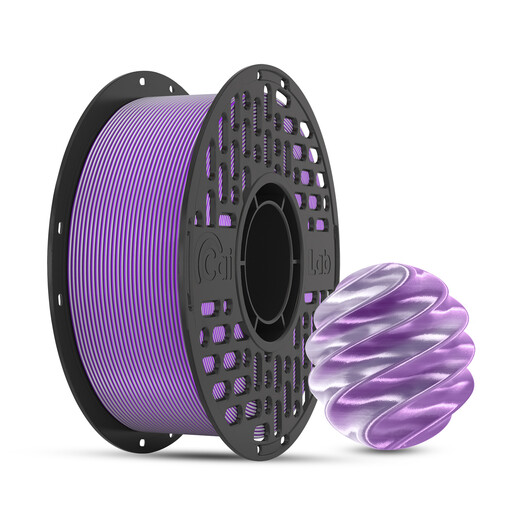
What makes it stand out This dual-colour filament combines two shades of purple for a dynamic visual effect. Depending on the object's orientation and the light angle, the colours blend and separate, creating a unique result with every print.
Key Features
Who is it for? For artists, designers, and makers who want their prints to stand out. Perfect for vases, figurines, or any object meant to be viewed from different angles.
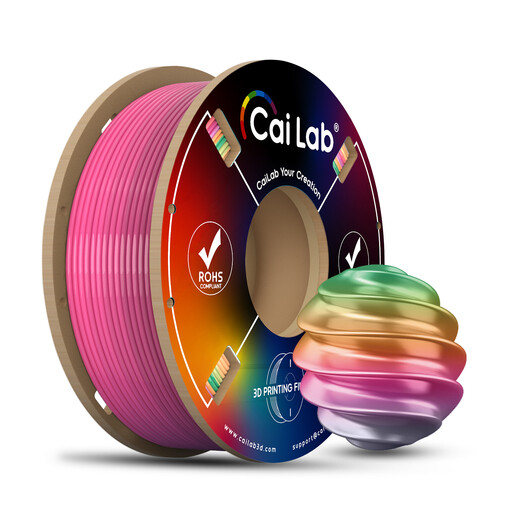
What makes it stand out This rainbow filament offers a smooth, gradual colour transition across the entire spool. It allows you to create colourful objects without having to change filament mid-print.
Key Features
Who is it for? For creators of large decorative objects. The taller the print, the more spectacular the gradient will be. It's an excellent choice for toys, sculptures, or personalised gifts.
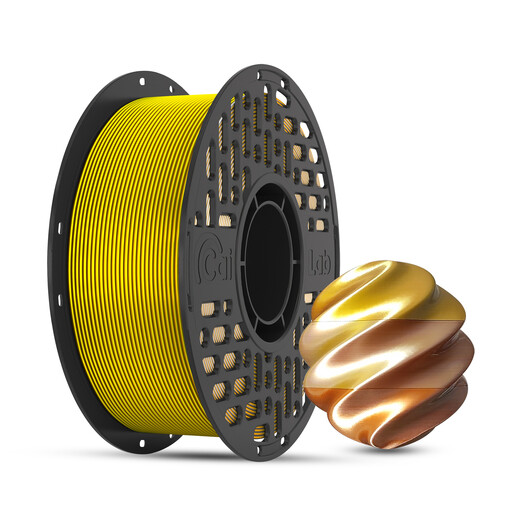
What makes it stand out This filament combines three metallic colours (gold, silver, copper) into a single strand. The result? An object with a complex metallic appearance, whose reflections constantly change with the light and angle.
Key Features
Who is it for? Ideal for projects that require a "precious" or "antique" aesthetic, such as trophies, costume parts (cosplay), artefact replicas, or jewellery models.
Our selection is just a taste of what 3D printer filament has to offer. Are you looking for a specific shade or effect that you didn't find here?
Discover our full range of Silk PLA filaments
The key difference lies in the addition of specific polymers (elastomers) to the Silk PLA formula. These additives change how the material reflects light, giving it its characteristic shiny and satin-like finish, whereas standard PLA offers a more matte or only slightly glossy appearance.
The settings are very similar to those for standard PLA. However, to maximise the satin effect, we often recommend slightly increasing the extrusion temperature (by 5 to 10°C) and slightly reducing the print speed. This helps the layers fuse more uniformly, which enhances light reflection.
Like any PLA filament, Silk PLA is hygroscopic: it absorbs moisture from the air. This moisture degrades print quality (causing bubbles, a rough surface, and brittle filament). To prevent this, always store your spool in an airtight bag with the provided silica gel packet. If your filament has absorbed moisture, you can dry it in a dedicated filament dryer or a conventional oven at a very low temperature (following the manufacturer's instructions to the letter!).