
Livraison le jour même ou le lendemain

Qualité garantie

Débloquez vos offres de bienvenue: Livraison GRATUITE | Jusqu'à -80 % | 30 jours d'essai gratuits à JoyPlus
Téléchargez l'application
Standard PLA is perfect for getting started in 3D printing. But when your projects deserve a finish that truly stands out, Silk PLA filament is the answer. Designed to deliver a smooth finish and a satin-like sheen, this material transforms any object into a visually stunning piece.
Whether you're an Etsy creator, an artist exploring new textures, or a hobbyist looking to elevate your prints, choosing the right filament is crucial. This guide will help you navigate the unique properties of Silk PLA and select the product that will bring your most ambitious creations to life.
Does the 3D printer filament market feel like a jungle? Don't worry. Here are a few essential criteria to guide you to the right choice, hassle-free.
The main appeal of Silk PLA is, of course, its visual finish. Beyond solid colours, more dynamic options are available:
Good news: most Silk PLA filaments are nearly as easy to print with as standard PLA. However, a few checks are necessary to achieve a perfect result:
Like all PLA-based filaments, Silk is sensitive to moisture. Prolonged exposure to ambient air can make it brittle and degrade print quality (causing bubbles or an irregular surface). The best practice is to store it in an airtight bag with a desiccant packet as soon as you're done using it.
Here are a few products that stand out for their finish and creative potential.
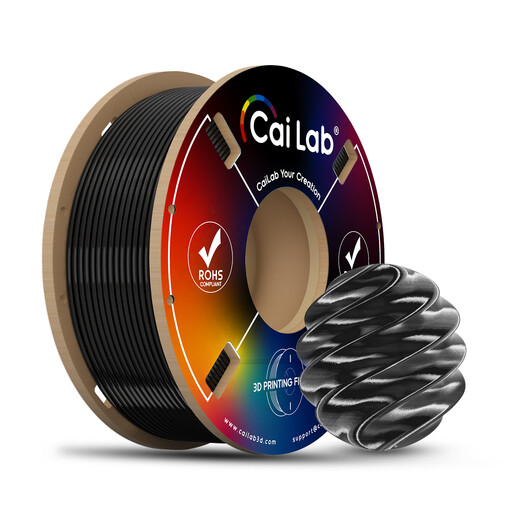
Why it stands out: This filament is distinguished by its deep black finish with a highly pronounced silky sheen. Unlike a standard matte black, it catches the light to enhance the details and curves of your prints, giving them an elegant and professional appearance.
Advantages:
Who is it for? For creators and professionals who want to produce prototypes, decorative objects, or enclosures with a chic, polished finish. It's ideal for parts whose surface details deserve to be subtly highlighted by the light.
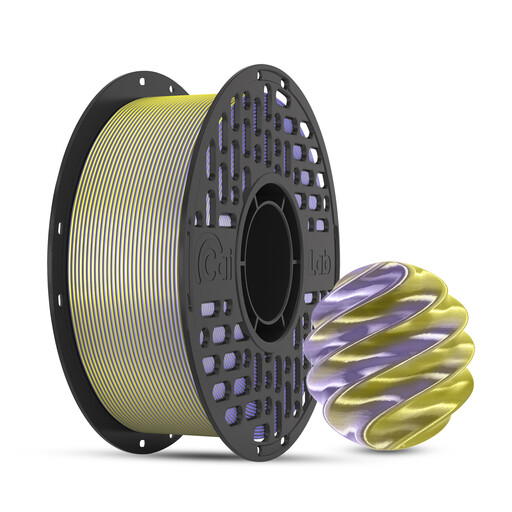
Why it stands out: This dual-colour PLA filament fuses two hues, gold and lavender, into a single strand. The result? A print whose colour shifts depending on the viewing angle. This dynamic effect gives each piece a unique character and a fascinating finish.
Advantages:
Who is it for? For artists, makers, and sellers who want to create objects with a real "wow" factor. Perfect for vases, figurines, jewellery, or any piece whose curves will showcase this interplay of colours.
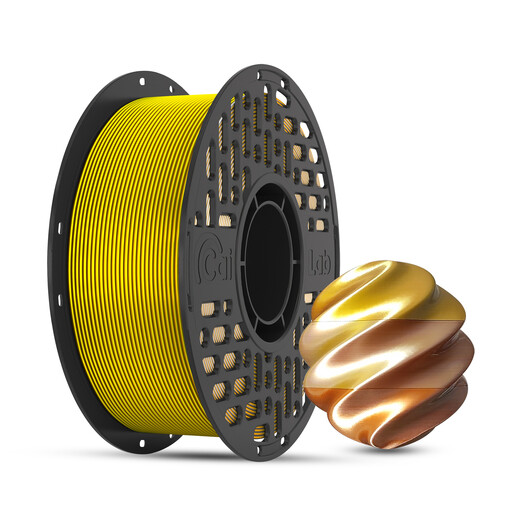
Why it stands out: This tri-colour PLA filament goes a step further by fusing three metallic colours: gold, silver, and copper. Depending on the object's orientation on the build plate, you'll get subtle gradients or sharp colour separations, for a finish that perfectly mimics precious metals.
Advantages:
Who is it for? For makers and creators who want to achieve a complex metallic look without the need for painting. Ideal for trophies, collector's models, cosplay armour, or decorative objects with a luxurious look.
Our selection is just a preview of the possibilities offered by Silk PLA. Every project is unique and may require a specific colour, finish, or effect. If you haven't found what you're looking for here or are simply curious, many other options exist, with different hues, matte finishes, or other special effects.
Explore the complete collection of silk-effect 3D filaments to find the perfect one for your project.
The main difference lies in its composition. Silk PLA contains additives, most often elastomers, that alter how the material reflects light. This is what gives it that ultra-shiny and smooth surface, whereas standard PLA offers a more matte or slightly satin finish.
Generally, no. It prints with settings very similar to those for classic PLA. However, to achieve the best possible shine, it's often a good idea to print a temperature tower. A slightly higher extrusion temperature (while staying within the recommended range) tends to maximize the sheen. As for bed adhesion, it is quite comparable.
The colour-shifting effect depends heavily on the object's geometry and its orientation on the build plate. Curved surfaces and models with multiple facets are perfect for showcasing the hue transitions. For the same model, a simple 90-degree rotation on the build plate can produce a radically different visual result. Don't hesitate to experiment: it's the key to mastering these filaments.