
Livraison le jour même ou le lendemain

Qualité garantie

Débloquez vos offres de bienvenue: Livraison GRATUITE | Jusqu'à -80 % | 30 jours d'essai gratuits à JoyPlus
Téléchargez l'application
3D printing has made creation accessible to everyone, allowing makers and enthusiasts to bring their wildest projects to life. But to go from a simple functional prototype to a stunning decorative object, Silk PLA filament is a game-changer. With its smooth surface, near-metallic sheen, and unique way of playing with light, it elevates any figurine, vase, or decorative piece.
With a huge number of options on the market, it can be hard to know where to start. This guide is here to help, with practical advice for finding the perfect spool and a selection of tried-and-true filaments.
Before you pull out your credit card, let's review the essential criteria for a successful purchase that's compatible with your machine.
Nearly all consumer-grade 3D printers run on 1.75?mm filament. It's the industry standard. The real differentiating factor is the dimensional tolerance. A tight tolerance, around ±0.02?mm, ensures a consistent diameter throughout the entire spool. This consistency is the secret to avoiding the dreaded nozzle clogging and ensuring smooth extrusion. It's an essential prerequisite for achieving the famous satin effect unique to Silk PLA.
The term "silk" refers to that distinctively smooth, glossy appearance. But this category includes several variations:
The secret to a good filament? It must be perfectly dry. PLA (polylactic acid) is hygroscopic, meaning it has an unfortunate tendency to absorb ambient moisture. Filament that has absorbed moisture becomes brittle and can cause bubbles during extrusion, completely ruining the surface finish. Therefore, check that your 1?kg PLA spool comes in vacuum-sealed packaging with a desiccant packet. A neat, tangle-free winding is also a sign of quality that will save you hours of frustration.
We've selected a few standout options that are perfect for bringing your most beautiful creations to life.
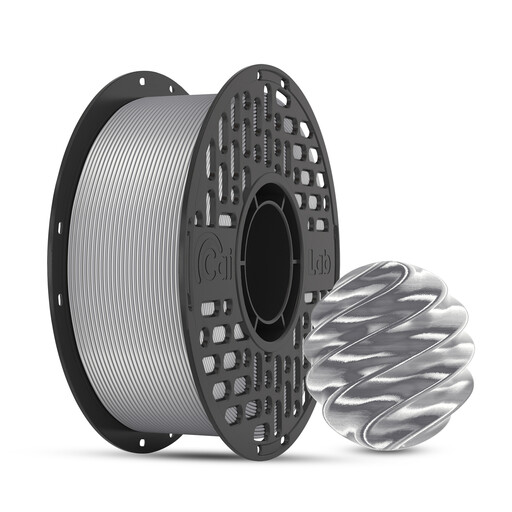
What we liked: This filament offers a classic and elegant silver finish, with a very pronounced silky effect that catches the light beautifully. Its glossy appearance is ideal for simulating a subtle metal, with a pure silver tone perfect for trophies or jewellery. In use, it's easy to work with, offering smooth extrusion and excellent layer adhesion, which reduces the risk of warping.
Who is it for? For makers who want to produce decorative objects, figurines, or appearance prototypes with an understated and high-quality metallic finish.
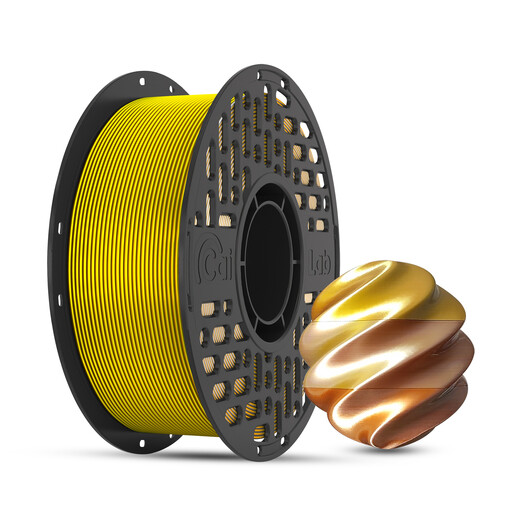
Its standout feature: The tri-colour effect is clearly its key selling point. It creates a subtle gradient between gold, silver, and copper on a single piece. The result is unique: the object's appearance changes with the viewing angle, all without any post-processing. It naturally retains the typical sheen of Silk PLA, which further enhances the play of colours. It's a true invitation to creativity.
Who is it for? For artists and creative minds who want to experiment and produce objects with a truly unique and dynamic visual appeal.

The practical choice: A result of a collaboration, this filament focuses on reliability and consistency. The Anycubic name is a trusted one in the world of 3D printer filament, and the ±0.02?mm tolerance is a guarantee of peace of mind. Its silver finish is slightly textured, offering an excellent compromise between a standard matte PLA and an ultra-glossy Silk PLA. Its value for money makes it a prime option for those who print a lot.
Who is it for? For heavy users looking for a reliable filament for a variety of projects, from prototyping to final parts with a subtle metallic PLA effect.
Our selection is just a taste of what's possible. If you're looking for specific shades of silver or other metallic finishes, the possibilities are endless.
? Explore our full category of silver filaments to discover more choices.
The difference comes down to the additives. Silk PLA filament is enriched with polymers that give it that ultra-glossy, smooth surface that reflects light. Standard PLA, on the other hand, has a more matte or satin finish and prioritizes mechanical properties over pure aesthetics.
Generally, Silk PLA prints at temperatures similar to standard PLA, often between 200 and 220°C. A little tip to maximize the shine: opt for a temperature at the higher end of the manufacturer's recommended range. It's also a good idea to slightly reduce the print speed to ensure a perfect fusion between layers and achieve a flawless surface.
Storage is a key step. Always keep your 1?kg spool in an airtight bag with the original silica gel packet. If you live in a humid area, investing in an airtight storage box with an active dehumidifier is an excellent idea. A dry filament is the guarantee of successful, bubble-free, and snap-free prints.