
Livraison le jour même ou le lendemain

Qualité garantie

Débloquez vos offres de bienvenue: Livraison GRATUITE | Jusqu'à -80 % | 30 jours d'essai gratuits à JoyPlus
Téléchargez l'application
Are your 3D prints looking lacklustre? Tired of spending hours on a model only to get a dull, lifeless result? Silk PLA filament (or silk PLA) is the solution. Thanks to special additives, this material delivers an ultra-smooth, glossy finish that catches the light to make your creations shine.
This guide is here to help you choose the perfect silk-effect PLA filament for your projects. We'll review the essential selection criteria and present our top picks for achieving stunning results right from the first print.
By the Joybuy editorial team
Before you buy, there are a few points to check to ensure compatibility with your 3D printer and the quality of your future parts.
The vast majority of consumer 3D printers use 1.75?mm filament. It's the market standard. But the real differentiating factor is dimensional tolerance. A tight tolerance (e.g., ±?0.02?mm) ensures a consistent material flow, which reduces the risk of nozzle clogging and guarantees more uniform layers. A premium PLA filament stands out precisely for this consistency.
Silk PLA offers more than just a simple shine. The technology has evolved to offer much more complex visual effects:
One of the major advantages of silk PLA is its ease of use, which is very similar to standard PLA. Generally, an extrusion temperature between 190 and 230°C is recommended. Using a heated bed (between 35 and 55°C) can improve first-layer adhesion, but it's not always necessary. Remember to always store your spools away from moisture to prevent it from degrading the quality of your silk 3D print.
To help you get started, here are a few standout products known for their features and the creative possibilities they unlock.
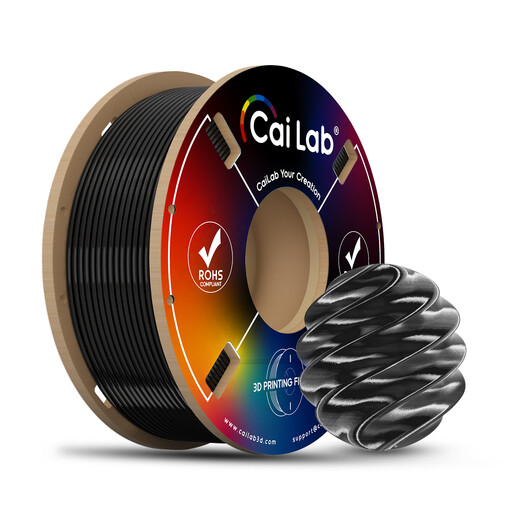
Why we love it: This filament offers a deep, intense black with a silky finish that enhances the finest details of your models. Unlike a standard matte black PLA, its subtle shine adds a touch of elegance and a professional look to any object.
Advantages:
Who is it for? For creators printing decorative objects, display stands, enclosures, or visual prototypes that require a finish that is both elegant and discreet.
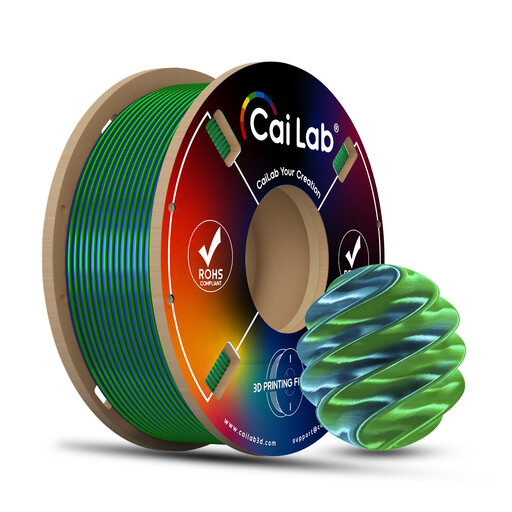
Why we love it: This dual-colour filament is an excellent choice for creating eye-catching pieces. By combining blue and green, it produces objects whose colour shifts depending on the viewing angle. Each print becomes a unique piece with a dynamic visual effect.
Advantages:
Who is it for? For makers and artists who want to produce figurines, vases, toys, or any object where the visual effect is paramount. It's a filament that unleashes creativity.
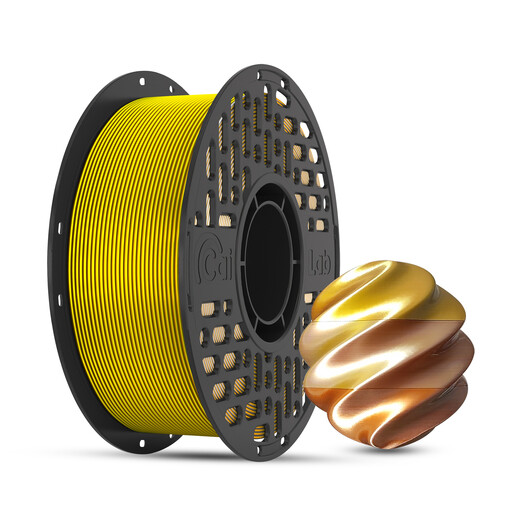
Why we love it: This tri-colour filament takes aesthetics a step further by fusing three metallic shades: gold, silver, and copper. The result is a finish that mimics the appearance of precious metals, with fluid colour transitions across the entire surface of the object.
Advantages:
Who is it for? For those creating jewellery prototypes, trophies, medals, board game pieces, or decorative objects that need a luxurious, metallic appearance.
Our selection is just a glimpse of the possibilities offered by silk PLA. If you want to explore other colours, different effects, or simply compare other brands, our full catalogue is here for you.
Discover Our Full Range of Silk PLA Filaments
The difference is primarily aesthetic. Silk PLA filament contains additives (usually elastomers) that reflect light differently, creating that very shiny, smooth finish which has the advantage of hiding layer lines. Mechanically, it can be slightly less rigid than standard PLA but remains just as easy to print.
No, not really. Its print settings are very similar to those of classic PLA. It may sometimes require a slightly higher extrusion temperature (about 5 to 10°C more) to achieve maximum shine. As with any new filament, it's a good idea to print a temperature tower to find the optimal setting for your 3D printer.