
Livraison le jour même ou le lendemain

Qualité garantie

Débloquez vos offres de bienvenue: Livraison GRATUITE | Jusqu'à -80 % | 30 jours d'essai gratuits à JoyPlus
Téléchargez l'application
Silk PLA filament (or PLA Silk) has the power to transform a simple 3D printed part into a true collector's item. Do you dream of achieving a satin-like finish and a spectacular sheen straight off the print bed, without getting into complex post-processing? Look no further. This guide is here to help you sort through the options and find the perfect 3D printer filament to elevate your most ambitious projects.
Don't worry, our goal isn't to drown you in indigestible technical jargon. Instead, we'll give you concrete tips for choosing the perfect spool of Silk PLA for your needs. Whether you're a passionate maker, a designer, or a professional looking for eye-catching prototypes, let's dive in!
The quality of your prints depends directly on the filament. For a guaranteed "wow" factor, here are the criteria to watch for before you buy.
What makes silk-effect PLA so special is, of course, its finish. Forget about conventional solid colours: while black or gold PLA filament remains a classic choice, much more dynamic options are now available.
Good news: Silk PLA is generally as easy to print as standard PLA. However, a few small adjustments are enough to optimise its finish and maximise its shine. Most manufacturers recommend a slightly higher extrusion temperature (usually between 190 and 230°C) to bring out the filament's full lustre. A heated bed (between 35 and 55°C) is a plus for adhesion, but not mandatory. In any case, check the manufacturer's recommendations for your spool of Silk PLA, as optimal settings can vary slightly from one brand to another.
Moisture is public enemy number one for most filaments, and Silk PLA is no exception. A filament that has absorbed moisture is a recipe for a failed print: expect bubbles, crackling sounds from the nozzle, and a surface full of imperfections... Goodbye, beautiful satin effect! Therefore, always choose spools that come in vacuum-sealed packaging with a silica gel desiccant packet. Once opened, store the spool in an airtight container to protect it and preserve its properties.
To get you started, we've selected a few filaments that stand out from the pack, both for their visual appeal and their ease of use.
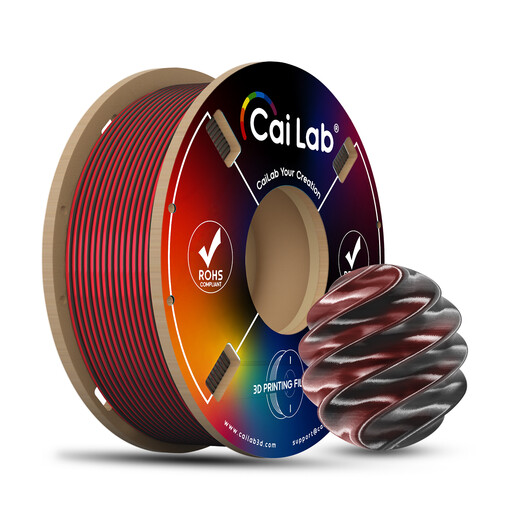
Why it stands out: Its dual-colour effect, of course! This filament fuses an intense red and black to create dynamic prints whose colour shifts depending on the viewing angle. It's the easiest way to add a spectacular touch to any 3D model.
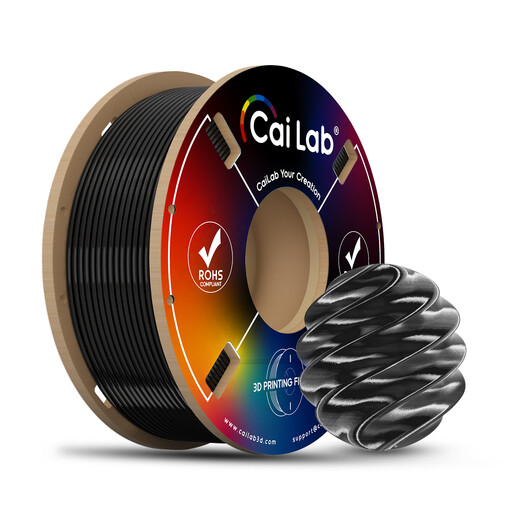
Why it stands out: Forget ordinary black. This black PLA filament offers a Silk finish that gives it a deep sheen and a luxurious look, transforming even the most functional part into a designer object.

Why it stands out: This gold PLA filament succeeds in delivering a stunningly realistic metallic look without the printing hassles of metal-filled filaments. Its shine and rich hue perfectly mimic real gold.
Our selection is, of course, just a starting point for exploring the fascinating world of Silk PLA filament. Every project is unique, with its own colour and finish requirements. Didn't find the perfect shade in this list? No problem, other options await.
? Explore our complete collection of Silk Filaments to discover a much wider colour palette and find inspiration for your next print.
1. What is the difference between standard PLA and Silk PLA filament? The difference lies in the formula. Silk PLA filament contains additives (often elastomers) that change how light reflects off the surface. This is what gives it its characteristic shiny, satin-like finish while also hiding the appearance of layer lines. Mechanically, its properties are very similar to those of standard PLA.
2. Is Silk PLA harder to print than standard PLA? No, it's just as easy to get started with. To achieve an incredibly shiny PLA filament, it's sometimes recommended to slightly increase the printing temperature and/or slightly reduce the speed. The best approach is to start with your usual PLA settings and then run a small test print to fine-tune the parameters for your machine.
3. How can I maximise the shiny effect of my print? For maximum sheen, the first rule is to ensure your filament is completely dry. Next, don't hesitate to experiment with the extrusion temperature: a value in the upper range recommended by the manufacturer often enhances the shine. Finally, a low layer height (e.g., 0.12 mm or 0.16 mm) will help create a smoother and therefore more reflective surface.