
Livraison le jour même ou le lendemain

Qualité garantie

Débloquez vos offres de bienvenue: Livraison GRATUITE | Jusqu'à -80 % | 30 jours d'essai gratuits à JoyPlus
Téléchargez l'application
When the temperature soars in the summer, our homes can quickly turn into an oven. It becomes difficult to sleep, stay focused while working from home, or simply relax. To make matters worse, the racket of a standard fan often adds to the discomfort of the heat. This is where the silent tower fan comes in—the ideal solution for finding cool relief, with the added benefit of peace and quiet.
I'm the Head of Product Curation at Joybuy, and my mission is to guide you through the jungle of available models. In this guide, we'll break down the essential criteria and present our selection of devices that stand out for their quiet operation and efficiency. The goal: to help you make the right choice for your home.
Before you decide on a model, let's review the features that truly make a difference. Here are the three key points to check to ensure you make the right choice.
For a fan, especially one in a bedroom, silence isn't an option—it's the number one priority. The noise level is measured in decibels (dB). Here's a quick guide:
The champions of silent cooling often feature a DC (direct current) motor, which is known for being quieter and more energy-efficient than its AC (alternating current) counterpart.
A fan should be quiet, yes, but not at the expense of performance. The airflow power, expressed in m/s or m?/h, determines its ability to effectively circulate air in a room.
Certain features truly enhance daily comfort:
Today's fans are smarter than ever, with features that make life easier and optimize their efficiency. A smart fan can be controlled from a smartphone app or by voice (via Alexa or Google Assistant) for total flexibility.
Safety is another crucial point, especially if you have children or pets. The so-called "bladeless" design, with its very fine grilles, reduces the risk of household accidents. Finally, choosing a low-consumption fan is a smart move for your wallet and the planet. Take a look at the power in watts (W): a good device typically consumes between 30 and 50 W at full speed.
Here are three models that check all the boxes: silence, performance, and features. Each has its own strengths to meet specific needs.
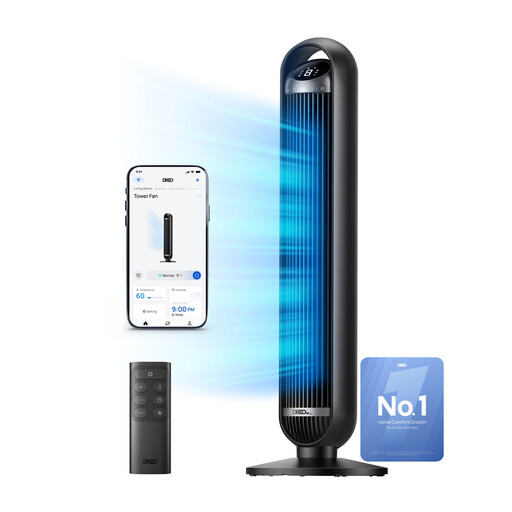
Why it stands out: What's immediately striking about this model is its silence. Thanks to its TurboSilent technology and DC motor, the manufacturer claims a noise level of just 25 dB at low speed—barely more than a whisper. It's also a smart fan, fully controllable via the Dreo app or by voice.
Advantages:
Who is it for? This is the perfect choice for tech enthusiasts who want a modern, discreet device that's easy to integrate into a smart home ecosystem. It is particularly well-suited for bedrooms and offices where silence is golden.
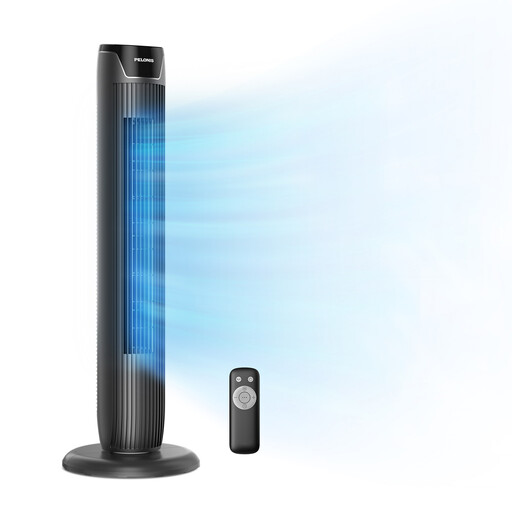
Why it stands out: The PELONIS tower fan focuses on automation and safety. Its "AI smart" mode automatically adjusts the speed based on the ambient temperature. With a minimum noise level of 27 dB, it knows how to go unnoticed. It also includes a child lock, a real bonus for families.
Advantages:
Who is it for? This model will appeal to those who prioritise simplicity and automated functions, without necessarily wanting Wi-Fi connectivity. It's an excellent choice for family living rooms or children's bedrooms.
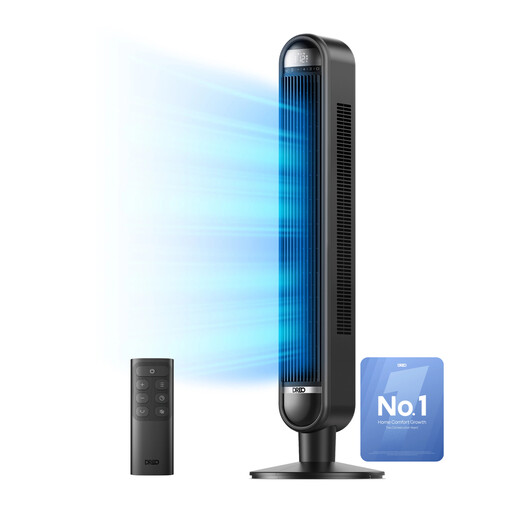
Why it stands out: With its height of 106 cm and a powerful airflow reaching 7.6 m/s, this DREO fan was designed to quickly cool large spaces. Its 90° oscillation and internal design ensure even air distribution. Despite its power, its Night mode remains discreet with a contained noise level of 34 dB.
Advantages:
Who is it for? This is the ideal model for those who need to cool a spacious room without compromising on quiet operation at night. Its power also makes it an excellent complement to an air conditioner to better distribute cool air.
Our selection focuses on models that excel in silence and performance. If you want to explore a wider range or compare other features, feel free to browse our full category.
? Discover all our silent tower fans
In practice, the terms column fan and tower fan are used interchangeably. They both refer to tall, slim, vertical fans. Rather than focusing on the name, it's better to compare the technical specifications: noise level, airflow power, and features.
Yes, as long as you choose the right model. A device rated under 35 dB in night mode will be perfectly suitable. Features like "Sleep" mode (which reduces intensity over time) or a timer (for a scheduled shutdown) are specifically designed to ensure comfortable and silent cooling all night long.
Rest assured, modern fans are low-consumption devices. A tower fan consumes between 30 and 60 watts on average, a far cry from an air conditioner. Models equipped with a DC motor (direct current) are particularly economical and allow you to stay cool for hours without sending your electricity bill through the roof.