
Livraison le jour même ou le lendemain

Qualité garantie

Débloquez vos offres de bienvenue: Livraison GRATUITE | Jusqu'à -80 % | 30 jours d'essai gratuits à JoyPlus
Téléchargez l'application
When a heatwave sets in, summer nights can quickly turn into a nightmare. The dilemma is always the same: suffocate in silence or try to sleep through the racket of a traditional fan. Fortunately, the silent tower fan is a game-changer. It's the elegant and discreet solution for getting back to peaceful nights and staying productive at the office.
Designed to blend into your decor, this appliance combines efficiency with acoustic discretion. Our guide is here to help you navigate the jungle of options and find the perfect model for your needs, whether it's for a bedroom, a living room, or as a desk fan.
Before diving into our selection, let's review the key criteria to help you make the right choice.
For a silent tower fan, the noise level isn't a minor detail—it's the number one criterion. Measured in decibels (dB), it determines your comfort. For a bedroom or office, aim for a model that doesn't exceed 40?dB in night mode or at low speed. The top performers even go as low as 25?dB, the equivalent of a whisper. A pro tip: devices with a DC (direct current) motor are not only quieter but also offer more precise control over the ventilation.
No, a powerful yet silent fan is not a myth. Its power is measured by its airflow (in m?/h) or air speed (in m/s). A good tower fan must be able to circulate air effectively throughout the entire room.
Also, consider the oscillation angle: an oscillating fan with a 60° or 90° range ensures an even distribution of coolness. Finally, versatility is king: various modes (Normal, Natural, Night) and multiple speeds allow you to adjust the airflow to your liking. And let's admit it, a fan with a remote control remains a must-have for convenience.
Choosing a low-energy fan is a smart move for both your wallet and the planet. Models with DC motors are champions in this regard, consuming significantly less energy than their AC motor counterparts.
And for the tech-savvy at heart, a smart fan is the icing on the cake. Controlling it from your smartphone or with your voice (via Alexa or Google Assistant) transforms the user experience.
Our editors have tested and selected models that excel in their balance of silence, performance, and features.
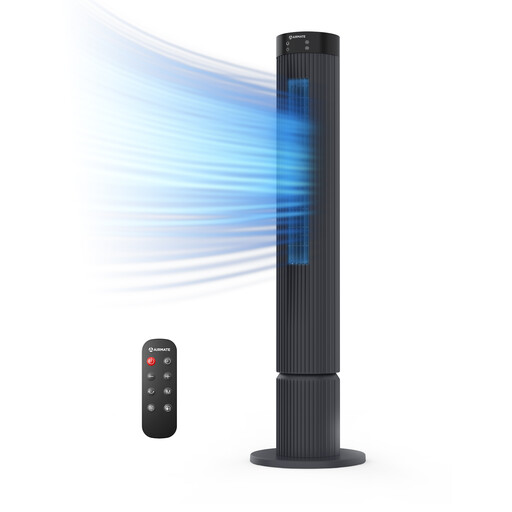
Key Feature: This model stands out with its cross-flow ventilation architecture, which boosts airflow for a range of nearly 12 meters. Its adjustable height makes it ultra-versatile, adapting to different environments from the living room to the bedroom.
Advantages:
Who is it for? Ideal for those seeking a high-performance, adaptable fan capable of cooling large spaces while remaining discreet.
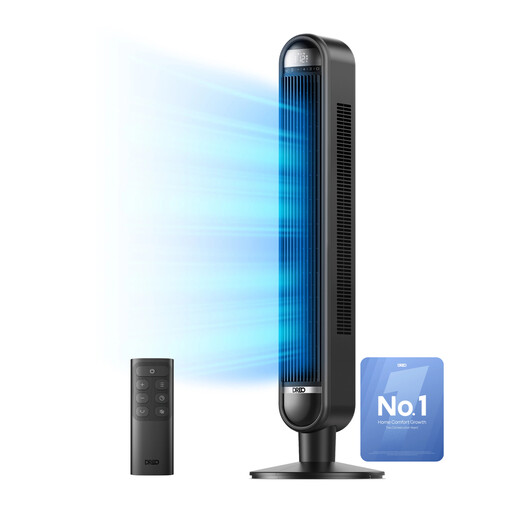
Key Feature: The DREO fan offers an excellent compromise between power and silence. With a maximum air speed of 7.6?m/s, it generates a powerful breeze, while its Night mode keeps the noise down to just 34?dB. Its 90° oscillation is a major plus for large living areas.
Advantages:
Who is it for? Perfect for efficiently cooling medium to large rooms, like a living room or master suite, without sacrificing tranquility.
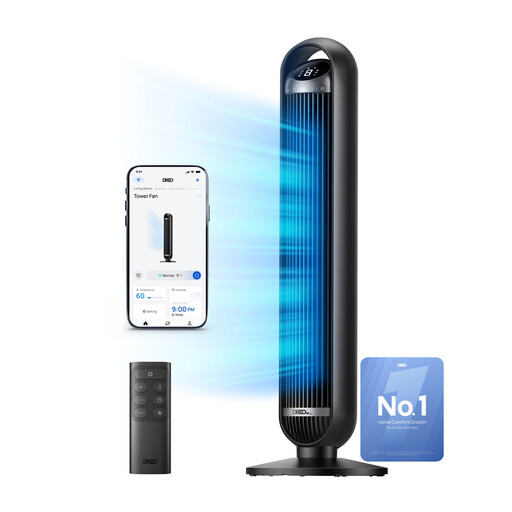
Key Feature: The ultimate solution for technophiles and sensitive ears. Thanks to its TurboSilent technology and DC motor, it's nearly inaudible, dropping to just 25?dB. Its smart connectivity makes it incredibly practical for daily use.
Advantages:
Who is it for? The obvious choice for smart home enthusiasts, new parents, and anyone for whom silence is golden.
Not convinced by the tower format? Looking for an even more mobile solution for travel or outdoor activities? Other options are available. For a portable and instant breath of fresh air, a handheld fan is an excellent alternative.
? Discover our selection of portable handheld fans with misters for a refreshing breeze wherever you are.
A fan is considered silent when it operates below 40?dB at low speed. for use in a bedroom, it's best to aim for a model that doesn't exceed 30?dB; its sound will then blend in with that of a mere whisper.
It all depends on the model. A low-energy fan is almost always equipped with a DC (direct current) motor. The advantage? It can consume up to 50% less energy than a conventional AC (alternating current) motor at the same power level. To get a precise idea, check the wattage (W) on the technical specifications sheet.
It's a matter of priorities. The tower fan is appealing for its sleek, modern design. It has a small footprint and blends into the decor. On the other hand, the traditional pedestal fan, with its large blades, often circulates a larger volume of air more directly, but it is also bulkier and its aesthetic is more... traditional.