
Livraison le jour même ou le lendemain

Qualité garantie

Débloquez vos offres de bienvenue: Livraison GRATUITE | Jusqu'à -80 % | 30 jours d'essai gratuits à JoyPlus
Téléchargez l'application
Here at the editorial desk, we review dozens of mechanical keyboards every year. And while the promise of "silence" is on everyone's lips (and every box), the reality is often far more... noisy. A clacky keyboard can ruin a late-night gaming session, pollute a recording, or simply get on the nerves of everyone around you.
This guide is here to help you decipher the marketing jargon, avoid bad deals, and find THE mechanical keyboard that combines silence, performance, and durability.
The market is saturated, and it's easy to be fooled by empty promises. Here are the two most common traps.
To avoid buyer's remorse, focus on these three technical points that make all the difference in performance and comfort.
This is the component that defines the typing feel and sound profile. For a silent gaming keyboard, look for linear or tactile switches that explicitly mention the presence of dampeners or factory pre-lubrication. This lube reduces friction and parasitic noises for a smoother, more muted keystroke. The ability to easily replace them (hot-swappable functionality) is a huge advantage for customising or repairing your keyboard over time.
The material of your keycaps has a direct impact on their durability and the sound they produce.
Whether for gaming or marathon typing sessions, comfort is non-negotiable. A keyboard with a wrist rest, preferably magnetic and padded, is a real plus for preventing fatigue and strain in your forearms. Also, ensure the keyboard has the correct layout for your language. For example, a user in the UK will need an ISO-UK layout, while a user in the US will need an ANSI-US layout. Be careful to check that it's a full, native layout and not a modified version of another region's standard.
Instead of a simple list, here are keyboards matched with typical user profiles to help you find the one that's right for you.
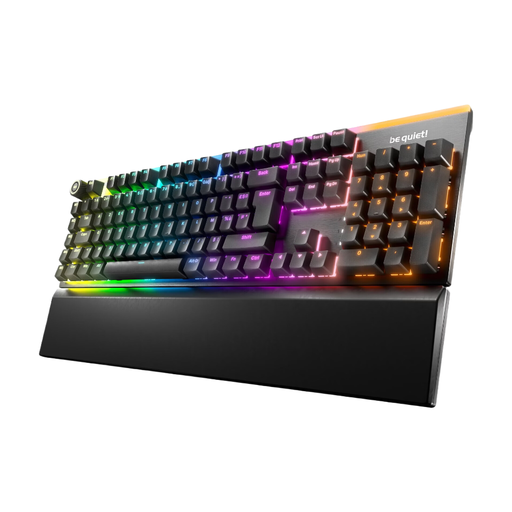
Why it's the right choice for this profile: They seek performance without compromising on discretion. They game late at night or in a shared space and don't want to disturb anyone, while still demanding flawless responsiveness and build quality for their competitive gaming sessions.
It doesn't just promise silence; it's engineered for it with 3 layers of sound dampening and factory pre-lubed Silent Tactile switches. The noise is absorbed at the source.
Double-shot PBT keycaps for maximum durability and a magnetic wrist rest for optimal comfort. The layout is a true French AZERTY (ISO-FR).

Why it's the right choice for this profile: This user loves to experiment. They want to be able to change their keyboard's typing feel, test different types of switches (linear, tactile, clicky), or effortlessly replace a faulty switch. For them, a keyboard is a long-term investment that needs to evolve.
It avoids the "fake customisation" trap by offering complete modularity. The 5-pin hot-swappable functionality ensures compatibility with almost all MX-style switches on the market.
Longevity and adaptability. You are no longer locked into the original typing feel. You can install even quieter or more tactile switches as you wish, without ever having to buy a whole new keyboard.
Why it's the right choice for this profile: A streamer or videographer needs a keyboard that is quiet enough not to pollute their audio recordings, aesthetically pleasing on camera (RGB mechanical keyboard), and functional with shortcuts for their editing or streaming software.
Its quiet operation is a major asset for audio recording. The RGB lighting is refined and per-key customisable without being gaudy, fitting perfectly into a professional streaming setup.
The programmable 3D multimedia dial and the 5 dedicated macro keys are powerful tools for controlling volume, playback, or launching complex actions with a single press.
Discover our full selection of keyboards that meet our criteria for quality and performance.
To be direct: no, and that's not the goal. A mechanical keyboard will always offer more pronounced tactile and audible feedback than a basic membrane keyboard. However, a well-designed silent mechanical gaming keyboard, with dampened switches, lubrication, and sound-dampening layers, significantly reduces high-pitched noises and clacks. The resulting sound is deeper, more muted, and far less distracting. You get to keep the pleasure of mechanical typing, without the nuisance.
The difference is striking. While ABS keycaps can start to show signs of wear (a shiny, "polished" look) after just a few months of heavy use, PBT keycaps maintain their original texture and appearance for several years. It's a true mark of quality that justifies the often slightly higher initial investment.
Not at all—that's the whole point! The process requires no soldering. You simply use a keycap puller to remove the keycap, then a switch puller to remove the switch from its socket. All you have to do is insert the new switch, making sure its pins are straight. The operation takes less than a minute per key and requires no special technical skills.