
Livraison le jour même ou le lendemain

Qualité garantie

Débloquez vos offres de bienvenue: Livraison GRATUITE | Jusqu'à -80 % | 30 jours d'essai gratuits à JoyPlus
Téléchargez l'application
Shoes scattered across the hallway, pairs that vanish in the wardrobe, boxes crushed at the back of the cupboard… Shoe storage addresses a very real need, but no single solution works for every home. Before you place an order, be sure to check the dimensions, stability and ease of access.
A box may state 35 cm in length, but its edges, opening or internal structure can significantly reduce the usable space. Thick trainers, high-top shoes or bulky soles may then struggle to fit properly.
Always check:
The label stackable shoe storage does not guarantee that multiple units will stay perfectly in place. An uneven base, a flimsy lid or boxes that are too heavy can cause the whole stack to shift.
For high-level storage, choose a structure with:
A clear shoe box lets you quickly identify its contents, but visibility is no substitute for air circulation. For shoes stored straight after being worn, ventilation holes can help with air exchange. However, they do not remove the need to let your shoes dry before sealing them away.
Also be wary of descriptions that promise perfect preservation without specifying the material, dimensions or conditions of use.
For storing trainers and low shoes, a height of between 14 and 19 cm may be suitable, depending on the shape of the shoe. Ankle boots and bulkier footwear require more space. Measure a representative pair, taking into account any protruding elements such as soles or laces.
A shoe organiser placed in a hallway must also leave enough room for comfortable passage. In a wardrobe, it is usually the depth and height of the shelves that impose the most constraints.
Polypropylene (PP) is commonly used for plastic storage boxes. Lightweight, it can generally be cleaned with a damp cloth. Depending on the design, an ABS plastic frame or a reinforced panel can improve overall rigidity.
To extend the life of your storage:
A box with a front-opening door lets you retrieve a pair without having to move the entire stack. A top lid is better suited for storing seasonal items or shoes you rarely wear. In a busy hallway, front access or an open shoe shelf will often be more practical.
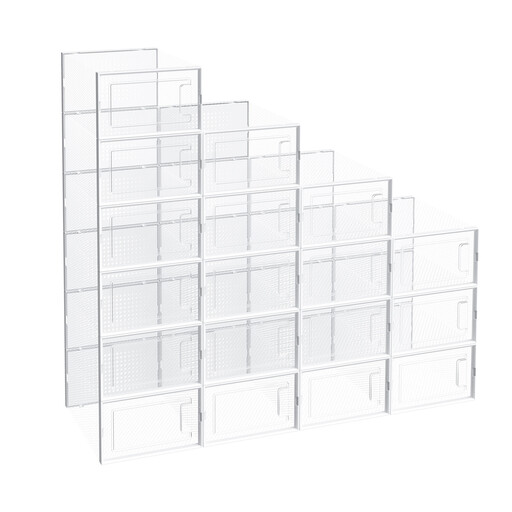
Why this suits this profile: This pack of 18 boxes is ideal for anyone wanting to organise several pairs in a cupboard or hallway without making multiple purchases. Each box measures 35 × 25.2 × 19 cm and features a front opening.
The stated dimensions and compatibility up to UK size 11 make it easy to check before buying. It is still essential to measure your largest shoes.
PP boxes, transparent doors, ventilation holes and a stackable design. The declared net weight of the pack is 7.7 kg.

Why this suits this profile: With their dimensions of 50.4 × 37.6 × 28.8 cm, these boxes are a good fit for a wardrobe, garage, balcony or boot. They are particularly suitable for bulky shoes and accessories.
A stated thickness of 2.5 mm, reinforcing ribs and a non-slip base reduce the risk of deformation and slipping when stacking.
Reinforced PP, a clip-on lid and integrated handles. The transparent finish lets you identify the contents without opening each box.
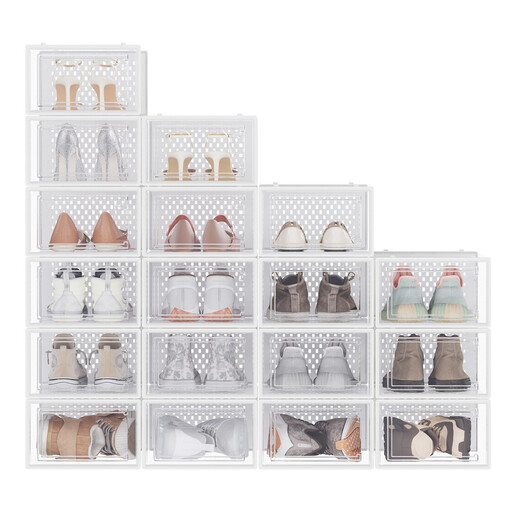
Why this suits this profile: This transparent and grey pack is designed for collections of trainers, flat shoes or smart-casual footwear. Its individual size of 33.3 × 23.1 × 14.3 cm makes it easy to organise storage pair by pair.
The front door means you don't have to remove boxes from above to access a pair. Still, compare the dimensions with your shoe size and the shape of your footwear.
18 compartments, a stackable structure, a transparent front and integrated ventilation. The body is stated as PP and the door as PS.
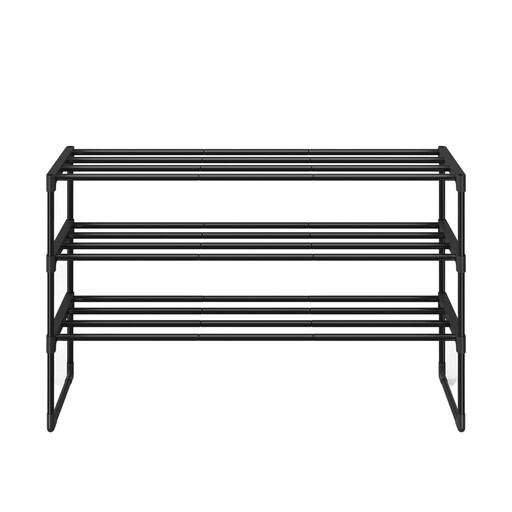
Why this suits this profile: With its 30 cm depth and 92 cm width, this 3-tier shoe rack can work in a hallway, cupboard or living room where quick access matters more than the protection of enclosed storage.
Its open structure avoids problems with doors that are too narrow or boxes that are the wrong size. On the downside, shoes remain exposed to dust.
Metal tubes, plastic connectors, tool-free assembly and a stated static load capacity of 10 kg per tier, giving a total of 30 kg.
We have prepared a full selection, updated in real time, of products that meet these exacting criteria as well as European safety standards.
Start by separating the shoes you wear regularly from seasonal pairs. The styles you use every day can stay on an open shoe shelf or in compartments with front access. Occasional pairs are better placed in a shoe box with a lid, either transparent or labelled.
For truly space-saving shoe storage, make use of height without creating a stack that is impossible to reach. Place heavy shoes on the lower levels and check stability after each addition. In a garage or utility room, choose a spot away from persistent dampness and heat sources.
Depth varies depending on the model. Always measure your longest pair, but also the space needed to open a door or remove a box. A depth of 30 cm may work for many low shoes, but it won't accommodate all ankle boots.
A closed box limits direct exposure to dust, but its level of protection depends on how well the lid or door fits. Ventilation holes help with air circulation, but shoes must be thoroughly dry before being stored.
Respect the stated maximum load, place boxes on a flat surface and put the heaviest items on the lower levels. Do not exceed the recommended stacking height and check regularly that the boxes remain properly aligned.