
Livraison le jour même ou le lendemain

Qualité garantie

Débloquez vos offres de bienvenue: Livraison GRATUITE | Jusqu'à -80 % | 30 jours d'essai gratuits à JoyPlus
Téléchargez l'application
A cluttered hallway, trainers piled up in the corridor, or boots taking over every inch of your wardrobe – choosing a shoe storage unit is about much more than just style. A poorly sized model can block a door from opening, misshape certain shoes, or become unstable over time.
Here are the key factors to consider before you buy, along with a selection of units suited to different needs and the layouts of British homes.
The stated capacity doesn't always reflect reality, especially when you need to store bulky footwear. A pair of thick trainers, ankle boots, or children's shoes takes up a different amount of space than a pair of ballet flats. A unit advertised for several pairs can therefore prove impractical if its compartments are too narrow or too shallow.
To avoid unpleasant surprises, check the internal dimensions, the height between shelves, and the usable depth. If you own boots, look for a boot and trainer storage solution rather than a simple shoe shelf.
In a hallway or corridor, a few centimetres can make all the difference. A unit that is too deep will reduce the width of the walkway and may obstruct a door or cupboard from opening. Conversely, a very shallow model may not be suitable for larger shoe sizes.
Measure the available space in three dimensions: width, depth, and height. Also remember to allow for skirting boards, handles, and everyday movement. A narrow shoe storage unit will easily fit in a hallway, while a wider model will be simpler to organise in a dressing room.
A metal frame or a thick panel isn't enough to guarantee good stability. Examine the assembly system, the base surface area, the connectors, and the maximum load capacity. With an open shelf, an uneven floor can also cause movement or even tipping.
Always install the unit on a level surface and follow the manufacturer's weight guidelines. In a home with young children, check the safety instructions and arrange for suitable wall fixing if necessary.
A hallway shoe storage unit must remain easily accessible without encroaching on the walkway. A depth of 20 to 30 cm can be useful in a narrow hallway, but it needs to be considered alongside the size of the shoes you need to store.
Units with doors hide the shoes and create a tidier impression. However, they require you to carefully check the space needed for them to open. Removable shelves, on the other hand, allow you to adjust the height for trainers, ankle boots, and high-top shoes.
An open structure makes access and ventilation easier, while a closed shoe rack offers better protection from dust. The right choice therefore depends on the room, how often you use the shoes, and your storage habits.
Metal is suitable for those looking for a lightweight, ventilated structure that is easy to move. A metal shoe organiser with a lacquered finish can fit into a contemporary décor. Clean it with a soft cloth and avoid abrasive products, which could scratch the surface.
MDF and wood-derived panels often allow for a unit with doors and a top surface. They need to be protected from excessive humidity and cleaned without leaving standing water. In all cases, check the quality of the joints, hinges, and handles.
Do not overload the shelves beyond the stated limit. The total weight depends on the number of pairs, but also on their material: hiking boots or heavy boots weigh significantly more than canvas shoes.
For expandable storage, stackable models allow you to add another unit as your collection grows. However, make sure that stacking is intended by the manufacturer and that each element remains perfectly stable.
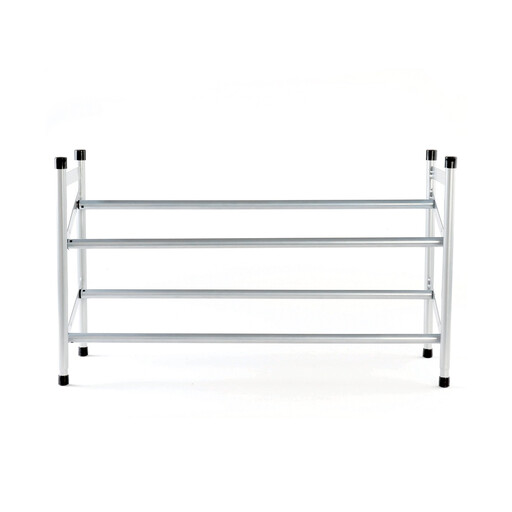
Why this choice suits this profile: This epoxy-lacquered metal model measures 62 × 23 × 35 cm and requires no assembly. It is ideal for organising a first hallway, a cupboard, or a cloakroom.
Its dimensions are clearly stated and its stackable design allows you to gradually increase capacity, rather than buying an oversized unit from the start.
Epoxy-lacquered metal, grey colour, L-shape format, and the ability to stack several units sold separately.
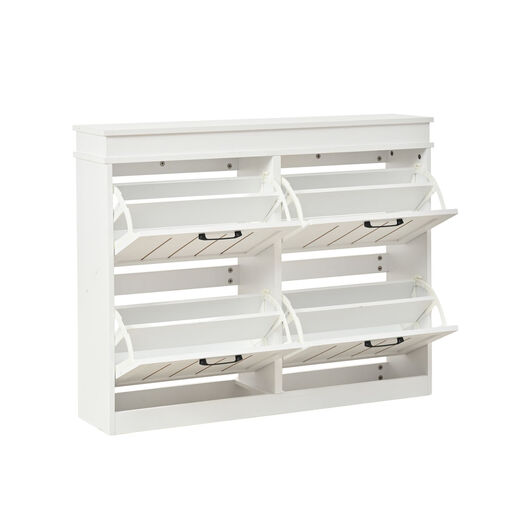
Why this choice suits this profile: Its low, wide format fits in a hallway or living room where you want to hide shoes away while keeping a handy top surface.
The external dimensions, four doors, and eight compartments are clearly stated. The removable dividers allow you to adapt the internal space.
Four hinged doors, eight compartments, black handles, and a flat top surface.
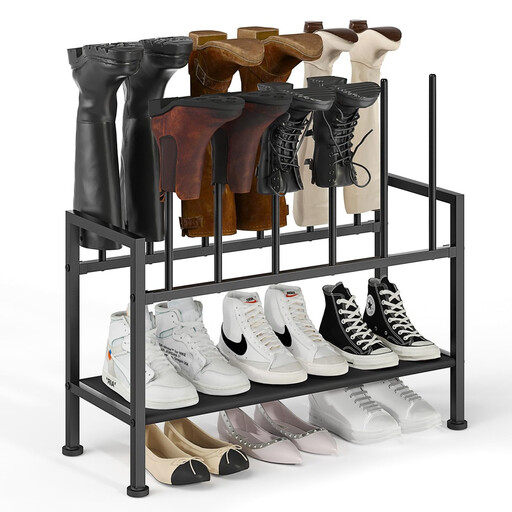
Why this choice suits this profile: This open storage unit is designed for households that switch between smart shoes, trainers, and high-top styles, and want to keep them within easy reach.
Its open design prevents you from forcing shoes into compartments that are too shallow. Still, measure the available height if you plan to store boots in it.
Metal structure, direct access to shoes, and organisation suited to different formats.
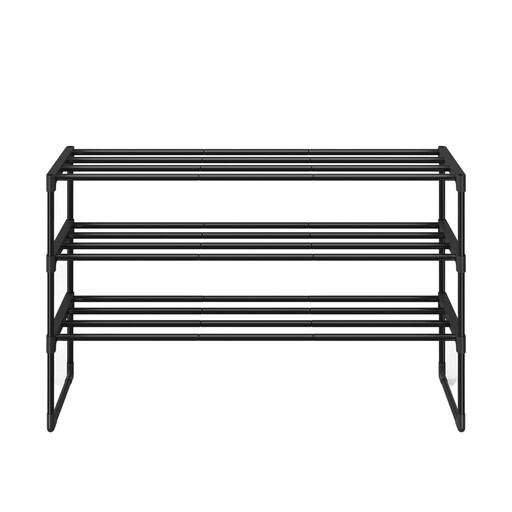
Why this choice suits this profile: With dimensions of 30 × 92 × 55 cm, this narrow model fits in a hallway, dressing room, or living room. It can be positioned, turned, or stacked depending on the available layout.
The dimensions and stated static load — 10 kg per shelf and 30 kg total — provide concrete benchmarks. Respect these limits and install the unit on a stable surface.
Three tiers, metal tubes, plastic connectors, and tool-free assembly.
We have put together a comprehensive, real-time updated selection of products that meet these demanding criteria and European safety standards.
Start by measuring the width of the walkway and the available depth, taking skirting boards into account. A narrow shoe storage unit or a vertical structure generally frees up more floor space. Install it on a level surface and check that the doors, drawers, or lids can open without obstructing movement.
The lifespan depends on the material, the quality of the joints, the load it bears, and how well it is maintained. Avoid exceeding the stated capacity, dust the unit regularly, and do not let moisture build up. A metal structure should be protected from deep scratches, while an MDF unit should be kept away from standing water.
No, standard models operate without a power supply. Their running cost is therefore essentially limited to the purchase price and maintenance. For practical storage, focus on choosing a suitable capacity, a stable structure, and access that matches how often you use your shoes.