
Livraison le jour même ou le lendemain

Qualité garantie

Débloquez vos offres de bienvenue: Livraison GRATUITE | Jusqu'à -80 % | 30 jours d'essai gratuits à JoyPlus
Téléchargez l'application
Shoes piling up in the entryway is a classic problem. It's a real headache that quickly turns your hallway into a minefield. The obvious solution? A good shoe rack. The market, however, is flooded with models that promise the world but quickly prove disappointing. Before you make a purchase, it's crucial to know how to spot the traps that can turn a promising buy into a bulky, useless regret.
Our editorial mission is to help you see things more clearly. Together, we'll break down the hidden flaws and the criteria that truly matter to find the perfect shoe storage solution—one that won't literally fall apart on you after a few months.
An attractive price or a sleek design often hides major defects. Here are the three most common problems that will send a shoe rack to the landfill in just a few months.
To avoid falling into the trap, forget the marketing hype and focus on objective technical criteria. These are the true indicators of a shoe organiser's quality and practicality.
The durability of your rack depends directly on its components. A metal shoe rack is often a wise choice, but not all metals are created equal.
A space-saving shoe storage unit is, above all, a well-sized piece of furniture. The first step: before buying, take out your tape measure and precisely measure the available space (width, depth, height).
The format of your organiser should match its location.
Every home has unique constraints. Here are a few recommended options, chosen for their pragmatic design and their ability to meet specific user profiles.
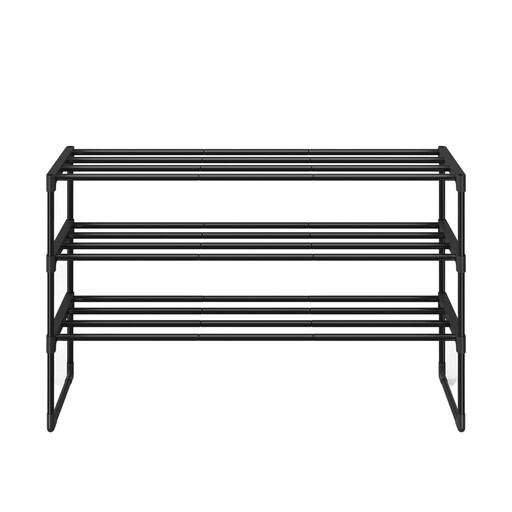
Why we love it: Perfect for a family or anyone looking for a simple, effective solution to end the clutter in their entryway or closet. Its large capacity and stackable design adapt to growing storage needs.
Its structure of sturdy metal tubes and high-quality plastic connectors ensures excellent stability. Say goodbye to warping and wobbling! The advertised capacity (16-20 pairs) is realistic for its generous dimensions (92 cm wide).
Its versatility (can be assembled straight, inverted, or stacked) and lightning-fast, tool-free assembly.
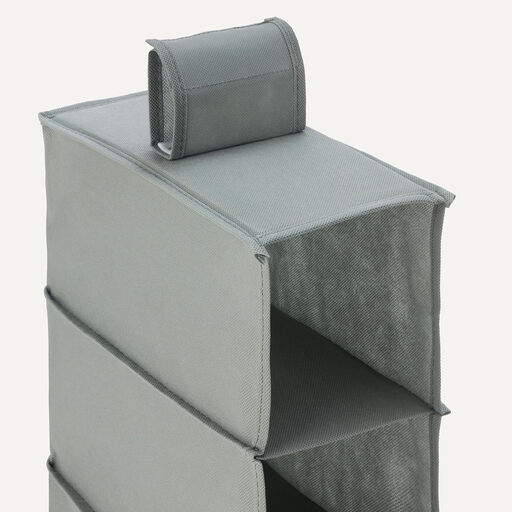
Why we love it: The dream solution for those living in apartments or studios where every square centimetre counts. This system uses the vertical space in a wardrobe to organise shoes while keeping the floor clear.
Since it's hanging, the problem of floor stability is simply eliminated. Its design is specifically engineered for space-saving shoe storage, avoiding the risk of choosing a unit that's too bulky for a small room.
Foldable design for easy storage when not in use and maximisation of vertical closet space.
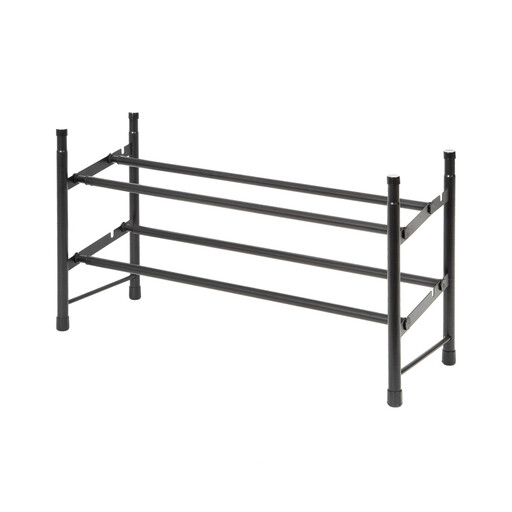
Why we love it: For those whose shoe collection is always growing or who move frequently. Its ability to extend from 62 to 117 cm allows it to fit into various spaces, from a narrow niche to a large dressing room.
Its epoxy-coated metal structure gives it excellent durability and good rust resistance, neatly sidestepping the flimsy materials trap. The fact that it's extendable solves the problem of fixed and often misjudged storage capacity.
Its adjustable length for a near-custom fit and the ability to stack multiple units to gain vertical space.
Discover our full selection of shoe racks that meet all our criteria for quality and durability.
It all depends on the type of shoes. For low-profile shoes like trainers or sandals, a space of 15 to 20 cm between shelves is sufficient. For ankle boots or high heels, plan for 25 to 30 cm. Some models offer adjustable shelves, which provide welcome flexibility.
If your rack is a bit wobbly, first check that it's on a completely flat surface. If the problem persists, place the heaviest shoes on the bottom shelf to lower the centre of gravity. For maximum safety, especially with children, it is highly recommended to secure tall units to the wall with an anti-tip strap (often included).
A shoe rack is an open structure. Its main advantage is good ventilation for your shoes and immediate access. A shoe cabinet, on the other hand, is enclosed (with doors, flaps, etc.). It protects shoes from dust for a cleaner look, but at the cost of ventilation. The choice depends on your priorities: easy access and airflow versus a streamlined aesthetic and protection.