
Livraison le jour même ou le lendemain

Qualité garantie

Débloquez vos offres de bienvenue: Livraison GRATUITE | Jusqu'à -80 % | 30 jours d'essai gratuits à JoyPlus
Téléchargez l'application
A cluttered entrance can quickly become a busy passageway that is difficult to keep tidy. However, choosing a shoe cabinet is not simply a matter of comparing prices or the number of compartments. Depth, stability and access to your pairs all play an important role in everyday use.
Some drawbacks only become apparent after installation: doors that intrude into the walkway, shelves that are too low for ankle boots, an unstable cabinet or a stated capacity calculated using particularly slim shoes. Here are the criteria to consider before buying, along with a selection of models suited to different types of home.
A bulky cabinet can reduce the usable width of a hallway or small entrance. Conversely, a slim shoe cabinet may not be deep enough to accommodate certain sizes properly.
Before ordering, measure:
If you live in rented accommodation, also check that you can secure the cabinet to the wall without damaging a delicate surface.
The number of pairs stated by a manufacturer rarely applies to every type of shoe. Chunky trainers, high-top shoes and boots take up considerably more space than flat shoes.
A cabinet advertised as holding 20 pairs may therefore prove impractical if its compartments are fixed. Adjustable or removable shelves allow you to adapt the internal height and make the most of every centimetre. For a family, also compare the number of levels, the width of each compartment and how easily you can reach the shoes you wear every day.
A white finish, a few gold details or doors that conceal the contents can make a shoe cupboard more appealing in an entrance. However, appearance should not come at the expense of stability.
Check the material used, the weight of the cabinet, the sturdiness of the feet and, above all, whether it has an anti-tip device. Wall fixing is particularly important for tall models, in homes with children or in areas with frequent foot traffic.
For entrance shoe storage, the width should match the household’s actual needs. A 60 cm model may be enough for a small collection or a compact space, while a wider cabinet will be more suitable for a multi-person household.
Models with drop-down or hinged doors conceal shoes and reduce the impression of clutter. An open shoe rack, on the other hand, lets you see the available pairs immediately and allows them to dry more easily after going out in the rain. The right choice therefore depends on your habits and where the cabinet will be installed.
High-density particle board is widely used in indoor furniture. It provides an even surface while keeping the weight reasonable. To preserve its appearance, clean it with a slightly damp cloth and avoid standing water, particularly around the edges and joints.
A metal frame can be a good option for lightweight, open storage. If so, check the maximum load specified for each level. This figure generally refers to a distributed static load: it does not mean that you can sit on each shelf.
A shoe cabinet with bench makes changing shoes in the entrance easier, provided that the seat is genuinely designed for this purpose. Check the stated maximum load, how the different components are secured and whether the cover can be removed for washing.
A model with a drawer can also hold keys, laces, cleaning products and various small accessories. The top surface then becomes a handy place for a key tray or a few decorative items. These additional features are useful as long as they do not make it harder to access your shoes.
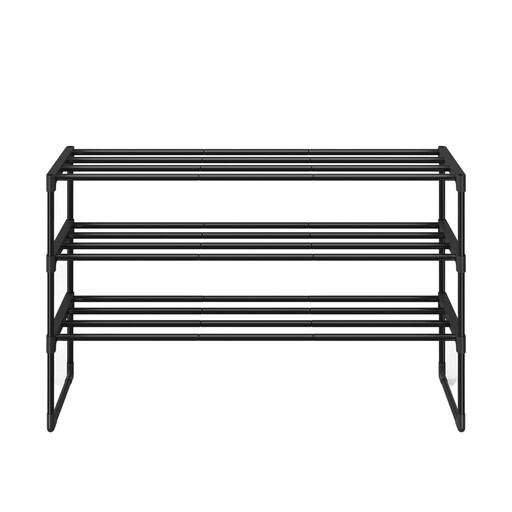
Why this choice suits this profile : This open storage unit is ideal for renters and anyone who wants to start with a lightweight solution without doors or tool-based assembly. Measuring 30 x 92 x 55 cm, it fits easily in a hallway or dressing room.
Its open design means that hard-to-reach shoes do not get pushed to the back of a cabinet, while tool-free assembly reduces the installation steps.
Three levels, stackable or reversible design, a stated static load of 10 kg per level and 30 kg in total.
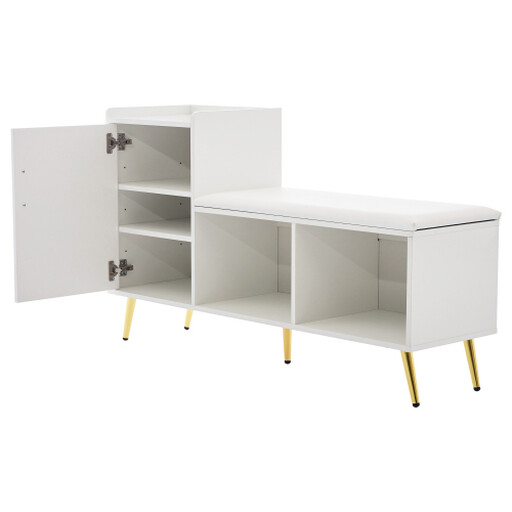
Why this choice suits this profile : With its 120 cm width and glossy white finish, this cabinet is designed for anyone looking for a decorative piece that combines a bench, doors and LED lighting in a well-kept entrance.
The bench and enclosed storage combine several uses. However, measure the available length before choosing this format.
Dimensions of 120 x 35 x 71,5 cm, padded seat, four levels, doors and LED lighting according to the product details.
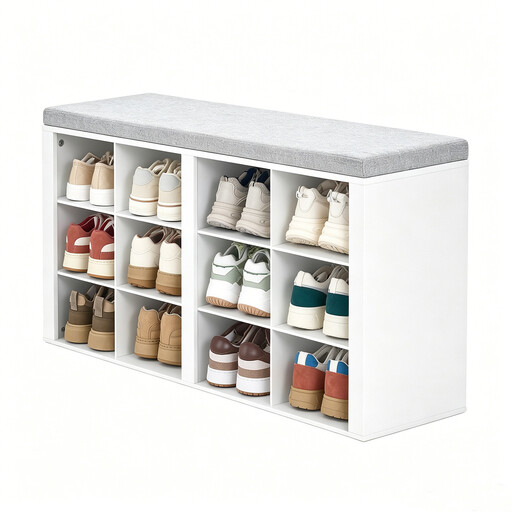
Why this choice suits this profile : This shoe cabinet with bench is suitable for a family that changes shoes frequently and wants a seat in the entrance, bedroom or hallway.
The adjustable shelves provide extra height for trainers, ankle boots or heeled shoes, rather than forcing you to work around fixed compartments.
Twelve compartments, a seat stated to support a load of 150 kg and a removable cover for easier care.
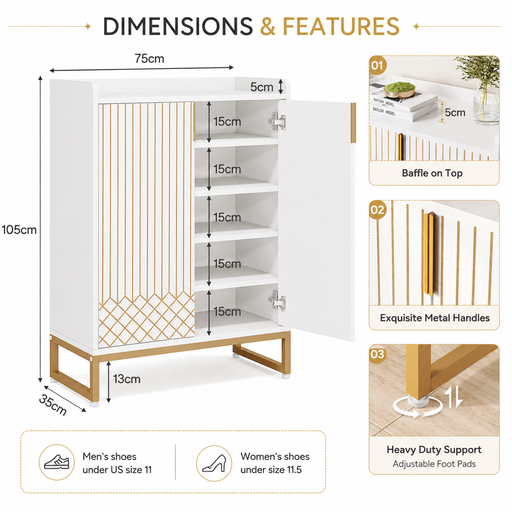
Why this choice suits this profile : This white shoe cupboard is designed for households looking for a stated capacity of 22 to 25 pairs, with enclosed storage for the hallway, bedroom or dressing room.
The doors protect shoes from dust, while the open lower shelf keeps the pairs you use every day close at hand.
Five levels, wooden structure, metal hinges and a top surface that can be used for displaying a few decorative items.
We have compiled a complete, real-time updated list of products that meet these demanding selection criteria and European safety requirements.
To extend the life of a space-saving shoe storage unit, assemble it on a perfectly level floor and tighten the fixings gradually. Never force a misaligned door: instead, check that the cabinet is level and inspect the position of the hinges.
If the product has an anti-tip device, install it according to the instructions and in line with the type of wall in your home. Place heavier shoes on the lower levels and observe the stated maximum load.
Finally, allow wet shoes to dry before storing them in an enclosed cabinet. This simple habit helps prevent unpleasant odours and the build-up of moisture inside the compartments.
Allow enough depth for your shoe size and bulkiest styles, while ensuring that there is still comfortable room to move around. In a hallway, a slim model or open design can reduce the visual sense of clutter.
A shoe cabinet with doors is ideal if you want to conceal the contents and limit visible dust. An open rack provides easier access and better ventilation, but requires more regular tidying to keep the entrance looking neat.
Start by counting the pairs you actually wear, then allow a reasonable amount of extra space. Next, check the compartment dimensions, whether the shelves are adjustable and the load they can support. A large capacity is only useful if it remains accessible and suits your shoes.