
Livraison le jour même ou le lendemain

Qualité garantie

Débloquez vos offres de bienvenue: Livraison GRATUITE | Jusqu'à -80 % | 30 jours d'essai gratuits à JoyPlus
Téléchargez l'application
A hallway cluttered with trainers, ankle boots and smart shoes quickly becomes a hassle. Yet choosing a shoe cabinet isn’t just about counting the number of compartments. Depth, stability, ventilation and the type of opening all have a direct impact on everyday comfort.
Here are the main pitfalls to avoid, the criteria to check, and several solutions suited to British homes.
A cabinet advertised for 25 pairs won’t necessarily hold 25 pairs of boots or bulky shoes. The figures are usually calculated using flat shoes, stored in an optimised way. Thick soles, high-top styles and larger sizes quickly reduce the available space.
For a household that already has a sizeable collection, it’s wise to allow some margin. A closed shoe cabinet with several tiers can hold the pairs you wear regularly, while a separate shelf can store the bulkier styles.
A shoe storage unit that’s too deep can stop a door from opening, narrow the walkway or encroach on a circulation area. Before ordering, measure the available width, the ceiling height and the space needed in front of the unit.
In a narrow hallway, a shallow model or a narrow shoe cabinet will often be more practical than a large cupboard. Also remember to check the height of the skirting boards and whether there’s a radiator nearby.
A white shoe cabinet or a contemporary finish may fit easily into your décor, but its appearance says nothing about its stability. A lightweight frame, flimsy connectors or shelves that aren’t properly supported can quickly limit its everyday use.
Examine the materials, dimensions, maximum load rating and assembly instructions. For a tall model, wall fixing may be wise, depending on your room layout and the manufacturer’s recommendations.
Start by counting how many pairs you need to store now, then add a margin for future purchases. Claims like shoe cabinet for 25 pairs should always be compared with the shape and size of the compartments.
Also measure:
An open shoe shelf makes access and ventilation easier. A closed model offers better protection from dust and hides shoes away, but you need to pay more attention to air circulation.
Metal works particularly well for open structures, especially a metal shoe rack installed in a hallway, dressing room or utility area. Lacquered or epoxy-coated metal tubes withstand everyday use, but stability also depends on the quality of the joints and how level the floor is.
MDF or composite wood generally allows for a closed shoe cabinet with a more decorative finish. Check the hinges, feet and rigidity of the top panel. The unit must be placed on a flat surface and not loaded beyond the stated limits.
After a rainy day, shoes can retain moisture. So avoid shutting them away immediately in a completely closed cabinet. Let them dry before storing them, and clean the inside of the unit regularly.
For metal frames, a soft cloth is usually enough. Don’t use abrasive products on a lacquered finish. For panel-based cabinets, limit contact with water and wipe up any splashes quickly.
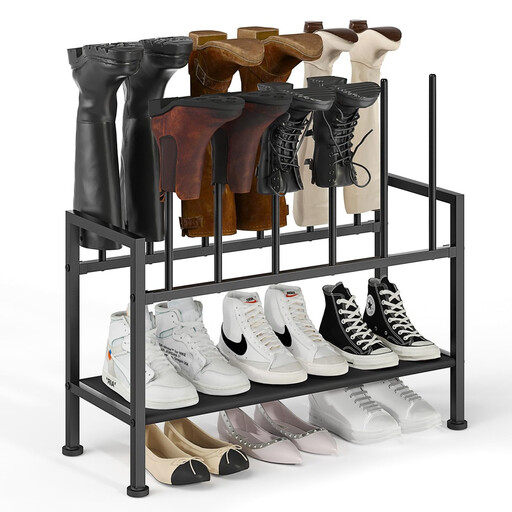
Why this model could work: this open shelf fits easily into a hallway or dressing room where quick access matters more than concealed storage. Its black frame accommodates different types of footwear, including high-top styles.
Open storage stops you from locking in damp shoes and lets you see the actual space available at a glance.
Metal frame, floor-standing design and construction suited to both shoes and boots.
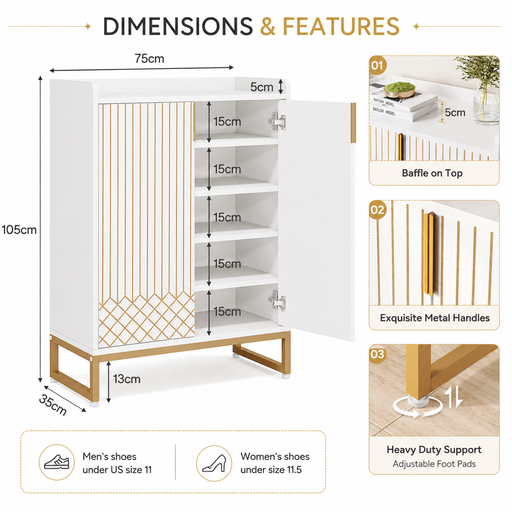
Why this model could work: this white, closed shoe cabinet is aimed at households wanting to store around 22 to 25 pairs while keeping a top surface for a few decorative items.
The five tiers and doors let you assess capacity before buying and help limit dust exposure.
Advertised capacity of 22 to 25 pairs, five tiers, doors, open bottom shelf and wooden structure with metal feet.
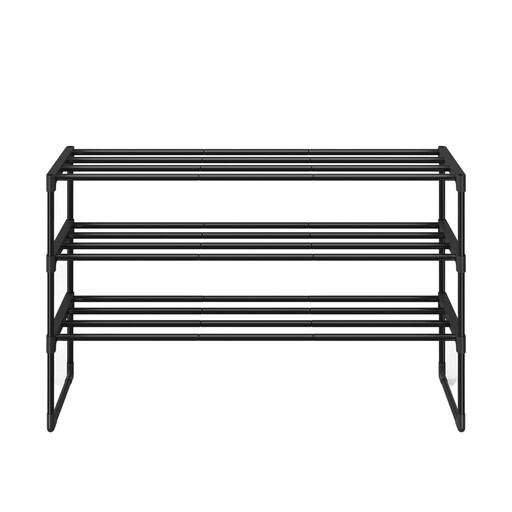
Why this model could work: with dimensions of 30 × 92 × 55 cm, this rack fits into a hallway, cupboard or living room when the available width is limited.
The advertised capacity of 16 to 20 pairs and a maximum load of 10 kg per tier help you size your purchase more accurately.
Metal tubes, plastic connectors, tool-free assembly and a stackable or reversible design depending on your layout.
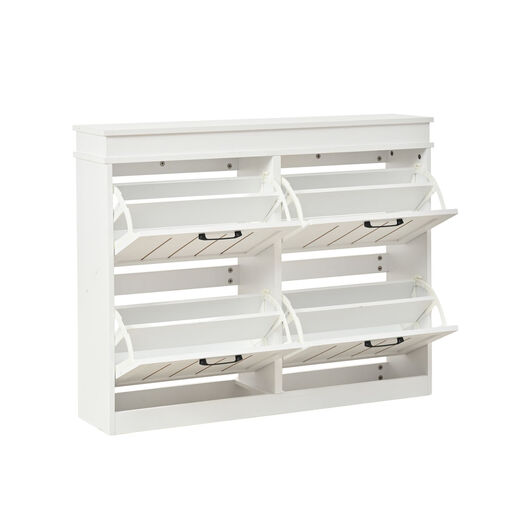
Why this model could work: its 24 cm depth is ideal for hallways and walkways where every centimetre counts.
The dimensions are clearly stated, so you can compare them with the actual width of your walkway before ordering.
Four hinged doors, eight compartments, removable dividers and a flat top panel.
For hallway shoe storage, place the unit near the door without reducing the width of the walkway. Open models work well for shoes you wear frequently. Closed cabinets fit more easily into a living room or bedroom, as long as you let pairs dry before storing them.
A stackable shoe rack lets you add tiers gradually, but each element must sit on a stable base and be installed according to the instructions. Don’t stack several modules if the manufacturer doesn’t allow it. In any case, check the stability after assembly and use an anchoring device when recommended.
We’ve put together an updated selection of products that meet these criteria, to help you organise your shoes in different rooms of the home.
The capacity depends on the width of the compartments and the type of footwear. A claim of 22 to 25 pairs may suit smaller styles, but ankle boots and larger sizes take up more room. Measure your collection before buying.
An open shelf makes access and ventilation easier. A cabinet with doors offers better protection from dust and creates a tidier look. To avoid odours and moisture, let shoes dry before storing them in a closed cabinet.
Respect the stated load, distribute weight evenly across the tiers and avoid moving the unit when it’s full. Clean surfaces with a cloth suitable for the material, and regularly check the screws, hinges and connectors.