
Livraison le jour même ou le lendemain

Qualité garantie

Débloquez vos offres de bienvenue: Livraison GRATUITE | Jusqu'à -80 % | 30 jours d'essai gratuits à JoyPlus
Téléchargez l'application
Your entryway is the first impression guests have of your home. Yet, it too often transforms into a chaotic battlefield where the whole family's shoes pile up. A good shoe cabinet seems like the obvious solution, but the purchase can quickly turn into a headache. Between unrealistic capacity claims and materials that deteriorate in months, it's easy to end up with buyer's remorse.
As the head of product selection at Joybuy, my mission is to help you see things more clearly. Let's cut through the marketing jargon and focus on the facts. Here are the pitfalls to avoid and the essential criteria for finding the cabinet that will finally bring order to your entryway.
A cabinet that looks appealing in photos can turn out to be completely impractical in reality. Here are three common design flaws that make them a pain to use day-to-day:
For a successful purchase, you need to look beyond the design. Focus on these three technical aspects that will make all the difference in the long run.
Sturdiness is the non-negotiable criterion. For a composite wood cabinet, opt for particle board with a thickness of at least 15 mm. Check for solid feet (metal or solid wood) that raise it off the floor to protect it from ground-level dirt and moisture (think rainy days!). A crucial detail that's often overlooked: the anti-tip device. It's a simple bracket to secure the cabinet to the wall, which is essential for everyone's safety, especially children.
A good shoe cabinet should adapt to your needs, not the other way around. The key is modularity. Look for models with height-adjustable or removable shelves. This allows you to configure the interior to accommodate everything from high heels to winter boots. To assess the real capacity, don't rely on the advertised number of pairs; instead, check the depth and width of the compartments.
The basics: take out your tape measure and measure the space you have available. For entryway shoe storage or a hallway, a narrow shoe cabinet (usually less than 30 cm deep) is often the best solution. Also, consider its use: a shoe bench with a seat is perfect for putting on shoes without losing your balance, while a closed cabinet will protect your pairs from dust while keeping the entryway looking immaculate.
Every household has different constraints and habits. Here is a selection of solutions that cater to specific user profiles, taking into account the quality and practicality criteria we've just discussed.
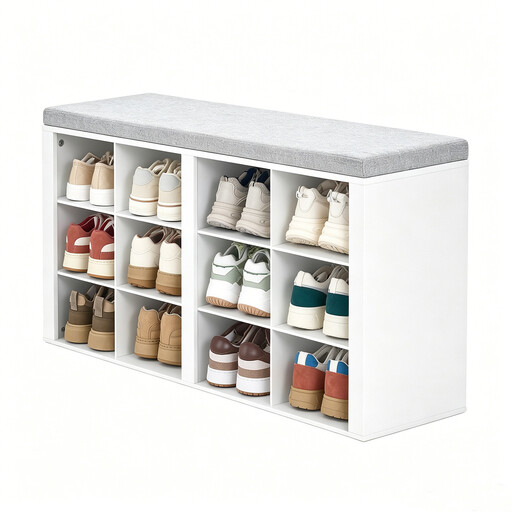
Why it's a match: This shoe bench with a seat is perfect for entryways where you like to sit down to put on your shoes. It combines storage and functionality, which is ideal for families.
Its height-adjustable shelves overcome the lack of modularity. You can easily create taller compartments for ankle boots or hiking shoes.
The seat supports up to 150 kg, a testament to its sturdiness. The cushion is removable and washable, a real plus for maintenance.
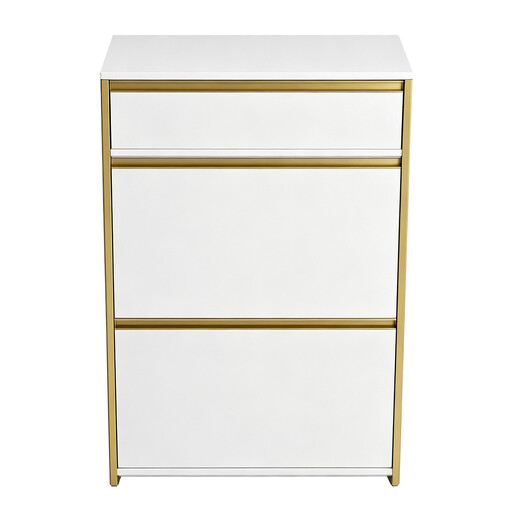
Why it's a match: At only 24 cm deep, this narrow shoe cabinet is the solution for hallways and entryways where every inch counts. Its sleek white and gold design integrates easily.
It sidesteps the fragility trap with its high-density panels and, most importantly, its dual anti-tip system that ensures a rock-solid wall attachment.
Its storage is ultra-versatile: 4 adjustable shelves, a drawer for keys and shoe polish, and a top surface for displaying a few decorative items.
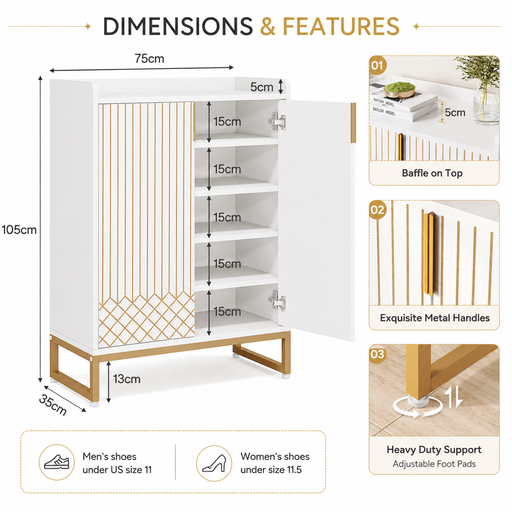
Why it's a match: This high-capacity shoe cabinet is perfect for collectors or large families. Its designer shoe cabinet style with doors conceals clutter and adds a touch of elegance.
It debunks the false capacity promise: its 5 well-designed tiers genuinely accommodate 22 to 25 pairs of different sizes.
Its wooden structure is stabilised by square metal feet for perfect support. The doors, meanwhile, keep shoes protected from dust.
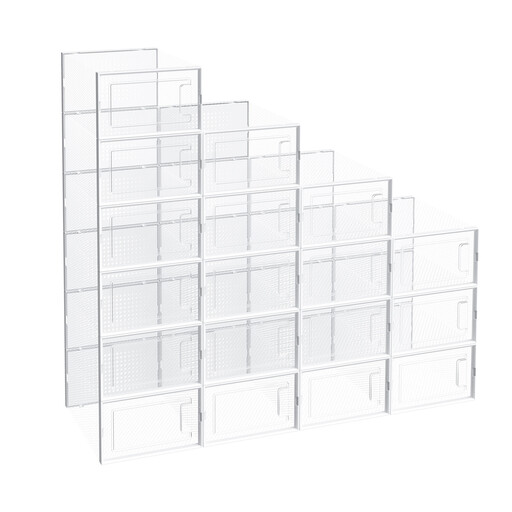
Why it's a match: For sneakerheads or fans of bespoke storage, these stackable boxes are ideal. They allow you to build a custom storage wall and admire your collection at a glance.
This system shatters the constraints of fixed capacity and modularity. You add boxes as your collection grows; each pair gets its own dedicated case.
The clear plastic lets you spot the right pair in a second. The front-facing door provides easy access, and vents prevent unpleasant odours.
Explore our full selection of products that meet our quality criteria and current safety standards.
Regular dusting with a soft cloth is usually sufficient. For stains, a slightly damp cloth will do the trick, as long as you dry the surface immediately afterwards. Above all, avoid abrasive products or excessive water, which would cause the wood to swell! Pro tip: remember to tighten the screws once a year to ensure rock-solid stability.
Absolutely, if you choose a quality model. The key thing to check is the weight capacity stated by the manufacturer. A bench certified for 120 to 150 kg, like the HaluPeit model in our selection, is perfectly designed for an adult to sit on daily.
We refer to a cabinet as "narrow" when it's under 30 cm deep, with the most space-efficient models going down to 24 cm. The essential step before buying: measure your largest pair of shoes! In a tilt-out cabinet, shoes are stored vertically, which explains the space saving. For a model with classic shelves, check that the depth allows the doors to close without anything getting stuck.