
Livraison le jour même ou le lendemain

Qualité garantie

Débloquez vos offres de bienvenue: Livraison GRATUITE | Jusqu'à -80 % | 30 jours d'essai gratuits à JoyPlus
Téléchargez l'application
Shoes piling up in the entryway? It's a real headache. Beyond the visual clutter, it creates a daily obstacle course. Finding the right shoe cabinet is therefore essential to reclaim a clear and welcoming entryway.
This guide is here to help you find the perfect storage solution, tailored to your space, needs, and decor. We'll break down the key criteria to consider before you buy and present our selection of the best models available right now.
To ensure you make the right choice, here are the essential points to check before you commit.
Entryway shoe storage solutions come in various forms, each with its own advantages:
Get your tape measure out! Accurately measure the space where you plan to install the furniture (width, depth, height). Remember to leave enough clearance for doors or drawers to open, or you might find yourself stuck.
Next, take stock: how many pairs of shoes need to fit? Don't forget to account for different sizes: boots, high heels, and bulky trainers have different height requirements. Some models offer adjustable shelves, a real bonus for accommodating your entire collection.
The choice of materials directly impacts the durability and aesthetics of your furniture. Particleboard, which is very common, is appealing for its excellent value for money. Steel, on the other hand, is the star of the industrial style, providing sturdiness and character.
Finally, make sure the furniture's style matches your decor. Whether it's modern, minimalist, industrial, or Scandinavian, the shoe cabinet should blend seamlessly into your entryway to create a cohesive and welcoming space.
To help you decide, here is a selection of products that cater to different needs and budgets.
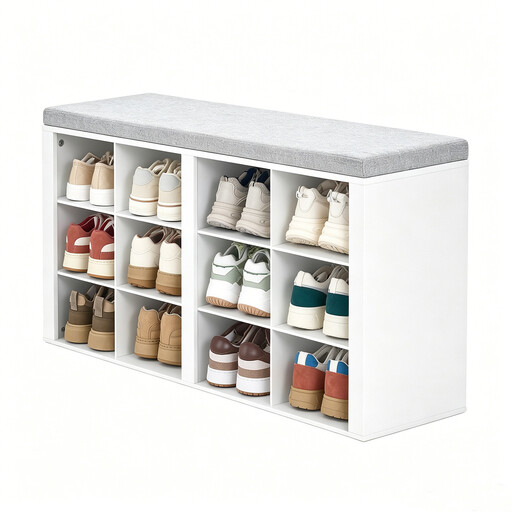
What We Love
This shoe bench is a particularly clever and versatile model. Its key feature is the height-adjustable shelves. They allow you to configure the 12 compartments to accommodate everything from trainers to ankle boots. The padded seat adds a much-appreciated touch of comfort for daily use.
Key Features
Who is it for?
Ideal for those looking for a functional and modular entryway bench with seating that can evolve with their shoe collection.
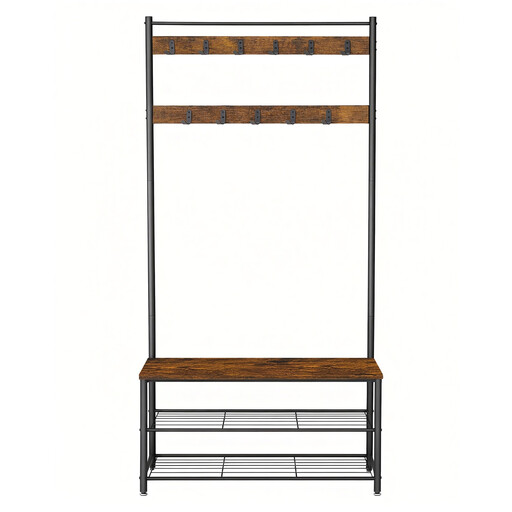
What We Love
This hall tree is the very definition of smart furniture: it combines three functions in one compact unit. It features 9 hooks for coats and bags, a practical bench for sitting, and two shelves for shoes. Its design, which pairs rustic wood with black steel, gives it a very trendy industrial style.
Key Features
Who is it for?
Perfect for those looking to optimise a small entryway or hallway with a multifunctional piece of furniture that is both sturdy and stylish.
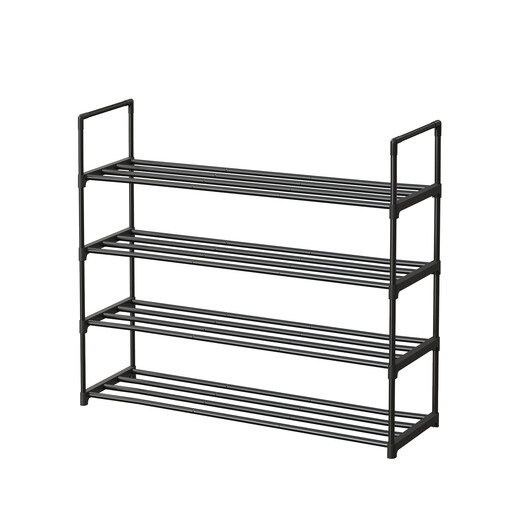
What We Love
This shoe rack gets straight to the point: simplicity and efficiency. With its 4 tiers, it offers impressive storage capacity in a compact format. Its structure of metal tubes and plastic connectors allows for ultra-fast, tool-free assembly.
Key Features
Who is it for?
The ideal option for those looking for a budget-friendly storage solution that is quick to install and can accommodate a large shoe collection.
If the models featured aren't exactly what you're looking for, or if you simply want to explore other styles, many other solutions are available.
? Discover our complete collection of entryway furniture
1. How do you store shoes when you're short on space?
For small spaces, focus on verticality with tall, narrow racks. Wall-mounted units or over-the-door shoe organisers are also excellent tricks to free up floor space. A compact shoe bench remains an incredibly effective 2-in-1 solution.
2. What depth should I choose for a shoe cabinet?
The standard depth for a shoe cabinet ranges from 30 to 40 cm, which allows pairs to be stored flat. For hallways and other very narrow spaces, there are shallow-depth models (15 to 25 cm), often equipped with drop-down doors where shoes are stored vertically. In any case, make sure the depth is sufficient for your largest shoe sizes!
3. How do I choose the right shoe bench?
To choose the right shoe bench, estimate the storage capacity you need (the number of compartments) and check the maximum weight the seat can support. Also consider comfort (padded cushion or not) and the materials, which should harmonise with your decor and intended use.