
Livraison le jour même ou le lendemain

Qualité garantie

Débloquez vos offres de bienvenue: Livraison GRATUITE | Jusqu'à -80 % | 30 jours d'essai gratuits à JoyPlus
Téléchargez l'application
Your entryway is your home's calling card. Yet, it's all too often sabotaged by a pile of shoes that ruins any sense of harmony. The designer closed shoe cabinet emerges as the perfect solution for blending style and storage. But be warned: the market is flooded with models making tempting promises that quickly turn into costly disappointments.
As a product expert at Joybuy, I'm here to break down the market for you. Let's analyse the three common pitfalls to avoid so your purchase doesn't become a headache.
For a successful purchase, focus on objective facts rather than marketing hype. Here are the three key points to scrutinise.
Don't just trust the advertised number of pairs; look at the internal configuration. A good high-capacity shoe cabinet offers adjustable or removable shelves. This allows you to adapt the space to accommodate everything from high boots to simple trainers. Check the internal dimensions of the compartments. A depth of at least 30 cm is a good benchmark for comfortably storing most adult shoe sizes.
The lifespan of your cabinet depends directly on its construction.
A modern entryway cabinet should complement your space without overwhelming it. For narrow hallways or entryways, models less than 30 cm deep are ideal. Style is, of course, a key factor. A white shoe cabinet with clean lines fits into most decors, adding light and a sense of spaciousness. The golden rule: measure your available space before any purchase, and don't forget the clearance needed to open doors or flaps.
Every household has different constraints and expectations. Here is a selection of storage solutions that cater to distinct user profiles, taking into account the quality criteria we've just discussed.
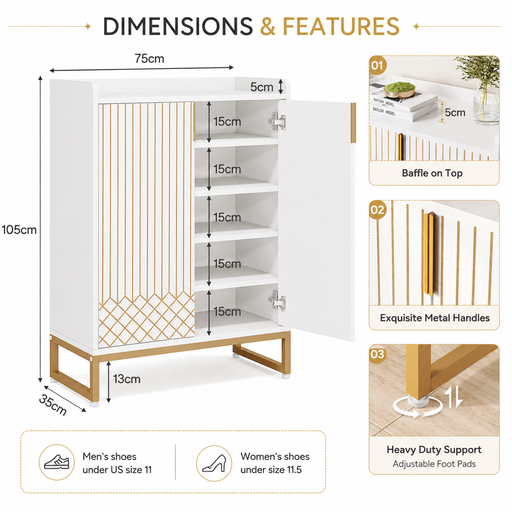
Why we chose it: This model combines substantial storage with absolute discretion. It's ideal for a family entryway where pairs of shoes accumulate quickly. Its modern, clean design integrates effortlessly.
Its advertised capacity of 22 to 25 pairs is realistic for mixed use (adults/children), and its wooden structure with square metal feet sidesteps the issue of fragility. The doors provide protection from dust.
It combines high-capacity closed storage (5-shelf shoe organiser) with a polished aesthetic, thanks to its white finish, embossed patterns, and gold handles.

Why we chose it: For those seeking an open and adaptable storage solution. This unit can hold shoes as well as books, plants, or storage boxes, evolving with your needs over time.
As an open unit, it completely bypasses the problem of poor ventilation. Its sturdy particleboard structure and included anti-tip kit ensure rock-solid stability.
Maximum versatility. It can serve as a room divider, a bookcase, or a shoe rack, offering a level of flexibility that specialised furniture lacks.
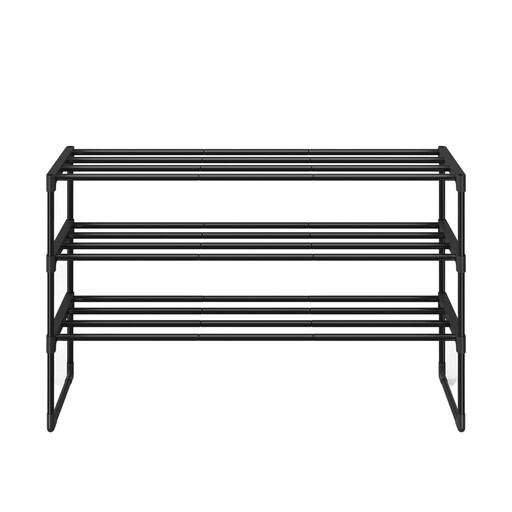
Why we chose it: The simple, cost-effective, and ultra-functional solution for organising shoes in a closet, laundry room, or small entryway. Its narrow, stackable design optimises vertical space.
Its 100% metal structure is robust and built to last, avoiding the trap of flimsy plastic connectors. Its open design ensures perfect ventilation for shoes.
An excellent capacity-to-price ratio with tool-free assembly. Its modularity allows you to adapt it to different spaces by stacking multiple units.
We have curated a full range of products that meet our quality criteria and safety standards.
Opt for models that incorporate ventilation grilles or discreet openings at the back. If your cabinet is completely enclosed, place dehumidifier bags (like bamboo charcoal) inside and make sure your shoes are completely dry before storing them.
In a hallway or entryway where every centimetre counts, shoe cabinets with drop-down doors are the best solution. Their depth, typically between 24 cm and 30 cm, preserves comfortable walking space. Don't forget to measure the area, including the clearance needed for the flaps to open fully.
Not at all. The term "particleboard" covers a wide range of quality. A cabinet made from medium-density fibreboard (MDF) that is at least 15 mm thick and has a quality melamine finish will offer excellent durability and good resistance to scratches and moisture. It's often the best compromise between quality and price.