
Livraison le jour même ou le lendemain

Qualité garantie

Débloquez vos offres de bienvenue: Livraison GRATUITE | Jusqu'à -80 % | 30 jours d'essai gratuits à JoyPlus
Téléchargez l'application
A cluttered hallway can quickly become a daily nuisance: shoes abandoned by the door, coats with no designated spot, and small accessories piling up on a console table. A shoe bench with seat brings several functions together in one piece of furniture, but not all models are equal when it comes to the constraints of a corridor or a small entrance.
Before you place your order, three pitfalls deserve your attention:
In a small entrance, a narrow shoe cabinet makes it easier to move around. Measure the available area precisely and leave a margin in front of the unit. A door, radiator or light switch can complicate installation if the cabinet is too deep.
A depth of 30 to 35 cm is generally better suited to narrow walkways. If the model also includes a coat rack, check the ceiling height as well. The JOYFURNOS cabinet featured later measures 32 × 70 × 177 cm: its height allows you to hang coats, but assumes you have enough vertical space.
Adjustable shelves let you adapt the space to different types of footwear. They're particularly handy when your household uses a mix of flat shoes, ankle boots, heels and sports shoes.
Also check:
A shoe cabinet with drawer can be very practical in a family hallway: small items stay separate from the shoes. To estimate capacity realistically, take into account shoe size, the volume of the footwear and how it needs to be stored.
The weight limit given by the manufacturer usually refers to a static load, evenly distributed. It doesn't mean the bench is designed to withstand jumping or a heavy weight concentrated on one area.
For a hallway storage unit, look for:
Particle board is very common in this category. Its strength depends on the thickness, the quality of the joints and the conditions of use. Avoid installing a cabinet in a persistently damp environment without checking the manufacturer's recommendations.
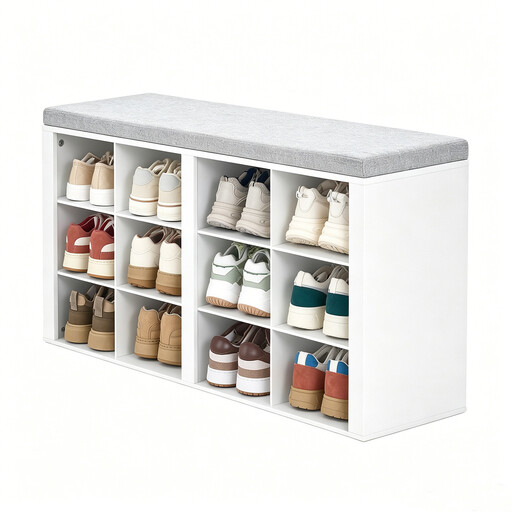
Why this choice suits this profile: This shoe bench with seat is ideal for a first purchase seeking simple organisation, with a seat for putting on shoes and compartments suited to everyday use in a hallway, bedroom or corridor.
Its adjustable shelves let you modify the internal space rather than relying on fixed-size compartments. The removable cushion covers also make routine cleaning easier.
12 compartments stated, dimensions of 30.5 × 104.5 × 49.5 cm and a declared load capacity of 150 kg for the unit.
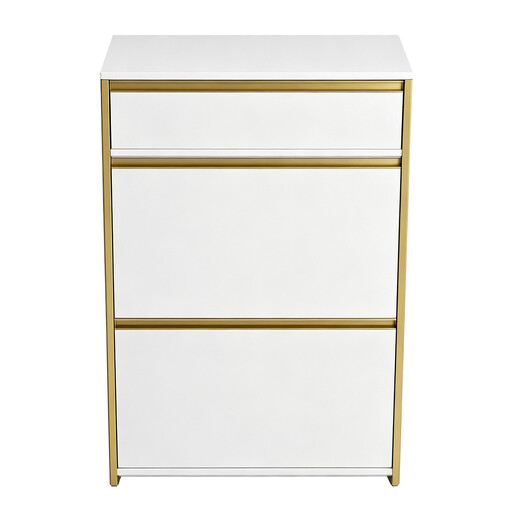
Why this choice suits this profile: Its white and gold finish complements a contemporary décor, while the top surface can hold a few decorative items or everyday accessories.
Its stated depth of 24.5 cm suits the constraints of many hallways. The removable, adjustable shelves reduce the risk of wasting space with different shoe sizes.
Two hinged doors, a drawer, four adjustable shelves and a stated capacity of up to 12 pairs of shoes.
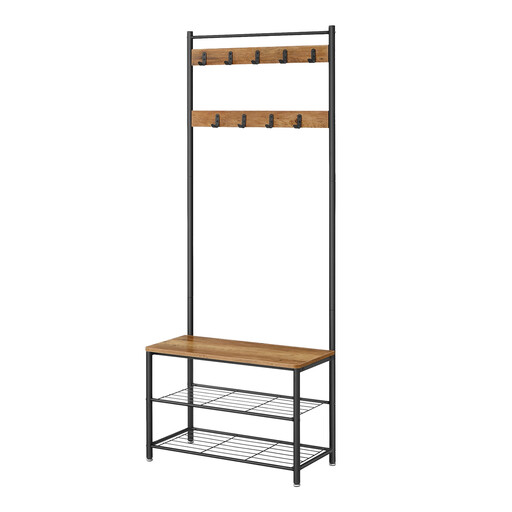
Why this choice suits this profile: This coat rack with bench combines hooks, a seat and shoe storage in a single structure. An ideal setup for a family or a heavily used hallway.
The loads are stated separately for the hooks, bench and shelves. The anti-tip kit must be fixed to the wall following the instructions provided.
Nine hooks stated at 3 kg each, bench rated for 136 kg, four adjustable feet and a steel frame with particle board panels.
We've put together a comprehensive, real-time updated selection of products that meet these strict selection criteria as well as European safety regulations.
Before you start assembling, sort the parts and check that each component's reference matches the one in the manual. Tighten the screws gradually to avoid misaligning the panels. For a tall unit, use the supplied anti-tip system and choose fixings suitable for your wall type.
Place the shoes you wear most often within easy reach and reserve the higher spaces for boots or occasional pairs. Clean the panels with a slightly damp cloth, then dry them quickly. For a shoe bench with a cushion, a removable cover makes maintenance easier, but it's best to follow the manufacturer's recommendations.
Measure the width of the passage once the cabinet is installed. A shallow model can work in a corridor, but also check the length and width of your shoes. A reduced depth may limit storage for bulkier styles or require a particular orientation.
The capacity depends on the number of shelves, their spacing and the type of footwear. Boots and trainers take up more room than flat shoes. Adjustable shelves let you adapt the layout, but it's better to compare the internal dimensions rather than relying solely on the stated number of pairs.
For a tall structure, especially a coat rack with a bench, an anti-tip fixing is an essential precaution. Follow the manual, the stated maximum load and the type of wall in your home. Fixing it doesn't remove the need to distribute the weight sensibly across the hooks and shelves.