Choose based on the size of the loads you actually group together, the space available and when you can do your washing, rather than simply on the number of people in your household. A front-loading machine is worth considering if you regularly have large loads, while a top-loader may be a better fit if space is tight. If your current machine already handles suitably full loads, organising your washing cycles better may be all you need.
Who is this advice for ?
Families who do larger loads
If your laundry piles up quickly, check the size of your sorted loads before considering a larger-capacity machine. According to ADEME, a 7 kg washing machine is enough in most cases: the number of people in your household alone doesn’t determine the capacity you need.
House shares and households with different schedules
When several people share the same machine, programme length and spin noise matter just as much as capacity when you’re arranging washing times.
Households with limited space
A top-loader can save you from needing space in front of the machine for a door to open. You’ll still need enough clearance above the lid, and should check that its capacity suits the loads you do together.
What should you check ?
Front-loading washing machine
Consider this : if you regularly have large loads and there’s enough clearance for the door to open.
Bear in mind : a larger capacity offers little benefit if the drum is often only partly full.
Top-loading washing machine
Consider this : if width is limited or a top-opening lid works better for your space.
Bear in mind : the lid needs overhead clearance and, according to Electro Dépôt, top-loaders generally have a lower capacity than front-loading machines.
Your current machine with better-planned cycles
Consider this : if its capacity is already suitable and the main challenge is sharing washing times.
Bear in mind : a schedule won’t solve insufficient capacity or cycles that don’t fit your household’s routine.
| Factor |
What to check |
Your needs |
| Capacity |
Compare the kilograms of dry laundry the machine can take with the sorted loads you put together. According to ADEME, 7 kg is enough in most cases; don’t choose based only on the number of people in your household. |
I want to fill the drum sufficiently without mixing fabrics that shouldn’t be washed together or waiting too long before each wash. |
| Cycle length |
Check the Eco 40-60 programme duration on the model’s energy label. For a quick programme, check the maximum load and suitable fabrics separately. |
The machine needs to be free in time for other people in the household; an Eco programme won’t necessarily meet the need for a short cycle. |
| Installation |
Measure the width, depth and access to the machine. Allow clearance in front of a door or above the lid of a top-loader. |
In a small room, I need to be able to install, open and use the machine without blocking the way. |
| Noise and spin |
Compare the spin noise and its class on the energy label, as well as the spin-drying efficiency class, for the programme and model in question. |
If the machine is near living areas, I want to take its noise into account at the times when my household uses it. |
| Energy use and durability |
Compare the kWh per 100 cycles and litres per cycle shown on the energy label on a like-for-like basis. In France, also check the model’s durability index. |
I want to compare machines that suit our loads while taking their long-term use into account. |
What should you avoid ?
-
Choosing a large capacity based only on the number of people in your household
Sorted loads can still be small, even in a shared household. ADEME recommends choosing a capacity that suits your needs and avoiding half loads.
For a while, keep an eye on the laundry you actually put together, including days when it builds up, before settling on a capacity.
-
Assuming Eco 40-60 is a quick programme
This programme is used as a reference when comparing factors such as duration, water and energy use; its run time may not suit the way you share the machine.
Check its duration on the energy label, then separately check the load size and fabrics allowed by the model’s short programmes.
-
Measuring the width of a top-loader but not checking the lid clearance
A top-loader avoids the clearance needed in front of a door, but you still need to be able to open its lid. Its capacity also needs to suit your household’s loads.
Measure the overhead clearance, depth and access routes, then check the capacity of the model you’re considering.
Which brands should you consider ?
A brand is a useful starting point, but for your household, the format and features of the specific model matter most.
Bosch
Bosch lists freestanding and integrated washing machines on its French website.
- Check which installation type suits the space you have available.
- Compare capacity, noise and programme length for each individual model.
Electrolux
If you’re considering an Electrolux model, start with its format and your household’s usual loads.
- Compare the model’s dimensions and opening with the space you have in mind.
- Don’t assume how noisy or energy-efficient a machine is based on the brand name alone.
Whirlpool
You can assess a Whirlpool model using the same capacity and installation criteria.
- Check whether its format works with the space constraints in your home.
- Check the energy label and durability index for the exact model before comparing it with others.
Washing machines to suit your needs
These Joybuy models include front-loaders for larger combined loads and a top-loader for spaces where width is more of a concern. The right choice still depends on your usual loads, the space available and when you can do your washing.
 Image unavailable
Haier X Series 11 HW100-BD14397PGU1, 10 kg, 1 400 rpm
This 10 kg front-loader is worth considering if your household regularly combines large loads; otherwise, you may not make much use of its capacity. If you share washing times, bear in mind that the Eco 40-60 cycle is listed as taking 3 h 58, and compare the spin noise with the planned location.
View on Joybuy
 Image unavailable
Electrolux EW7FI259160V, 9 kg, 1 600 rpm
Consider the 9 kg capacity if the loads you combine regularly reach that size. The product information describes SensiCare as a feature that adjusts the cycle to the load; if you need to book a short time slot, check the duration and conditions for the QuickCare programme, which are listed inconsistently.
View on Joybuy
 Image unavailable
Candy TCA464TM4-S ProWash 500, 6 kg top-loader, 1 400 rpm
This top-loader suits spaces where width is a concern, with a listed width of 40.5 cm, as long as there’s room to open the lid. Its 6 kg capacity may mean more cycles if your combined loads are large; its listed spin noise of 79 dB is also worth considering if it’s near living areas. Check the load allowed for the quick programme you’re considering.
View on Joybuy
 Image unavailable
Electrolux EWF1410N2, 10 kg, TimeSave
The 10 kg capacity is worth considering if your household regularly has large combined loads. TimeSave is described as a feature that reduces cycle length, so check which programmes it applies to and how long they take before relying on it for shared washing times. The listed spin noise is 76 dB.
View on Joybuy
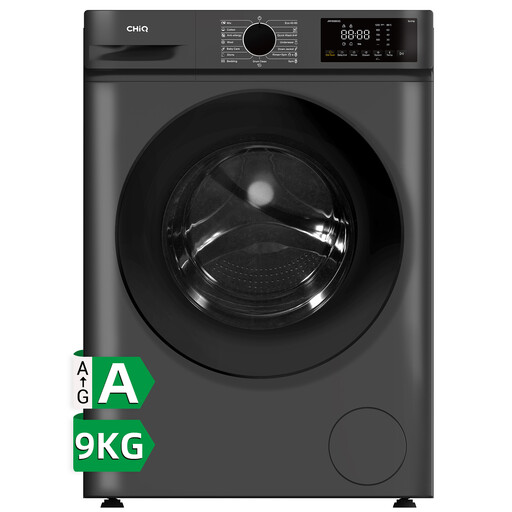 Image unavailable
CHiQ JW95883G, 9 kg, 1 400 rpm, dark grey
Compare this 9 kg front-loader with the loads your household actually combines. A 15-minute cycle is listed for lightly soiled everyday laundry, not for every wash. Check the dimensions before planning the installation: the listed depth and width measurements are inconsistent.
View on Joybuy
Frequently asked questions
What capacity should you choose when several people use the same washing machine ?
Choose based on the loads you can actually combine after sorting, rather than simply on the number of people in your household. ADEME says that 7 kg is enough in most cases; a larger capacity is mainly justified if you regularly have large loads that will fill the drum properly.
Can a top-loading washing machine work for a shared household ?
Yes, if limited width is the main obstacle and the capacity is sufficient for your household’s loads. A top-opening lid needs overhead clearance; according to Electro Dépôt, top-loaders generally have a lower capacity than front-loading machines.
How can you compare cycle length and noise ?
Check the energy label for the exact model to find the Eco 40-60 programme duration and spin noise. The European Commission describes Eco 40-60 as the reference programme subject to requirements for duration, efficiency and water use, so don’t assume it’s the shortest programme.
What should you look at when comparing two washing machines for long-term use ?
In France, compare the durability index shown for each model, then check the warranty terms and any parts that matter to you. The French Ministry for Ecological Transition says this index has applied to washing machines since 8 April 2025; it supplements energy-use information but doesn’t replace checking the exact model.


