Which features should you compare?
First rule out sizes that won’t fit your kitchen, then compare the capacity and usage information for the models that remain. Freestanding and integrated describe how an appliance is installed; check its width separately.
| Feature |
What to check |
Who is this important to? |
| Capacity and cycle frequency |
Place setting capacity and basket space for the dishes you use every day. |
If dishes from several meals are still waiting when the machine is full, I mainly want to avoid having to run extra cycles. Around 31% of consumers prioritise loading capacity. |
| Water and electricity |
Litres per reference cycle and kWh per 100 cycles on the energy label, comparing appliances with a suitable capacity. |
If the machine runs often, I want to compare how much it uses each time. Around 25% of consumers put controlling water and electricity use first. |
| Noise |
Declared noise level in dB(A) and noise class, especially if the kitchen is near living areas. |
In an open-plan kitchen or one close to a bedroom, I want to run a cycle without disturbing the others in the household. Around 19% of consumers prioritise quiet operation. |
| Space and connections |
Dimensions, door clearance and connections; for an integrated model, the cabinet niche and door panel; for a tabletop model, check the exact instructions. |
If the kitchen is already fitted, I first need to find an appliance that fits in the space and can be connected. Around 25% of consumers put installation feasibility ahead of other considerations. |
ADEME explains that the energy label shows electricity consumption in kWh per 100 reference cycles and water consumption in litres per reference cycle. These figures, like the declared noise level, are best considered alongside the model’s capacity. Low consumption per cycle alone doesn’t tell you how many cycles your household’s washing-up will need.
Brands to consider
These examples of product ranges can help you identify sizes and specifications to compare. The features mentioned apply only to the specific models listed.
Bosch
Bosch Électroménager France offers freestanding and integrated dishwashers.
- Depending on the model, the brand highlights adjustable baskets and some connected features. Check whether they’re included on the model you choose.
- For installation, Bosch advises allowing for the water supply, electricity and drainage. Check the instructions for the specific model to find out what’s required.
Whirlpool
Whirlpool France offers a range of freestanding models, including 60 cm options.
- The specifications for the W8F HS61BS list 15 place settings, 41 dB and 9,9 L per cycle. These figures apply to this model, not the entire range.
- Its installation guide advises taking the water supply, drainage and electrical socket into account.
Electrolux
Electrolux France offers narrow integrated appliances for kitchens where space is limited.
- The specifications for the EES42210L list a width of 45 cm, capacity for 9 place settings and water consumption of 9,9 L per cycle.
- These specifications are for the EES42210L. Check those of any other 45 cm model, along with the dimensions of its cabinet niche.
Miele
Miele France offers freestanding and fully integrated dishwashers.
- For some models, its range page lists declared noise levels of 41 dB or 43 dB.
- Size and noise levels vary by model. Check the specifications for an appliance that suits your kitchen.
Freestanding dishwashers on Joybuy
These freestanding models are worth considering if your shared kitchen has the right space and connections. Their listed capacities are similar, so compare their exact dimensions, declared noise levels and energy label figures too.
 Image unavailable
Whirlpool WFP5O41PLGX, 14 place settings
Worth considering if several people fill the dishwasher quickly: the title lists 14 place settings and energy class C. A width of 60 cm is stated, but another width measurement also appears in the product information. Check the exact dimensions and clearance needed before deciding where to put it.
View on Joybuy
 Image unavailable
Samsung DW60M6050FS, 14 place settings
If flexible programming matters in your shared kitchen, the title lists 14 place settings and seven cycles. The appliance is described as freestanding, but installation beneath a worktop is also mentioned. Check the clearance requirements in the model’s instructions.
View on Joybuy
 Image unavailable
Indesit D2F HK26 S, 14 place settings
If a high-capacity freestanding appliance suits the space available, this model is listed for 14 place settings, with a width of 60 cm and energy class E. Check its energy label to compare kWh per 100 cycles with those of other suitable models.
View on Joybuy
 Image unavailable
Hotpoint H4FD641A, 14 place settings
If your kitchen is close to living areas, it’s worth comparing this model’s declared noise level with those of other appliances you’re considering. The title lists 14 place settings, 60 cm, 41 dB and energy class C. Its automatic door opening at the end of a cycle is also worth bearing in mind because of the hot steam.
View on Joybuy
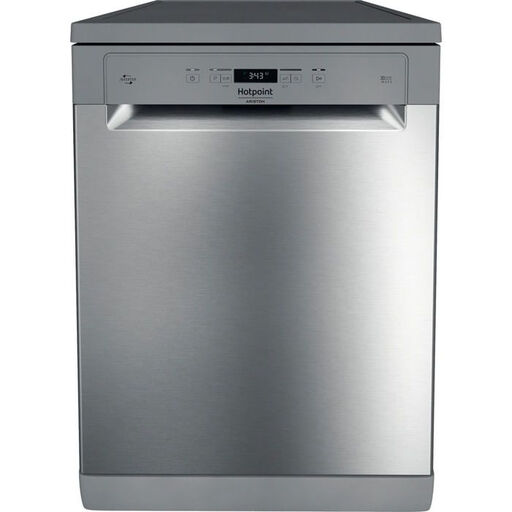 Image unavailable
Hotpoint HFC3C32WX, 14 place settings
Its listed capacity of 14 place settings could suit a shared household where the dishwasher runs frequently; the title also lists energy class D. Check the model’s dimensions and clearance requirements, as well as its water and electricity consumption on the energy label.
View on Joybuy
Frequently asked questions
What connections do freestanding and integrated dishwashers need?
You’ll need a water supply, drainage and an electrical supply, as outlined in the installation guides from Whirlpool France and Bosch Électroménager France. Check where these connections are and follow the instructions for your chosen model, particularly regarding dimensions and clearance around the connections.
What should I compare on the energy label if the dishwasher runs often?
Compare the kWh per 100 reference cycles and litres of water per reference cycle, two figures explained by ADEME. Also check the declared noise level and make sure each appliance has a suitable capacity for your household’s washing-up.
Does France’s repairability index apply to dishwashers?
Yes. France’s Ministry for Ecological Transition includes dishwashers among the product categories covered by this index in France. Check the index for the model you’re considering, but don’t use it to judge its capacity, noise or consumption.
What protection applies if a dishwasher bought from a trader isn’t as described?
In France, the Ministry of the Economy says that the legal guarantee of conformity applies to new, second-hand or reconditioned goods sold by a trader to an individual. It covers lack of conformity and is separate from any commercial guarantee offered by the seller.
How do I set the water hardness before using the dishwasher for the first time?
Set the appliance according to the local water hardness and the instructions in its manual. Electrolux France recommends checking the water hardness with a test kit or with your water supplier before adjusting the model’s water softener.


