What should you look for?
In a shared home, first check whether a machine can be installed and used without blocking access, then compare its capacity with the loads you actually do. If there’s no suitable space, using an external launderette is another option to consider.
Front-loading
Consider it if: there’s enough room to open the door and accommodate the dimensions of your chosen model.
Bear in mind: the usable depth must allow for the connections as well as the door opening.
Top-loading
Consider it if: width is limited but there’s enough space to open the lid freely.
Bear in mind: a narrower machine isn’t necessarily shallow; the Whirlpool TW6522FRESHCAREFR model presented by the brand is 40 cm wide and 60 cm deep.
Shallower front-loader
Consider it if: depth, rather than width, is the main constraint.
Bear in mind: you’ll still need to measure the other dimensions and allow room for the door to open. Candy lists its ProWash 550 BP 48SBL6-S as 595 mm wide and 488 mm deep.
External launderette
Consider it if: your home can’t accommodate a shared machine or you can’t organise access to one.
Bear in mind: travelling to the launderette and its opening hours need to work for your household’s regular laundry routine.
| Criterion |
What to check |
Who should consider it? |
| Capacity and loads |
Compare the capacity in kg with the size of your usual loads and whether you can combine laundry. ADEME says that 7 kg is usually sufficient, but you should still assess your own needs. |
If we often run half-empty drums, we need a capacity that suits the loads we can combine. This would be the top priority for around 31% of consumers. |
| Noise and spin performance |
Check the spin noise in dB, its noise class and the spin-efficiency class; the revolutions per minute don’t tell you everything. |
When the machine runs close to occupied rooms, I want to be able to assess the noise without relying on the maximum spin speed alone. Around 31% of consumers would put this need first. |
| Available space |
Measure the width, depth and height, then check the connections, delivery route and clearance needed to open the door or lid. |
If the alcove or access route is narrow, I first need an appliance we can install and open as normal. This would be the top priority for around 23% of consumers. |
| Consumption and service life |
Compare the energy and water use for the reference programme on the label. Check service features and the terms of any warranties separately. |
With regular cycles, we want to understand how much water and electricity the machine uses, without confusing a commercial warranty with its service life. Around 15% of consumers would put this need first. |
Washing machines to consider on Joybuy
These front-loaders, top-loaders and shallower front-loaders illustrate different options for a shared machine. Match their capacity to your household’s loads, then check the dimensions and noise figures before choosing a format.
 Image unavailable
Bosch WGE02407FR — 7 kg front-loader
Worth considering if your household’s usual loads suit a capacity of 7 kg.
Advertised maximum spin speed: 1 400 rpm; energy class A. Check the depth, including the door, and allow room for it to open and for the connections.
View on Joybuy
 Image unavailable
Haier T Series 7 THASN276TM6-S — 7 kg top-loader
Worth considering if width is limited and everyone can access the top-loading drum.
Advertised maximum spin speed: 1 200 rpm; energy class A. Also measure the depth and check there’s enough clearance above the lid.
View on Joybuy
 Image unavailable
Electrolux EW7FI259160V SteamCare SmartSelect — 9 kg front-loader
Only consider this model if your household’s regular loads justify a 9 kg capacity rather than a smaller drum.
Advertised maximum spin speed: 1 600 rpm. Before comparing this model with others, check the depth of the space, clearance for the door and the spin-efficiency class.
View on Joybuy
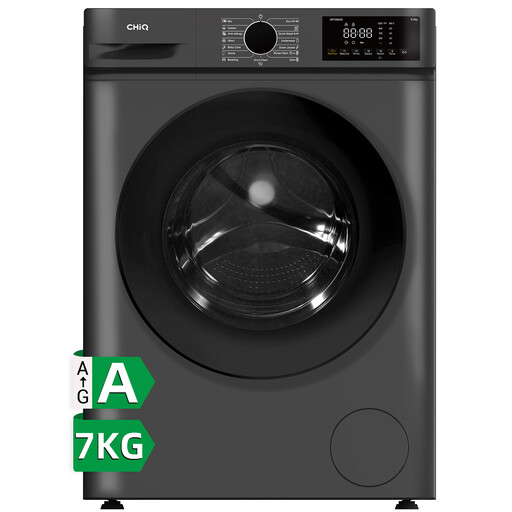 Image unavailable
CHiQ JW75883G — 7 kg dark grey front-loader
Worth considering if the available depth is a key constraint and a 7 kg capacity suits your shared loads.
Advertised maximum spin speed: 1 200 rpm; energy class A. Check all the installation dimensions, as well as the model’s noise and spin-performance figures.
View on Joybuy
 Image unavailable
Candy ProWash 500 TCA464TM4-S — 6 kg top-loader
Worth considering for a narrow space if your usual loads are suitable for a 6 kg drum.
Advertised maximum spin speed: 1 400 rpm; energy class B. If several people combine their laundry, check that this capacity is enough and that the lid can open fully.
View on Joybuy
Frequently asked questions
Is a 7 kg washing machine always enough for a shared home?
No, 7 kg isn’t a universal rule for a shared home. ADEME says this capacity is usually sufficient, but recommends choosing according to your needs. Consider the loads your household actually builds up and any bulky items you wash.
How can you compare the noise levels of two washing machines?
Compare the spin noise in dB and its class on each model’s label, rather than looking only at revolutions per minute. Also check the spin-efficiency class. At home, the floor and how level the machine is can affect how it runs.
Is a top-loading washing machine suitable for every small space?
No. A top-loader can solve a lack of width, but not necessarily a lack of depth or overhead clearance. For example, Whirlpool lists its TW6522FRESHCAREFR as 40 cm wide and 60 cm deep. Remember to measure the space needed to open the lid too.
What protection do you have if an appliance bought from a trader isn’t as described?
In France, private individuals are covered by the statutory guarantee of conformity for new, second-hand or refurbished goods sold by a trader, according to the Ministry of the Economy. Keep your sales documents and, if installation was agreed, the terms of that service so you can explain the problem clearly to the seller.


