For alterations at home
If you mainly take up hems, make repairs and sew small tubular items, check that the machine has the stitches you need, a buttonhole function and a free arm before looking at decorative patterns.


For the occasional alteration, start with a machine whose stitches and accessories cover the hems, repairs and first projects you have in mind. If you regularly sew clothes or home furnishings, consider the settings and convenience features that suit your projects rather than focusing on the number of stitches alone. For denim or sewing several layers together, check that the manufacturer says the exact model is suitable for the materials you plan to use. If possible, try it out with your fabric layers.
How often you sew, what you plan to make and the fabrics you work with all affect the features to look for. UFC-Que Choisir’s buying guide recommends starting with the projects you have in mind.
If you mainly take up hems, make repairs and sew small tubular items, check that the machine has the stitches you need, a buttonhole function and a free arm before looking at decorative patterns.
If you regularly work on projects ranging from clothes to patchwork, stitch and tension settings become more important, as does the compatibility of the presser feet with the work you have planned.
If you often sew denim, upholstery fabrics or several layers together, look for the manufacturer’s guidance on these materials for the specific model. This guidance doesn’t guarantee that every thickness will feed through the machine.
Make a list of your first projects, then compare them with the stitches, settings and accessories offered by the model you’re considering. An extra feature is only useful if it suits a project you have in mind.
| What to consider | What to check | For my projects |
|---|---|---|
| Everyday alterations | Look for straight stitch, zigzag and a buttonhole function. Check for a free arm if you sew sleeves or trouser legs. | I mainly take up hems and make repairs, so the basic functions matter more to me than a wide choice of patterns. |
| Settings and controls | Check the stitch length, width and tension settings that will be useful for your fabrics. Compare manual controls with the automatic features you’d actually use. | For clothes I sew regularly, I want to be able to adjust my settings. Speed control could also be useful if it suits the way I work. |
| Thick fabrics | Check which fabrics and layered projects are listed for the exact model. Check which needles, threads and presser feet are suitable, then try your project’s fabric layers if possible. | I often work with denim or upholstery fabrics, so I can’t tell whether a machine will handle my fabric thicknesses just by looking at it. |
| Accessories and instructions | Check which presser feet are included, which compatible models are available and whether you can access the instructions for the machine. Make sure you know which accessories are included and which need to be bought separately. | I’m planning to sew zips, blind hems or quilts, so the available presser feet need to suit these projects. |
| Machine embroidery | Know the difference between decorative stitches and functions that let you embroider patterns. If you’re looking at a sewing and embroidery machine, check the features and accessories of the exact model. | If I want to embroider patterns by machine, a list of decorative stitches alone doesn’t confirm that the machine is right for the job. |
A large selection of patterns won’t replace the functions you need for alterations or clothes.
Write down three projects you plan to make and check the stitches, presser feet and features each one requires.
An electronic machine with decorative stitches isn’t necessarily a sewing and embroidery machine. Singer France distinguishes between these categories in its range.
If you want to embroider patterns by machine, check the embroidery features and accessories of the exact model.
Singer France describes specific models as suitable for denim or sewing several layers together. This doesn’t apply to every model or every combination of fabrics.
Check which materials the manufacturer lists and, if possible, try a combination similar to yours with the appropriate needle, thread and presser foot.
A project may require a compatible presser foot that isn’t included with the machine. The instructions can also help you identify the machine’s settings and maintenance procedures.
Check what’s in the box, the accessory model numbers and whether the instructions are available before you choose.
These ranges showcase different features. A characteristic listed for one model doesn’t automatically apply to other machines from the same brand.
Singer France describes the M2105 as a compact mechanical machine, the Supera 5523 as suitable for projects involving thicker fabrics, and the HD 6605 C as an electronic model designed for materials including denim.
Janome describes its mechanical 1522 series as having 22 built-in stitches and a one-step buttonhole function.
BERNINA France describes the 335N as having a touchscreen for selecting stitches.
This Joybuy option is suited to alterations and small sewing projects at home. If you regularly make clothes or sew thick layers together, check that its features and the materials it can handle are right for your projects before choosing it.
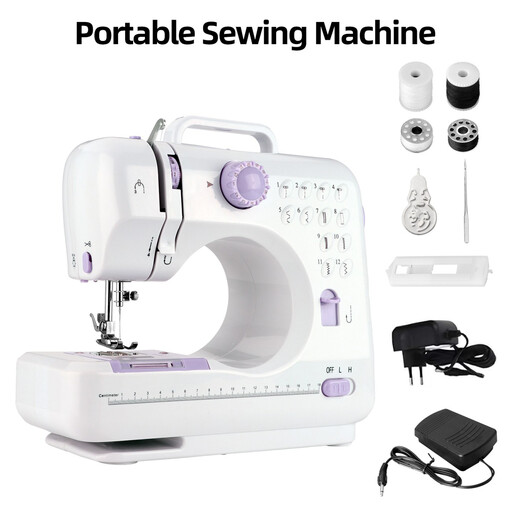 Image unavailable
For alterations where space is limited, this machine offers 12 stitch patterns, reverse sewing, two speeds and control by button or foot pedal. Check that its stitch patterns include the ones you need for your projects, and check which presser feet are included and what fabric thicknesses the machine can handle.
Check for straight stitch, zigzag and a buttonhole function for the jobs you have in mind. If you plan to sew tubular items, check for a free arm too. For buttonholes, see whether the process takes one step or four.
Not necessarily. A mechanical machine may be suitable if its settings and accessories cover the projects you have in mind. Singer France explains that mechanical machines differ from electronic ones in their controls, so consider the automatic features and speed control of an electronic model in light of how you’d use it.
Decorative stitches alone don’t confirm that a machine has an embroidery function. If you want to embroider patterns, look for a sewing and embroidery machine or an embroidery machine, and check the features and accessories of the exact model.