Occasional alterations at home
You want to shorten a hem, repair a garment or tackle small jobs on everyday fabrics. Easy-to-understand controls and the stitches you need for these tasks matter more than a long list of patterns.


For the occasional hem or repair on everyday fabrics, start with a straightforward machine that has the stitches you need. If you regularly sew clothes or home furnishings, focus on whether the machine is suitable for your fabrics and what adjustments it offers. For patchwork or embroidery, consider the features, workspace and compatible accessories your projects require. Electronic controls can make adjustments easier, but they don’t prove that a machine is suitable for the thicknesses you want to sew.
How often you sew and the fabrics you work with will affect which features matter. A machine for the occasional hem is not the same choice as one for regular creative projects.
You want to shorten a hem, repair a garment or tackle small jobs on everyday fabrics. Easy-to-understand controls and the stitches you need for these tasks matter more than a long list of patterns.
You switch between projects and may sometimes work with denim, canvas or several layers of fabric. Check the settings and fabrics specified for the exact model, rather than assuming every machine designed for regular use can handle the same thicknesses.
Your projects may call for specific feet and guides, free-motion sewing, more space around the needle or a suitable embroidery area. Decide which techniques and dimensions you need before choosing a machine and its accessories.
Que Choisir recommends starting with the projects you have in mind, how often you’ll use the machine and the fabrics you’ll sew. First decide what you’ll use it for most, then compare the features of the exact model. Decorative stitches and electronic controls alone won’t tell you whether it’s compatible with your fabrics.
| What you’ll use it for | What to check | Who it suits |
|---|---|---|
| Simple alterations | Straight stitch, zigzag and buttonhole; a free arm if you sew sleeves or trouser hems. | For the occasional hem or repair, I want to use the stitches I need without having to learn lots of settings. Around 30% of consumers would put simple alterations at the top of their list of needs. |
| Regular use and thicker fabrics | The fabrics and thicknesses the model is designed for; tension settings and, if available, presser-foot pressure adjustment. | If I regularly sew clothes or home furnishings, I need to check that the machine can also handle the layers I plan to join. This versatility would be the top priority for around 40% of consumers. |
| Patchwork and embroidery | Compatible feet and guides; sewing space, free-motion features or embroidery area, depending on the project. | For repeated topstitching, working with several layers or embroidering a design, I need features suited to the specific project. Around 30% of consumers would prioritise these specialist uses. |
A mechanical machine can handle everyday sewing if it has the stitches and settings you need. On an electronic model, a speed control or simpler stitch selection can make it more convenient to use. Check separately which fabrics it can handle and which accessories are included.
For denim, upholstery or frequent work with multiple layers, Que Choisir recommends considering machines better suited to these tasks than entry-level models. Before buying, compare the model’s specifications with your own projects and, if possible, test it with the thicknesses you actually plan to sew.
A list of patterns doesn’t tell you whether it can sew several layers repeatedly. Que Choisir distinguishes between machines that are more robust for certain types of work on thick fabrics.
Check which fabrics the model is designed for, its settings, and which needles and feet are compatible with your projects.
A foot, guide or hoop may only fit certain machine models. Assuming it’s compatible could stop you from using the technique you have in mind.
Check the machine’s full model reference against the accessory’s compatibility list before choosing it.
For quilting and embroidery, the available space, free-motion features or embroidery area may matter more than a general description or the number of patterns.
Make a note of the techniques and dimensions your projects call for, then check the stated capabilities of the model and its compatible accessories.
According to Your Europe, for products covered by the European Union’s harmonised rules, the CE mark indicates that the manufacturer declares the product complies with the relevant requirements. It doesn’t compare how easy the machines are to use or how well they suit your fabrics.
Check the machine’s documentation, features and suitability for your planned sewing separately.
These ranges give you a starting point for comparison, but don’t assume that every machine has the same features. Always check the exact model you’re interested in.
Singer France offers mechanical and electronic machines, including models aimed at beginners and for sewing at home.
Janome France offers mechanical and electronic machines, as well as models designed for quilting.
PFAFF France offers domestic sewing and embroidery machines, as well as overlockers.
bernette offers sewing and embroidery machines, as well as accessories for creative projects.
This Joybuy machine is presented as an option for repairs and small sewing projects at home. If you need specific stitches or plan to work with thick fabrics, check what it can do before choosing it for these tasks.
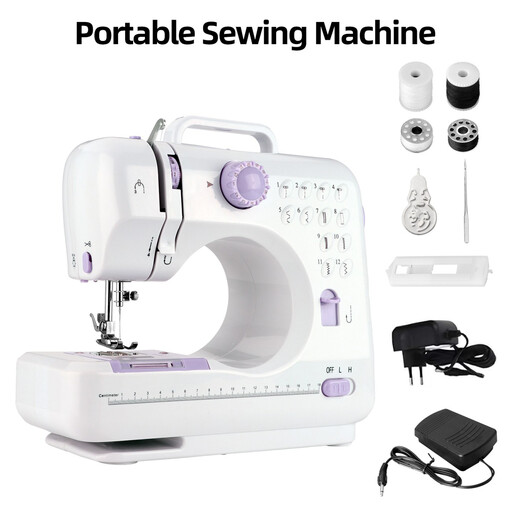 Image unavailable
Worth considering for repairs and small sewing projects at home, using fabrics suited to the machine.
The product name states that it has 12 built-in stitches and reverse sewing. Check whether it has a zigzag stitch, a free arm and stitch-length adjustment if your alterations require them. Also check which fabrics and thicknesses this model is designed for.
Check for a straight stitch, zigzag and buttonhole stitch: Que Choisir lists these as basic stitches for sewing at home. If you’re working on sleeves or trouser hems, also check whether the machine has a free arm.
No. A mechanical machine may be suitable if its stitches and settings, and the fabrics it’s designed for, match the clothes you want to sew. An electronic model can make it easier to select stitches or control the speed, but you’ll still need to check that it’s suitable for the fabrics you’ll be working with.
Look for a machine that’s designed for these fabrics and the thicknesses you have in mind, rather than relying on the number of stitches or the stated power alone. Check the settings, needles and suitable feet. If you can, try sewing your planned layers together.
Choose them for a technique you genuinely plan to use, such as free-motion sewing or parallel topstitching. Before selecting a foot or guide, check it’s compatible with the exact model of your machine.
Follow your model’s instructions for cleaning, removing lint and any lubrication it may need. As the tasks and how often you need to do them can vary, ask the manufacturer or retailer if the instructions don’t answer your question.