Households that freeze meals in portions
If you often take out prepared meals and small bags of food, compare upright freezers with drawers. Their compartments help you keep food separate, without having to rummage through a deep chest.


If your fridge has enough room for fresh food but not for meals and frozen food, a separate freezer is the most direct solution. An upright freezer makes portions easy to access, while a chest freezer suits larger stocks if you have the right space for it. A tabletop or under-counter model can provide extra capacity in a smaller space. If you also need to replace or upgrade your fridge, consider a larger-capacity fridge freezer instead. In every case, compare usable capacity, dimensions, room temperature, energy consumption and the stated power-cut storage time.
If you often take out prepared meals and small bags of food, compare upright freezers with drawers. Their compartments help you keep food separate, without having to rummage through a deep chest.
If you buy in bulk, store large containers or keep a substantial stock of frozen food, a chest freezer is worth considering if you have enough floor space. Also think about how you’ll organise smaller items in the chest.
A tabletop or under-counter freezer can provide a little extra storage. If your fridge is also too small, measure the available space for a larger-capacity fridge freezer before choosing a second appliance.
Consider this if: you regularly take out portions and want to organise them across several drawers.
Bear in mind: the drawer size may limit how easily you can store bulky containers.
Consider this if: you have a large amount to store and a suitable space for a freezer that opens from the top.
Bear in mind: you’ll need to organise things carefully to reach food at the bottom.
Consider this if: you need extra space for a few portions and have limited room.
Bear in mind: this compact format won’t replace a large family-sized freezer.
Consider this if: you also need more room for fresh food or need to replace your fridge.
Bear in mind: check that the freezer compartment has enough space for your supplies; replacing your fridge freezer won’t give you separate freezer storage.
| What to consider | What to check | Your needs |
|---|---|---|
| Capacity and storage | Compare the usable capacity with the amount you usually store, then check the drawer size or whether it comes with baskets. Make sure your largest containers will fit. | I want to store more meals without losing small portions at the bottom of the appliance. |
| Location | Measure the appliance, check it will fit through the route to the room, and allow enough clearance for the door to open and for ventilation. Compare the room’s minimum and maximum temperatures with the model’s permitted range. | I might put my freezer in a cellar or garage, so I need to make sure it can operate at the temperatures in that room. |
| Energy use and maintenance | When comparing appliances with similar storage capacity, look at energy use in kWh/year as well as the energy rating. Check how the model defrosts. | I want to compare annual electricity use and find out whether I’ll need to defrost the appliance manually. |
| Power cuts and freezing capacity | Check the stated storage time in hours during a power cut and the freezing capacity in kg/24 h. If the appliance will be away from your main living areas, check whether it has a suitable alarm. | I sometimes freeze several batches of fresh food at once, or keep a large stock in a separate room. |
A large chest has room for bulkier items, but portions and small bags stored underneath can be harder to find.
Plan to use baskets and organise the food so that older items are easy to reach. If you often take out different portions, compare upright freezers with drawers too.
The permitted ambient temperature depends on the model, not just its format. For example, Bosch specifies a range of 10 to 43 °C for climate class SN-T; some specific appliances are designed to operate at lower temperatures.
Note the room’s highest and lowest temperatures, then check the operating range in the manual for the freezer you’re considering.
The letter alone won’t tell you whether two appliances offer the right capacity, power-cut storage time or layout for your needs.
First compare formats and capacities that suit what you need to store, then compare kWh/year and the other features relevant to your installation.
An appliance’s freezing capacity is limited: Que Choisir recommends staying within the capacity shown on its rating plate.
Check the model’s capacity in kg/24 h if you plan to freeze large quantities.
These examples highlight features to check on a specific model; they don’t apply to every model from the same brand.
The Beko HSM14540 chest freezer is an example of a model whose features are worth checking if you’re planning to install it in a separate room.
The Bosch GSN58AWCV is an example of a large-capacity upright freezer. Assess it against the space you have and the amount you need to store.
The Liebherr CFe 2500 Pure chest freezer shows why it’s important to check whether a model can be installed in an unheated room.
These options include chest freezers for extra storage, an upright freezer for organising portions and a compact upright freezer for a little extra capacity. First choose the format that suits what you need to store and the space you have, then compare the models that fit.
 Image unavailable
With a stated capacity of 291 L, this chest freezer is worth considering if you need to store a large supply of frozen food. It has a removable basket to keep some items separate and can switch between freezer and fridge modes. The product information lists an energy rating of E, 226 kWh/year and dimensions of 1100 × 597 × 872 mm. Allow for the 10 cm ventilation clearance specified for this model, and check the permitted ambient temperature if you’re installing it in an unheated room.
 Image unavailable
This 95 L chest freezer is worth considering for extra storage rather than a large family-sized supply. It has a removable basket and can switch between freezer and fridge modes. The listed dimensions are 550 × 475 × 848 mm, and it has an energy rating of E and uses 165 kWh/year. Check that the capacity suits what you need to store, and make sure the room is within the permitted ambient temperature range.
 Image unavailable
With a stated capacity of 197 L, this chest freezer sits between the other two AUCMA capacities featured here. Its removable basket helps keep smaller items separate. The product information lists dimensions of 816 × 554 × 848 mm, an energy rating of E, 197 kWh/year and the option to switch between freezer and fridge modes. Check the required 10 cm ventilation clearance and the permitted ambient temperature range for your chosen location.
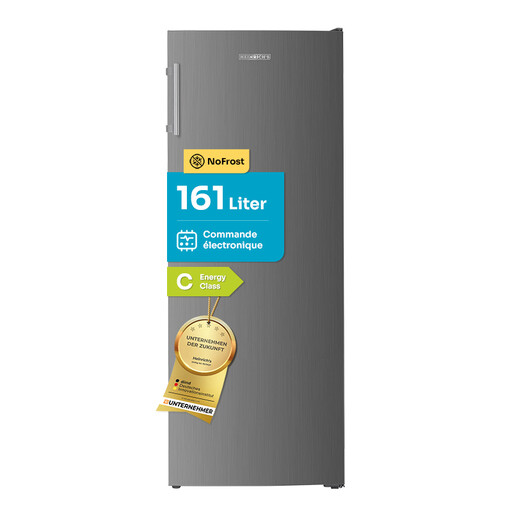 Image unavailable
This upright freezer could suit you if you want to organise portions across its three drawers and two shelves. The product information lists a capacity of 161 L, an energy rating of C and No Frost technology. Measure the space and access route, then check the installation clearances and the model’s permitted ambient temperature range.
 Image unavailable
This 60 L model has three compartments, making it a handy option for a little extra storage. The product information lists dimensions of 44,5 × 47,5 × 84,5 cm, an energy rating of E and a stated freezing capacity of 6 kg/24 h. If you’re thinking of placing it under a worktop, check the available height, ventilation and clearance needed to open the door.
Yes. It indicates the ambient temperature range the appliance is designed for. For example, Bosch Home Appliances France gives a range of 10 to 32 °C for class SN and 10 to 43 °C for SN-T. Compare the range for the specific model with the temperatures in your room, especially if it’s unheated.
No. The chest format alone doesn’t guarantee that a model is suitable. Beko states that the HSM14540 can operate at ambient temperatures as low as -15 °C, and Liebherr gives the same limit for the CFe 2500 Pure. Check the minimum permitted temperature in the documentation for the model you’re considering.
Start with how much food you need to store and how you want to access it. A larger capacity is only useful if it suits your supplies and the space available. Then compare energy use in kWh/year, dimensions, the stated storage time during a power cut and, if you freeze large batches, capacity in kg/24 h.
According to Anses, freezing food at home at -18 °C stops bacteria from multiplying, but most micro-organisms survive freezing. This temperature won’t make food safe if it was stored incorrectly beforehand. You should also follow food storage guidance and the appliance’s freezing capacity.